


In Australia, most mortgage brokers are paid by the lender, not by you. When your loan settles, the lender pays the broker an upfront commission. Mortgage and Finance Association of Australia (MFAA) says that the upfront commission is usually around 0.65% to 0.70% of the amount you draw down. Additionally, a broker may be paid a smaller trail commission of roughly 0.15% a year while the loan stays on the books. On a $700,000 loan, that is about $4,550 upfront. You do not pay it separately and it is not added to your loan balance.
Key points
- Lenders pay brokers, not borrowers: an upfront commission of about 0.65% to 0.70% of the drawn loan, plus a trail of about 0.15% a year of the outstanding balance.
- Commission is calculated on the loan net of any offset balance, so money sitting in an offset account does not inflate the broker's payment.
- If you refinance or repay within roughly 18 months to two years, the lender usually claws the upfront commission back from the broker, and the broker cannot pass that cost to you.
- Brokers must act in your best interests and disclose how they are paid before you proceed.
- Commission is the brokerage's gross revenue, not a broker's take-home pay.
How brokers get paid in Australia
The Mortgage and Finance Association of Australia (MFAA) explains that brokers receive two kinds of commission from lenders: an upfront commission when the loan settles, and a trail commission paid over time. Brokers facilitate over 80% of all residential mortgages in Australia, so this is how most home loans are now arranged.
The MFAA's consumer guidance says that in most cases your broker's service won't cost you anything, because the lender pays when your loan settles. The commission is a share of the value the lender expects to earn from the loan over its life. It is not a surcharge on your interest rate.
There are exceptions. Some brokers charge a fee for specific work, for example complex or non-standard scenarios. If a broker wants to charge you anything directly, that should be disclosed in writing before you commit.
Upfront commission: what it is and what it is worth
The upfront commission is paid once, after settlement. The MFAA puts the usual range for a standard residential loan at 0.65% to 0.70% of the drawn loan amount. Rates differ between lenders and products, so you will see slightly different figures quoted around the web.
Here is what that looks like in dollars, using 0.65%:
The formula is simple:
Upfront commission = drawn loan amount (net of offset) × commission rate
Two timing details are worth knowing. The money does not arrive straight away: it can take up to 90 days after settlement for the broker to be paid. And the amount is based on what is actually drawn, not on the limit you were approved for. If you are approved for $750,000 but draw $700,000, the calculation uses $700,000.
Trail commission: the ongoing payment
The second payment is the trail. The MFAA describes it as approximately 0.15% per annum of the outstanding loan balance, paid by the lender for as long as the loan stays with that lender and the broker remains attached to it.
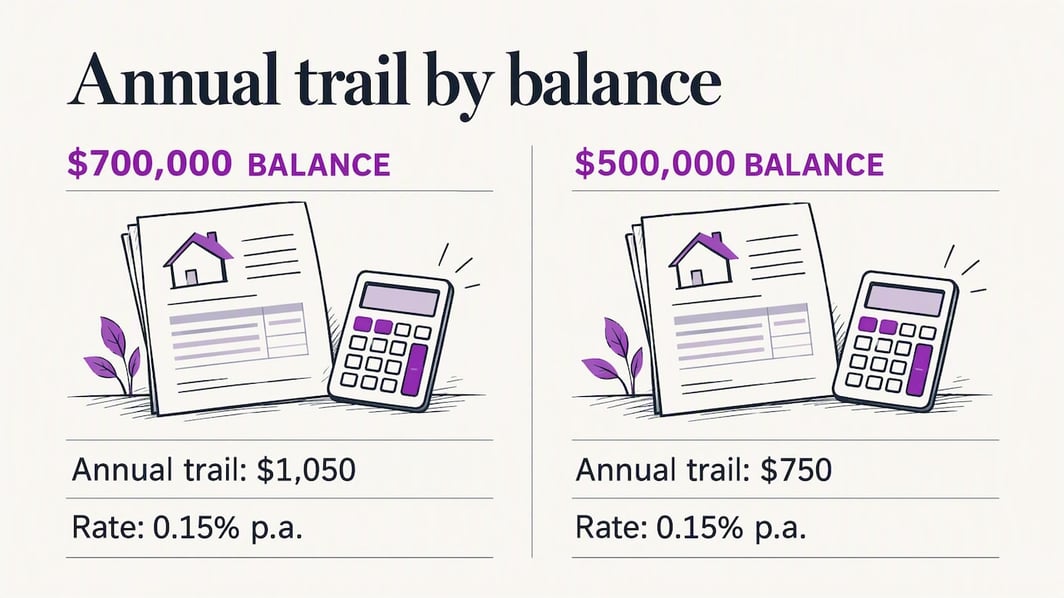
On a $700,000 balance, 0.15% is $1,050 a year. As you pay the loan down, the trail shrinks with the balance. On a $500,000 balance it would be $750 a year.
Why does it exist? The trail is meant to pay for the servicing work after settlement: answering questions, reviewing your loan, helping with rate changes or a change in circumstances. It is also the part of broker pay most worth testing. A trail is only good value if your broker actually contacts you. If you have not heard from yours in years, ask what service the trail is paying for.
A worked example, with and without an offset account
Commission is calculated on your loan balance net of any offset account. The MFAA gives a clear illustration: on a $700,000 loan at 0.65% upfront, the commission is $4,550. If you have $75,000 in an offset account, the commission is calculated on the remaining $625,000, which comes to $4,062.50.
According to the MFAA, calculating commissions net of offset balances is intended to discourage brokers from recommending unnecessarily large loans.
The reasoning is that brokers generally do not receive upfront commission on funds held in an eligible offset account when the commission is assessed.
However, this does not eliminate all potential conflicts of interest. Commission arrangements can vary between lenders, and the amount paid may depend on when offset balances are assessed.
The net-of-offset calculation is therefore one measure designed to reduce incentives for unnecessary borrowing. Mortgage brokers must also comply with best interests obligations, requiring them to act in their clients' best interests when providing credit assistance.
What happens if you refinance soon after settlement: clawbacks
If you refinance or repay your home loan shortly after settlement, your mortgage broker may have to return some or all of the upfront commission they received from the lender. This is known as a commission clawback.
Clawback arrangements typically apply during the first 18 months to two years of a loan, although the terms vary between lenders. ASIC's review of mortgage broker remuneration explains how these arrangements work.
Importantly, brokers cannot pass clawback costs on to borrowers. The cost is borne by the broker, not you.
However, clawbacks can create a financial incentive for brokers to discourage early refinancing. Mortgage brokers must act in your best interests and cannot recommend staying with a loan simply to avoid losing their commission.
If you're considering refinancing, the decision should depend on your financial circumstances and whether the benefits of switching outweigh the costs. Our guide on when to refinance your home loan explains what to consider.
Does commission influence which loan you are offered?
Mortgage brokers are generally paid by lenders, raising an important question: could the commission they receive influence the loan they recommend?
Under Australia's best interests duty, mortgage brokers must act in your best interests when providing credit assistance. This means they cannot recommend a loan simply because it pays them a higher commission. ASIC's Regulatory Guide 273 also requires brokers to prioritise your interests where a conflict exists.
However, these obligations do not guarantee that every recommendation will be the cheapest available.
In October 2026, ASIC's Report 840 found that seven of the eight major mortgage aggregator groups reviewed reported brokers recommending loans other than the cheapest option in more than 20% of cases.
A more expensive loan is not necessarily a poor recommendation. Features such as an offset account, greater flexibility or a lender's approval requirements may justify the additional cost.
However, ASIC identified instances where brokers had not clearly demonstrated why a more expensive loan was in the borrower's best interests.
Importantly, the review did not establish that brokers were favouring lenders offering higher commissions. Rather, it highlighted the need for brokers to explain and support their recommendations, particularly when cheaper alternatives are available.
What does this mean for you?
Before accepting a broker's recommendation, ask why that loan was chosen over cheaper alternatives. Compare the interest rate, fees, features and estimated total costs, and consider whether any additional benefits justify paying more.
A broker should be able to explain why the recommended loan is suitable for your circumstances, not simply why it meets the lender's approval criteria.
What brokers actually earn
A common assumption is that a $4,550 commission is the broker's pay for a day's work. It is not. Commission is the brokerage's gross revenue, and it has to cover aggregator fees, office costs, staff, marketing, professional indemnity insurance and compliance.
The MFAA's 2025 study of the industry reported average gross annual commission of about $192,354 before business expenses for the period from April to September 2023. Sole traders' average revenue, weighted for experience, was about $182,040, again before expenses. These are industry-body figures for a specific period, and they describe revenue rather than take-home income.
The delay in payment also matters. With commission arriving up to 90 days after settlement and subject to clawback, brokers carry real cash flow risk. None of that means you should not ask questions. It means the commission is a business model, not a windfall.
Questions to ask your broker about pay
A good broker will answer these without hesitation:
- How will you be paid on this loan? Ask for the upfront and trail rates for the lender they recommend.
- Do you charge me any fee? The answer is usually no. If it is yes, get the amount and reason in writing.
- Which other lenders did you consider, and why did you rule them out? This tests whether the recommendation was comparative.
- Does the commission differ between the loans you shortlisted? You are entitled to know.
- What service will I get for the trail? Ask how often they will review your loan.
- What happens if I want to refinance in two years?
Our longer checklist of questions to ask before choosing a mortgage broker covers licensing, panel size and how a broker handles your data.
Our perspective: commission is not the problem, inertia is
We built Bheja because we kept seeing the same pattern. Borrowers focus intensely on the one-off cost of getting a loan, and then do not look at it again. The real cost is rarely the commission. It is the gap that opens between the rate you are paying and the rate a new customer could get, sometimes called the loyalty tax, and it can quietly cost thousands of dollars over time.
So our view is practical. Lender-paid commission is a reasonable way to give people access to advice without an upfront bill, but it works best when three things are true. You know how your broker is paid. Your recommendation is checked against the wider market. And someone is watching your loan after settlement, whether that is your broker, you, or software doing it for you.
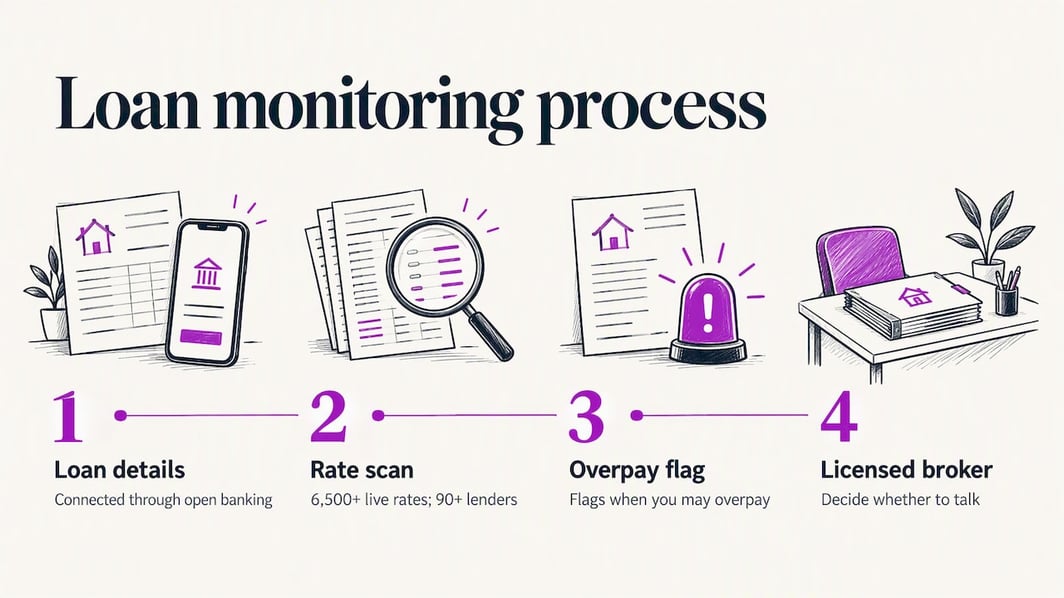
That is why we connect your actual loan details, through open banking, to more than 6,500 live rates from over 90 lenders, and flag when you may be overpaying. We do not ask you to take our word for it: you can see the comparison, and decide whether to talk to a licensed broker. We are open about our own model too. We earn referral fees when an application is completed through our broker partners, so we have a reason to be useful at the moment you are ready to act, and no reason to push you to switch when the numbers do not stack up.
We also think regulators are right to keep pressing on this. We have written about why ASIC wants brokers to stay proactive and how you can check a home loan recommendation yourself. A recommendation you can verify is worth more than one you have to trust.
Commission isn't necessarily the problem. It's what happens after the loan settles. Too many borrowers stop comparing, while better rates become available elsewhere. We built Bheja to help homeowners keep track of their loans, spot when they may be overpaying and make informed decisions about switching. — Pravin
Broker, bank or direct: how pay differs
The type of adviser you use changes who pays and who is compared.
The MFAA notes that, unlike bank staff, brokers can offer loan options from a range of lenders. Banks have their own staff incentives, and ASIC's RG 246 on conflicted remuneration lists commissions as an example of benefits that are generally conflicted for financial product advice, which is a separate regime from credit. For a deeper look, see our comparison of a mortgage broker versus a bank.
Check your own loan, then talk to a broker
Understanding how brokers earn commissions is important. So is knowing how your current home loan compares with what's available in the market.
Bheja's free Home Loan Health Check lets you compare your current rate against more than 6,500 live rates from over 90 lenders. You can see whether you may be paying more than necessary and explore potentially better options. You can also securely connect your loan through Open Banking (CDR) and receive alerts when a better rate becomes available.
If you're considering refinancing, Bheja makes the process simpler. With your consent, Open Banking helps prefill much of your application, reducing paperwork and manual data entry. A licensed mortgage broker reviews your circumstances, explains the available options and helps you assess whether refinancing is suitable for you.
You can also arrange a free, no-obligation consultation with a licensed broker to discuss your options, without committing to a switch.
Whether you refinance or stay with your current lender, Bheja can continue monitoring your loan and alert you when a potentially better rate becomes available.
FAQ
In most cases, no. The lender pays the broker a commission when your loan settles. Some brokers charge a fee in particular situations, and any such fee should be disclosed to you in writing before you proceed.