


Refinancing means taking out a new home loan, usually with a different lender, and using it to pay off your existing one. The process runs in eight stages: review your current loan, ask your lender for a better deal, compare options, cost the switch, apply, provide documents, get assessed, then settle. Timing varies by lender and by how quickly your paperwork is complete, but you should plan in weeks rather than days.
This guide walks through each stage in order, explains what happens behind the scenes at settlement, and shows where borrowers most often lose money without noticing.
Key points
- Start by asking your current lender for a better rate. ASIC's consumer guidance says new customers are often offered better deals than existing borrowers.
- It can help to compare at least two lenders using the Key Facts Sheet, then work out your switching costs and break-even point before you apply.
- Comparing repayments over the same loan term provides a clearer picture of potential savings. A new 30-year term may lower repayments but increase the total interest paid compared with your existing loan term.
- Expect to supply income, asset, liability and identity evidence, then wait for a valuation, credit assessment and settlement. Timing varies by lender.
What refinancing actually involves
When you refinance, your new lender pays out the balance of your old loan and takes over the mortgage over your property. You end up with one loan, with a new rate, new features and possibly a new term (if you opt). Nothing about your property changes hands. What changes is who holds the security, and on what terms.
People refinance for several reasons: a lower rate, a fixed period that is ending, access to an offset account or redraw, releasing equity, or consolidating other debts. Each reason changes which steps matter most. If your only goal is a lower rate, the first two steps below may save you the whole exercise.
The refinance process in eight steps
Step 1: Review the loan you have now
Before you look at anything new, write down your current balance, interest rate, rate type (fixed or variable), repayment amount and frequency, remaining term and any features you use, such as an offset account or redraw. Moneysmart's switching guidance starts here for good reason: you cannot judge a new loan against a loan you have not measured.
If you are not sure whether your rate is competitive, our Home Loan Health Check uses your actual loan details to show whether you may be overpaying and what the market currently offers.
Step 2: Ask your current lender for a better deal
When considering refinancing, you could start by asking your current lender for a better deal. A retention repricing can capture much of the benefit of switching without a new application, a valuation or a discharge. Having at least 20% equity and a solid repayment history generally strengthens your position.
There is a balanced view here. The RBA's research shows that refinancing and competition have narrowed the gap between new and existing mortgage pricing, so a new-customer rate does not automatically create a large saving. Equally, it means your lender's repriced offer may be competitive, and you should still test it against the market. We cover this trade-off in should you negotiate or switch lenders.
Step 3: Compare at least two other loans
Comparing at least two lenders can help you assess differences in interest rates, fees and features. You can request a Home Loan Key Facts Sheet from each lender for every loan you shortlist. These sheets use a standard format, making it easier to compare loans on a like-for-like basis.
Compare more than the headline rate:
- Rate and total cost of the loan over its life
- Application, ongoing and discharge fees
- Fixed or variable structure, and what happens when an introductory rate ends
- Offset and redraw access
- Rules on extra repayments
- Break costs if you leave early
The Moneysmart guide to choosing a home loan notes that the Key Facts Sheet does not contain every feature or condition, so ask the lender or broker targeted follow-up questions.
For context on where the market sits, the RBA's lenders' rates table reported August 2026 average new-loan rates of 6.24% for owner-occupiers and 6.40% for investors. These are averages, not offers. Your own rate depends on your loan-to-value ratio (LVR), credit profile, loan purpose and the lender's policy.
Step 4: Cost the switch and find your break-even point
A lower rate may not deliver overall savings unless the interest savings exceed the cost of switching. Add up the exit costs on your old loan (discharge fees and, for fixed loans, break costs) and the entry costs on the new one (application and settlement fees, and possibly valuation fees). Then divide the total by your monthly saving to estimate how many months you need to recover these costs.
Why does this comparison matter? A lower interest rate doesn't always mean a cheaper loan. For example, a loan with a $600 application fee could cost less overall than one charging $300 if the interest savings outweigh the higher fee. However, if the interest savings are too small to recover the additional cost, the lower-rate loan could end up costing more.
You can use Bheja's refinance calculator to estimate potential savings after accounting for refinancing costs. Actual savings may differ from these estimates, and the results do not guarantee loan approval.
A simple break-even formula
Total switching costs ÷ monthly repayment saving = months to break even
For example, if switching would cost you $1,500 in total and lower your repayment by $150 a month, you break even after 10 months. Those numbers are made up to show the arithmetic. Yours will differ.
Watch the loan term
An easy-to-miss error is restarting the clock. For example, resetting a partly repaid 25-year loan to a fresh 30-year term may lower your monthly repayment while increasing total interest. When you compare, set the new loan's term to your remaining term, and only extend it if you need the cashflow relief and understand the extra cost. You can keep your repayments at the old level on the new loan to shorten the term in practice.
Fixed-rate loans need a written break-cost estimate
If your current loan is fixed, ask your lender for a written estimate. ASIC explains that break costs depend on the relationship between your old fixed rate, prevailing rates and the remaining fixed term. Variable loans generally do not attract that specific fee, although discharge and other fees may still apply. If your fixed term ends in a few months, waiting may cost less than leaving early.
Step 5: Choose a loan and apply
Once you've compared the costs and potential savings, you can apply to refinance directly with a lender or through a licensed mortgage broker.
If you need help with the process, you can book an obligation free consultation with our licensed mortgage broker who can guide you through the application.
Step 6: Provide your documents
The lender will want to verify who you are and what you can afford. Typically that means:
- Identity: driver licence, passport or similar
- Income: recent payslips, tax returns or, if self-employed, financial statements
- Assets and liabilities: savings, other loans, credit card limits
- Living expenses: often supported by bank statements
- Current loan details: a recent statement showing balance, rate and repayments
- Property details: address, and rates notices or insurance where requested
Lenders differ in exactly what they ask for. Gathering these before you apply is the single easiest way to avoid delays.
Step 7: Valuation and credit assessment
Your new lender orders a valuation of the property, which sets your LVR, and assesses your credit history, income, expenses and liabilities. The valuation can affect your rate and whether you pay lenders mortgage insurance, so a lower-than-expected figure matters. Our LVR calculator lets you estimate where you stand beforehand. Approval depends on the lender's criteria, and no calculator can guarantee it.
If your repayments are on the edge of comfortable, test them against higher rates. The RBA raised the cash rate target by 25 basis points to 4.60% on 29 September 2026, and variable pricing can keep moving. Our rate change impact calculator shows what a further rise would do to your repayments.
Step 8: Discharge and settlement
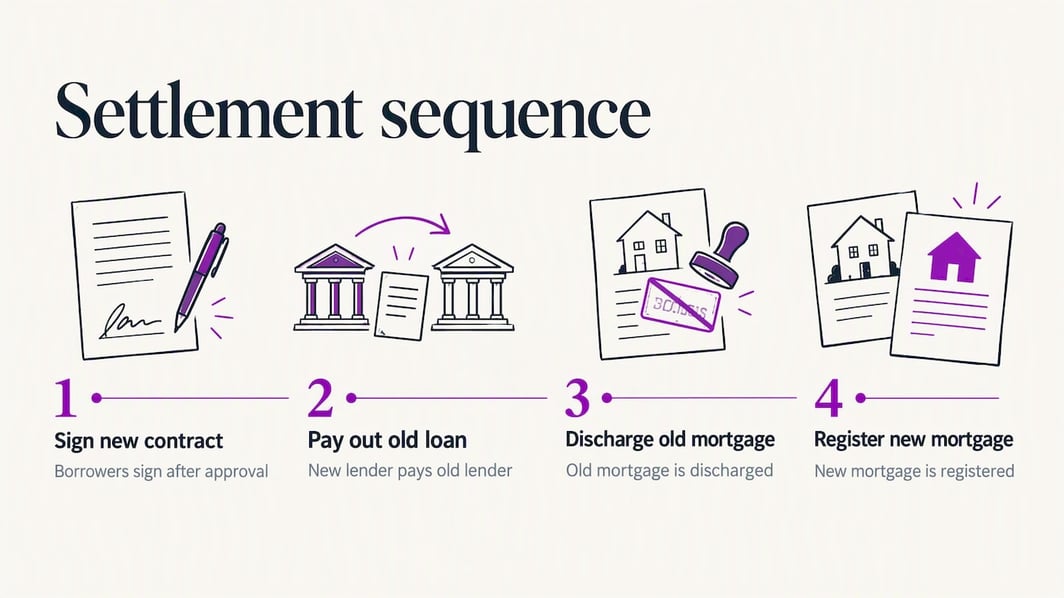
After approval you sign the loan contract. Your new lender then arranges settlement: it pays out your old lender, your old mortgage is discharged, and the new mortgage is registered. Most of this happens between the lenders, and you will usually be asked to sign a discharge authority for your old loan. All borrowers on the loan generally need to sign. Your old loan keeps accruing interest until it is paid out, and your new repayments start on the schedule in your new contract, so check the first due date.
How long does refinancing take?
There is no fixed timetable. Lenders, brokers and loan types differ, and the process moves at the speed of the slowest party: you supplying documents, the valuer, the credit assessor, or the old lender processing the discharge. A simple refinance with complete paperwork moves faster than one involving several properties, complex income or a non-standard lender.
Here is where the time typically goes:
To keep it moving, send documents together rather than in pieces, answer lender queries the same day, and make sure your existing loan is up to date. Ask your lender or broker for an estimated settlement date in writing at the start, and again after approval.
Bheja can save you time by pre-filling much of your application using Open Banking, which operates under Australia’s Consumer Data Right (CDR).
With your consent, you can securely connect your existing loan account and share relevant banking information. Bheja uses that information to fill in application details, reducing manual entry. You can review the information before submitting.
You stay in control of what you share and for how long, and can withdraw your consent. You authorise access through your bank, without sharing your banking password with Bheja.
How often should you refinance?
There is no universal Australian timetable, and no rule that stops you refinancing more than once a year. ASIC and Moneysmart frame it as a cost-benefit decision, not an automatic annual exercise. A review makes sense when:
- your fixed period is ending
- your income, family situation or property value changes materially
- your current rate has become uncompetitive
- the savings after all costs would be meaningful
Avoid refinancing for a cashback or headline rate alone. The RBA noted that cashback offers of up to $5,000 have appeared for some refinancing borrowers, while warning that the outcome depends on rates, fees and loan terms. A cashback can be outweighed by a higher rate over the following years. For more on timing, see when is the best time to refinance.
If you are consolidating debts
Rolling a car loan or credit card into your mortgage can lower your monthly outgoings, but it turns shorter-term debts into debt secured against your home, usually over a much longer period.
It can help to list every balance, rate, fee, penalty, term and repayment, then stress-test the consolidated repayment against higher rates, reduced income and rising living costs. Consolidation only helps if the spending that created the debts changes too. If you are in this position, speak with a licensed mortgage broker or a free financial counsellor on the National Debt Helpline before you commit.
Our perspective: the refinance you do not notice you need
Most of the refinancing mistakes we see are not made during the process. They are made before it, by leaving a loan untouched for years. A rate that was competitive at settlement drifts, and lenders do not usually write to tell you. That quiet leakage is why we built Bheja around your actual loan data, using open banking, rather than a generic comparison table.
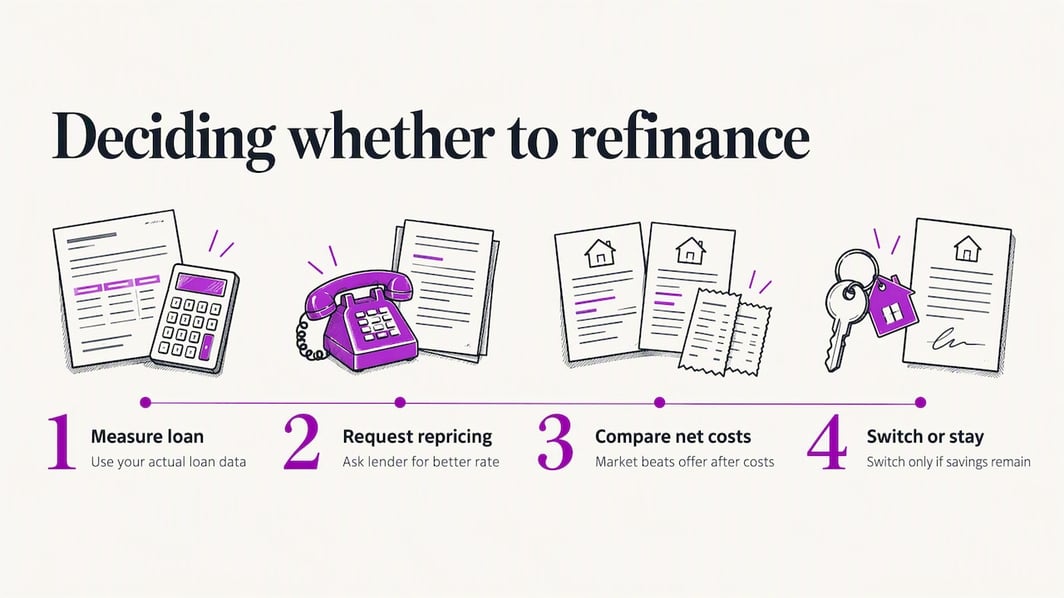
At Bheja, we think the process should be run in a particular order. Measure your loan first. Ask your lender for a better rate second. Only then, if the market still beats your repriced offer after all costs, switch. Sometimes the right answer from a health check is to stay put, and that is a good outcome, not a failed one.
We also think a refinance is not a one-off event. Rates move, your equity grows, and your needs change, so ongoing monitoring with alerts when a meaningful saving appears is more useful than a single comparison on a single day. And because lenders are paid in different ways, we believe you should be able to see the whole market rather than one lender's products.
How Bheja can help
If you want to see where you stand before you start, run the Home Loan Health Check. It reviews your current loan against live rates from over 90 lenders and flags whether you may be paying a loyalty tax. If switching looks worthwhile, you can connect with a Bheja broker to explore your options. If you’re not ready to switch, you can connect your existing loan for ongoing tracking and receive an alert when a better rate becomes available.
FAQ
Review your current loan, ask your lender for a better deal, compare at least two other loans using the Key Facts Sheet, and calculate switching costs and break-even. Then apply, provide your documents, go through valuation and credit assessment, and finally settle. Your new lender arranges the discharge of your old mortgage.