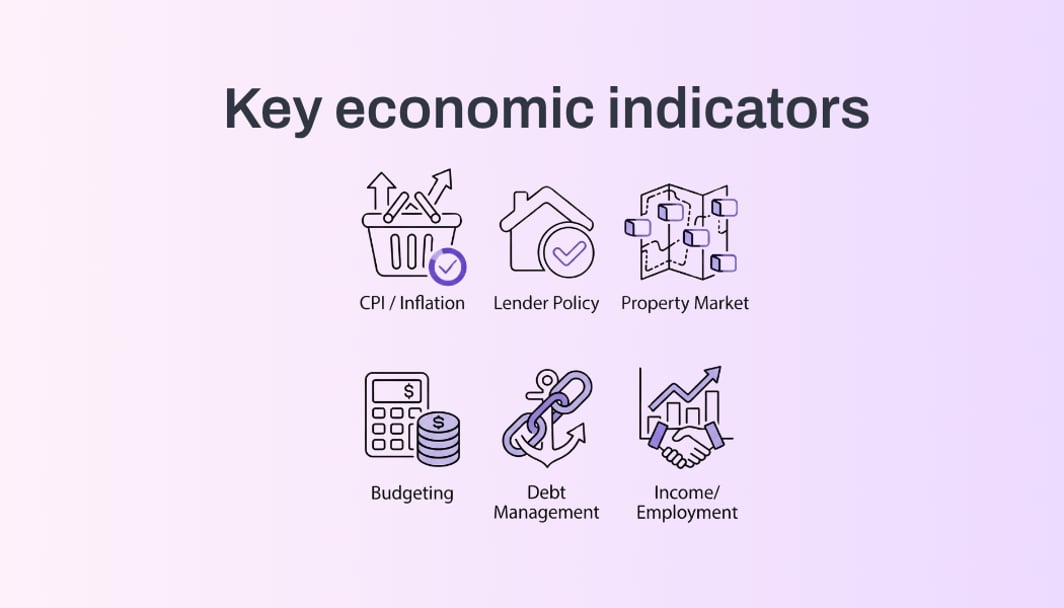
The RBA sets the cash rate based on six key indicators: CPI inflation, core inflation, unemployment, GDP growth, home prices, and wage growth. These metrics most directly signal the likely direction for rates. The Board also weighs global conditions, household debt, and financial stability, but the six core measures drive most decisions.
Economic Highlights
- Inflation down from 4.6% to 3.5% - still above the RBA target band
- Core inflation holding at 3.6% - keeping RBA rate cuts on hold
- Unemployment up from 4.1% to 4.4% as GDP growth slows to 0.3%
Inflation (CPI)
Consumer Price Index measuring changes in the cost of living. Both headline and core (trimmed mean) inflation are measured monthly, comparing to the same month last year.
Headline Inflation (YoY)
6 Months Ago
Core Inflation - Trimmed Mean (YoY)
6 Months Ago
Headline Inflation Trend (Monthly)
💡Expert Insights
Key Takeaway
The annual rate is falling, but the latest monthly jump shows inflation is not fully settled yet.
What's Happening
Headline inflation is at 3.5% in July 2026, down from 4.2% in April and 4.0% six months ago. It is also lower than 3.8% a year ago. Monthly inflation was 1.0% in July after a -0.1% fall in June, so the recent pace picked up again.
Impact on Borrowing
At 3.5%, inflation is still above the RBA’s 2-3% target, so rates may stay restrictive. If price pressures keep easing, borrowing costs could come under less pressure over time.
Unemployment Rate
The unemployment rate shows the share of people who want work and are looking for it, but do not have a job.
Current Value
Quarterly Change
fell to a lower level
Same Time Last Year
May 2025
💡Expert Insights
Key Takeaway
The job market is still fairly steady - unemployment has not broken out in either direction, so the RBA is likely watching for any clear cooling before changing rates.
What's Happening
Australia’s unemployment rate is 4.4% in May 2026, up from 4.3% a year ago and the same level as six months ago. It moved down from 4.5% in April after sitting at 4.3% in March and February.
Impact on Borrowing
At 4.4%, unemployment is close to the RBA’s inflation target zone of 2-3% pressure, so it does not point to an obvious need for deeper rate cuts. Borrowing costs may stay fairly steady unless labour market conditions weaken further.
GDP Growth
GDP growth measures how much the Australian economy is growing or shrinking over time. It shows whether total spending and production are rising or slowing.
Current Value
Quarterly Change
Growth rate for this period
Same Time Last Year
2025-Q1
💡Expert Insights
Key Takeaway
Growth is soft and steady rather than strong. That can cap wages and spending, but it may also keep pressure off the RBA to lift rates.
What's Happening
Australia’s GDP growth is 0.3% in 2026-Q1, down from 0.9% in 2025-Q4 and 1.0% in 2025-Q2. It is sitting at the same level as a year ago and slightly below six months ago.
Impact on Borrowing
Weak growth gives the RBA less reason to keep rates high for long, but inflation still needs to stay near the 2-3% target before borrowing costs ease much.
Home Prices
The average price of houses sold across Australia.
Current Value
Quarterly Change
rose by 2.0%
Same Time Last Year
2025-Q1
💡Expert Insights
Key Takeaway
Prices are climbing steadily, with the average house now about $129 higher than a year ago.
What's Happening
Mean house prices rose to $1,111 in 2026-Q1, up from $1,089 in 2025-Q4 and $1,051 six months ago. That is also up from $982 a year earlier.
Impact on Borrowing
Rising house prices can keep pressure on inflation and borrowing costs. If price growth stays above the RBA’s 2-3% target, rate cuts are less likely.
Wage Growth
Wage growth shows how fast pay packets are rising across Australia, measured by the ABS over a year.
Current Value
Quarterly Change
fell to a lower level
Same Time Last Year
2025-Q1
💡Expert Insights
Key Takeaway
Pay rises have settled into a stable but still solid pace, which helps workers but can keep pressure on inflation and slow RBA rate cuts.
What's Happening
Wage growth is at 3.3% in 2026-Q1, down from 3.4% last quarter and the same as 2025-Q3. It is well below 4.1% a year ago and has stayed around 3.3%-3.4% for six months.
Impact on Borrowing
With wages growing above the RBA’s 2-3% inflation target, the central bank may stay cautious on cuts. Strong wage growth can keep borrowing costs higher for longer.
Ready to act on these insights?
Use our tools and talk to experts to understand how these economic conditions affect your home loan
Explore More About the RBA Cash Rate
Frequently Asked Questions
The RBA primarily uses six indicators: CPI inflation, core inflation (trimmed mean), unemployment rate, GDP growth, home prices, and wage growth.