

- Consolidating into your mortgage usually lowers your interest rate and your monthly repayment, but spreading short-term debts over a long loan term can cost you far more in total interest.
- Your home secures the whole amount, so missed repayments put the property at risk. Moneysmart warns that consolidating can cost more and risk the asset the debt is secured against.
- You can reduce the cost by directing the repayment savings at the consolidated portion, or by asking for that portion to be split off as its own loan with a shorter term.
- Compare your current rate with the market before you decide. A consolidation is also a refinance, and a better rate is part of what makes it worthwhile.
It is possible to consolidate debt into your home loan, either by increasing your current loan or by refinancing to a new one. Your credit cards, personal loans and similar debts get paid out and added to the mortgage, so you make one repayment, generally at a lower rate. The catch is often the term. Debts that would have been cleared in a few years can end up stretched over 25 or 30 years, and your home becomes the security for all of it. Whether it saves you money depends on how you run the numbers and how you manage the loan afterwards.
How consolidating debt into a home loan works
Debt consolidation means rolling several debts into one new loan, so you make one regular repayment to one lender. Moneysmart lists credit cards, personal loans, store cards, buy now pay later and car loans as common candidates.
With a home loan, there are two usual routes:
- Increase your existing loan. You ask your current lender for a top-up, if you have enough equity, and use the extra money to pay out the other debts.
- Refinance to a new lender. The new loan covers your existing mortgage balance plus the debts you want to clear. The new lender pays out everything at settlement.
Either way, the other debts disappear and your mortgage balance rises by the same amount. A lender will generally want enough equity to keep your loan-to-value ratio (LVR), which is your loan balance divided by your property’s value, within its limits. You can check where you sit with our LVR calculator.
Why the lower rate can mislead you
Mortgage rates are normally well below credit card and personal loan rates, which is why the idea is appealing. The trap is often the term. A lower rate over a much longer period can still produce a bigger total bill.
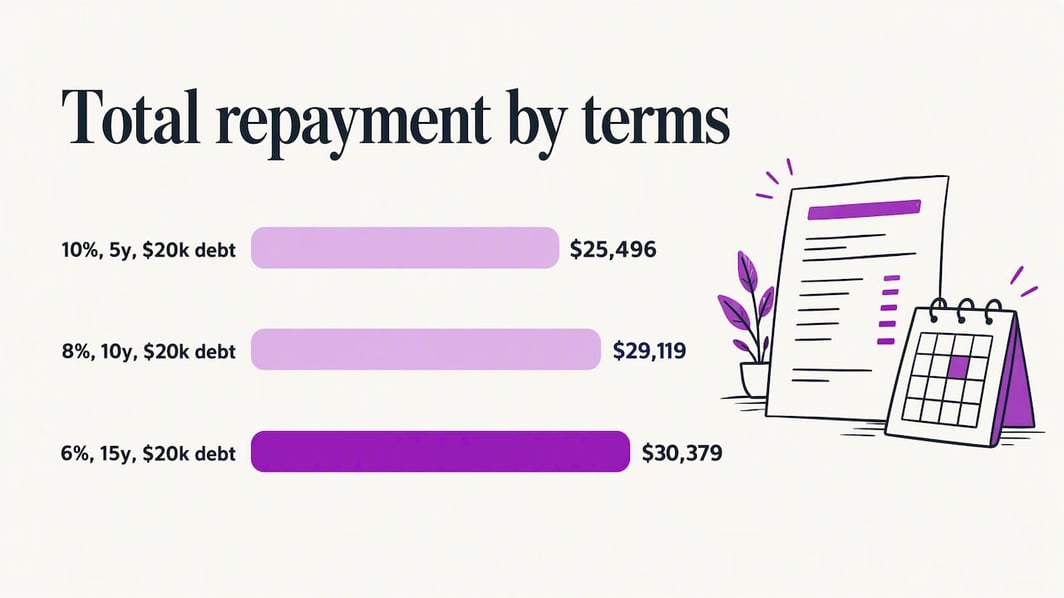
Moneysmart shows this with a $20,000 debt. At 10% over 5 years it costs a total of $25,496. At 8% over 10 years it costs $29,119, and at 6% over 15 years it costs $30,379. The rate falls each time, yet the total cost climbs.
Here is a worked example with our own illustrative numbers. Say you have $30,000 in credit card and personal loan debt and add it to a mortgage at 6% p.a. with 25 years remaining.
The 25-year option looks far cheaper each month, by around $400. But it costs roughly $18,000 more over time. The rate is identical in both rows. Only the time you take to repay it changes. You can test your own balances in our home loan repayment calculator.
When consolidating can make sense
Consolidation tends to work best when several of these are true:
- The new combined rate is clearly lower than the weighted average of what you pay now, after fees.
- You have a plan to repay the extra quickly, not to leave it sitting for 25 years.
- Your spending has changed. Moneysmart notes that having more credit available can tempt you to spend more, so consolidation works when the cards stop being used.
- You have enough equity and a stable income to pass the lender’s assessment.
- You would be refinancing anyway. If your current rate is above what you could get elsewhere, rolling debts in can be part of a sensible switch.
It tends to work poorly when the debts are small and nearly paid off, when you are already behind on repayments, or when the underlying cause is a budget gap that the new loan does not fix.
The risks to weigh before you apply
Your home secures the debt
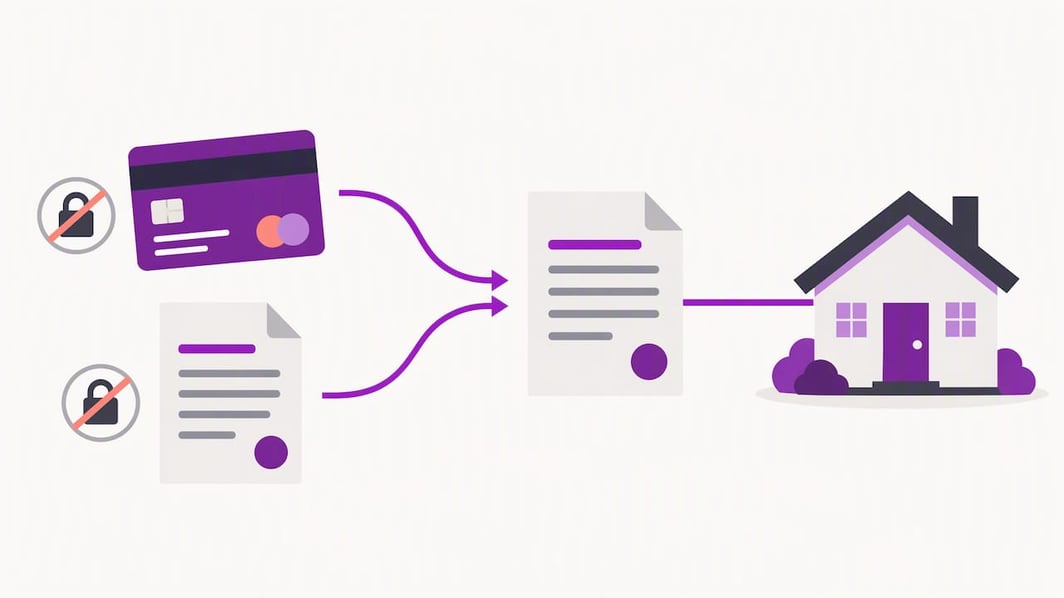
Credit cards and personal loans are usually unsecured. Once they sit in your mortgage, they are secured against your property. If you cannot keep up repayments, the lender can take action on the home, not just on an unpaid card. That is the single biggest change, and Moneysmart puts it at the centre of its warning.
You may pay more in total
As the table shows, long terms add up. Fees add to this too: discharge fees on the old loan, application or valuation fees on the new one, and possibly lenders mortgage insurance if your LVR climbs above 80%. Ask for every cost in writing and compare the total, not just the rate.
The cards can fill up again
Clearing a card gives you a limit again. If spending on it resumes, you carry the old debt inside the mortgage and a new balance on the card. Many people close the card accounts or lower the limits to a level they can manage after consolidating.
Tax treatment can get muddy
If you hold an investment property, mixing personal debts with investment borrowing can affect how much interest you can claim. The ATO’s guidance says deductibility depends on what the borrowed money is used for, not on the security. Mixed-purpose loans are harder to untangle. If you are an investor, keep personal debt and investment debt in separate loan splits where you can, and read this overview of how offset accounts interact with investment property before restructuring. An accountant can tell you how it applies to your situation.
Serviceability: a bigger loan has to pass the test
Consolidating debt into your home loan increases your mortgage balance, and the larger loan must still pass the lender's serviceability assessment.
APRA maintains a 3-percentage-point mortgage serviceability buffer. For example, if your new home loan rate is 6%, the lender generally assesses your ability to repay at 9%, or a higher rate if required by its lending policy.
Adding a large amount of debt to your mortgage can therefore affect how much you can borrow. However, reducing or closing credit card limits as part of the consolidation may improve your borrowing capacity, as lenders typically assess credit card commitments using the approved limits, not just the outstanding balances.
Ways to keep consolidation cheaper
These steps address the main weakness, the long term:
- Keep paying what you were paying. If your old debts cost you $900 a month combined and the new repayment is $400 higher, directing that difference at the mortgage shortens the loan. Moneysmart’s guidance on switching treats the freed-up cash flow as a way to speed up repayment, not as spending money.
- Split the loan. Ask whether the consolidated portion can be a separate split with its own shorter term, or whether you can make extra repayments on it first. Our guide to paying off your mortgage faster covers the practical options.
- Use an offset account. An offset account is a transaction account linked to your loan. Its balance is subtracted from the amount you pay interest on, while your money stays accessible. Check that yours is actually working for you.
- Match your repayment frequency to your pay cycle. Fortnightly repayments can shave time off a loan, as we explain in weekly vs fortnightly vs monthly repayments.
- Close or reduce the cleared cards. It removes the temptation and the extra limit lenders count against you.
A quick checklist before you decide
- List every debt: balance, interest rate, remaining term and any exit fee.
- Work out your total cost if you simply keep paying them as they are.
- Get the new loan’s rate, fees and comparison rate, and model the consolidated portion over a realistic payoff period (not just 25 or 30 years).
- Check your current mortgage rate against the market. If you are overpaying, a switch may save you money regardless of the debts.
- Ask whether a lower-cost alternative (a balance transfer, a negotiated hardship arrangement or a personal loan) fits better for a small amount.
What we think: use the mortgage as a tool, not an escape hatch
We built Bheja around a simple observation: most people only look at their home loan when something goes wrong, and by then the lender has had years of quiet rate drift in its favour. Debt consolidation is often the moment homeowners finally look, and that is useful, because the same review can reveal that the mortgage itself is the bigger cost.
Our view is that consolidation is a good outcome only if two things happen. First, the total cost, not the monthly relief, must fall. Second, the borrower must treat the extra balance as the first thing to clear. The lower repayment is a margin to use on the debt, not a reward.
We also think the order matters. Start with what your current loan costs, because a better rate on a $600,000 balance usually outweighs the interest on a $20,000 card. Then decide whether the other debts belong inside the same loan. If you are already struggling, the answer is different again: Moneysmart advises contacting your lender’s hardship team early, and AFCA offers free, independent dispute resolution if a request is unfairly declined. A free financial counsellor can also look at your whole position before you put your home on the line.
Check your loan first with Bheja
Before adding debt to a mortgage, it helps to know whether your current rate is competitive. Our Home Loan Health Check uses your open banking data to show whether you may be overpaying, and compares you against live rates from more than 90 lenders.
If a switch is worth exploring, our refinance service connects you with licensed mortgage brokers who can help with the application and the consolidation questions above. You can also test the numbers yourself with our refinance calculator.
FAQ
Yes, if you have enough equity and can pass the lender’s serviceability assessment. You either increase your current loan or refinance to a new one that includes the extra amount. Lenders will look at your income, expenses, credit history and the LVR after the debts are added.