

Bheja's quick take
- Interest-only means your repayments cover interest alone for a fixed term, so the principal does not fall.
- Repayments are lower during the interest-only term, but they jump when the loan reverts to principal and interest, and you pay more interest over the life of the loan.
- Interest on a loan used to buy a rental property can generally be claimed when the property is rented or available for rent, but extra repayments that reduce principal cannot.
- Before the term ends, compare your options: switch to principal and interest, repay in full, or refinance. Check what you can afford now, not only later.
An interest-only investment loan lets you pay only the interest on your borrowing for a set period, so your repayments are lower and your loan balance stays the same. When that period ends, the loan normally reverts to principal and interest, and your repayments rise because the same debt must now be repaid over fewer years. For property investors, interest-only loans can help manage cash flow and may offer tax benefits, depending on their circumstances. But there's a trade-off: you'll generally pay more interest over the life of the loan, and repayments can jump when the interest-only period ends.
What an interest-only investment loan is
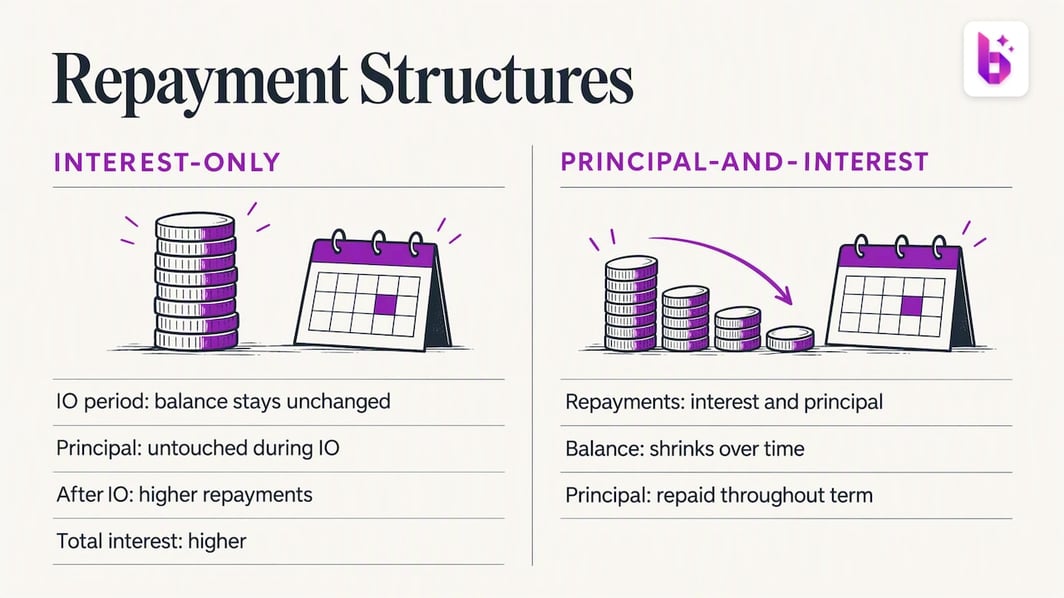
Every home loan repayment has two parts: the interest the lender charges, and the principal, which is the amount you originally borrowed. On a principal-and-interest (P&I) loan, each repayment covers both, so the debt shrinks over time. On an interest-only (IO) loan, you pay just the interest for an agreed period, often up to five years for owner-occupiers, and the principal sits untouched.
The Reserve Bank explains the consequence well. Because principal is not scheduled to fall during the IO period, the balance is higher than it would be on an equivalent P&I loan. The principal then has to be repaid over fewer remaining years, which lifts the repayments and the total interest paid.
In plain terms: an IO loan doesn't make the debt cheaper. It moves the cost of paying it down to later.
How long can the interest-only period last?
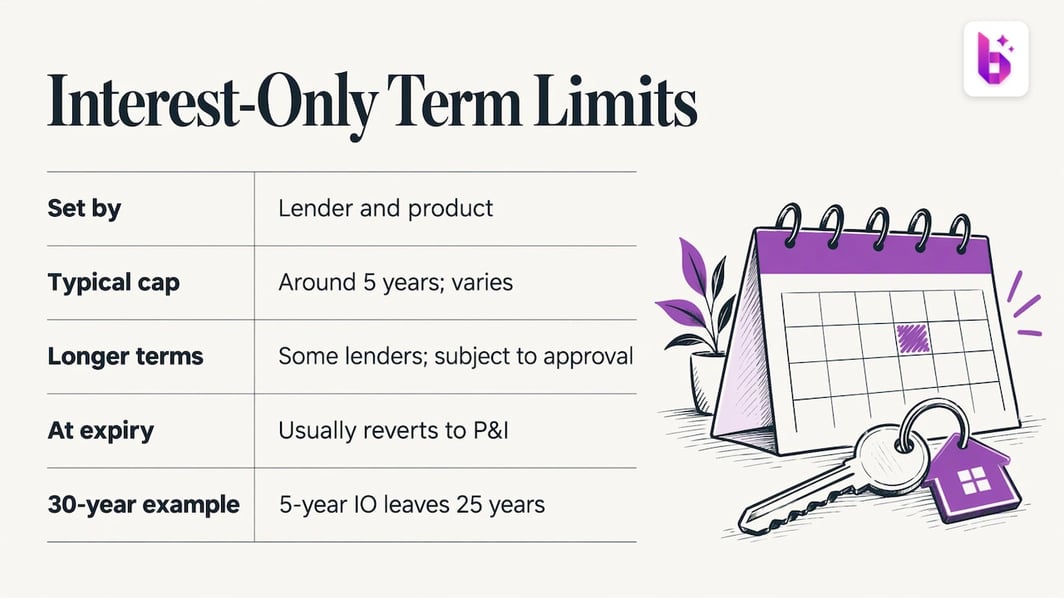
The term is set by the lender and the product, and it varies. Lenders commonly cap investment IO periods at around five years, with some offering longer terms to investors, subject to approval. Because policies change, check the product disclosure for the specific loan, or ask a licensed Australian mortgage broker to confirm current limits across lenders.
What does not vary is the end point. ASIC’s review of the market found that IO loans normally revert to principal-and-interest repayments at expiry, with the principal repaid over the residual term. Note that the residual term is the original loan term minus the IO years. A 30-year loan with five years of IO leaves 25 years to repay the entire balance.
Why some investors may choose interest-only loans
For property investors, the main appeal of an interest-only loan is lower repayments and greater flexibility with cash flow. There can also be tax considerations, although paying more interest doesn't necessarily leave you better off.
There are three common reasons investors choose interest-only repayments.
Lower monthly repayments. During the interest-only period, you don't have to repay the principal. This can make it easier to manage expenses, particularly if rental income doesn't cover the mortgage repayments and other property costs.
Tax considerations. Interest on a loan used to purchase an income-producing rental property is generally tax deductible, whether the loan is interest-only or principal and interest. Because an interest-only loan keeps the balance higher for longer, investors may incur more deductible interest. However, a larger deduction also means paying more interest, so it isn't necessarily a financial advantage.
More flexibility with available funds. Lower repayments leave investors with money they can use elsewhere. For example, they might build an emergency buffer, reduce non-deductible debt on their own home or invest in another asset. The RBA has previously highlighted this flexibility as a reason investors use interest-only loans.
The trade-off is that the principal remains unpaid during the interest-only period. When it ends, repayments generally increase because you must repay the loan over the remaining term.
An interest-only loan can help manage cash flow today, but investors need a plan for the higher repayments that follow.
A worked example: what the step-up can look like
The figures below are our own illustration, not a quote. We have assumed a $600,000 investment loan at 6.2% p.a. over 30 years, with the rate held constant, and rounded to the nearest $5.
Three things worth looking at:
- The step-up at year six is about $840 a month, roughly a 27% increase, even though the rate has not changed.
- After the switch you pay about $265 a month more than a borrower who chose P&I at the start, because you are repaying the same debt in 25 years rather than 30.
- Over the full 30 years, this example costs roughly $45,000 more in interest than the P&I loan, before counting that IO loans often carry a higher rate.
If you want to test your own numbers, the home loan repayment calculator lets you compare repayment types, and the mortgage calculators cover extra repayments and lump sums.
Rates are usually higher too
Moneysmart notes that lenders generally charge higher interest rates on interest-only loans than on equivalent P&I loans. Even a small margin compounds on a balance that is not falling. That is one reason the rate on an IO loan deserves more scrutiny than the headline repayment.
Tax: when is interest on an investment loan deductible?
The ATO generally allows you to claim interest on money borrowed to buy a rental property, provided the property is rented out or genuinely available for rent. What matters is how you use the borrowed money, not whether the loan is interest-only or principal and interest.
The ATO's guidance on interest expenses explains some important rules:
- Mixed-purpose loans: If you use part of your investment loan for private expenses, such as a holiday or renovations to your own home, you can only claim the interest relating to the income-producing portion.
- Principal repayments: You cannot claim repayments that reduce the amount borrowed. This applies to both regular and additional principal repayments.
- Record-keeping: You need records to support your interest claims, particularly if you use the loan for both investment and private purposes. The ATO has warned property investors about the importance of accurate records.
Keeping investment and personal borrowing separate can make tax reporting easier. For example, if you redraw money from an investment loan to pay for a holiday, the interest on that portion is generally not deductible, even though the loan is secured against your rental property.
A registered tax agent can explain which interest expenses you can claim based on your circumstances.
The risks to plan for
Interest-only loans can improve short-term cash flow, but they come with costs that aren't always obvious from the initial repayments.
Moneysmart highlights three main risks: higher interest costs over the life of the loan, larger repayments when the interest-only period ends, and slower equity growth.
Your loan balance doesn't reduce
With an interest-only loan, your regular repayments cover the interest but don't reduce the amount you owe.
This means you generally build equity only if your property increases in value or you make additional principal repayments. If property prices remain flat and you haven't reduced the loan balance, your equity won't grow through either of those sources.
If property values fall, you could find yourself with less equity than when you started. This may make it harder to refinance or sell without a shortfall.
Repayments can jump when the interest-only period ends
When your interest-only period ends, you start repaying the principal as well as interest. Because you have fewer years left to repay the loan, your monthly repayments can increase significantly.
The example above shows how much that increase could be.
Rather than waiting until the interest-only period ends, calculate what your P&I repayments could look like now. Allow for possible interest rate increases, rental vacancies and higher property expenses.
If the future repayments would stretch your budget, it's worth reviewing your options well before the interest-only period expires.
Plans to make extra repayments don't always work out
One reason borrowers choose interest-only loans is to free up money for savings, investments or additional repayments. But having a plan doesn't mean you'll always follow it.
The RBA has previously highlighted ASIC's concern that borrowers may overestimate their ability or willingness to make extra repayments.
One option is to regularly set money aside in an offset account, if your interest-only loan offers one. The balance can reduce the interest charged while keeping your savings accessible. However, an offset doesn't reduce the loan principal, so you'll still need to plan for higher repayments when the interest-only period ends.
Read our guides to mortgage offset accounts and offset vs redraw to understand the differences.
If you're considering an offset or redraw facility for an investment loan, check the tax implications with a registered tax agent.
What happens when the interest-only period ends
ASIC identifies three outcomes at expiry: increase repayments to amortise the principal over the remaining term, repay the loan in full, or refinance, which can include another interest-only loan if the lender approves it. In practice that gives you these choices:
- Let it revert to P&I. The simplest path. Make sure your budget can handle it, and consider building up to the higher repayment beforehand.
- Repay or part-repay the loan. Sale proceeds, savings or equity from other property can reduce the balance.
- Refinance. You might move to a lower rate, reset the structure, or request a new IO term. Approval is not automatic: the lender assesses your income and expenses again at the time.
- Split the loan. Some investors hold part of the debt as IO and part as P&I, which softens the step-up.
Start exploring your options at least six months before the IO term expires. That leaves time to negotiate, compare, and apply without being forced to accept whatever the lender offers at the deadline.
Our perspective
Most investors we speak to focus on the repayment figure at the start and give the end of the interest-only term far less thought. We think that is the wrong way round. The question is not whether interest-only is cheaper this month. It is what your loan looks like on the day it reverts, and whether you chose that structure on purpose.
The second problem is loyalty. Lenders tend to promote their own products, and an investment loan that was competitive when you signed can quietly drift out of line with the market. We call that silent leakage: nothing dramatic happens, but you pay more than you need to.That is why we built Bheja around your actual loan.
By connecting to your loan data through open banking, we show whether you may be overpaying and compare you with more than 6,500 live rates from over 90 lenders. Because we keep monitoring after the first comparison, you can be alerted when a better option appears, well ahead of an interest-only expiry. If you want to act, we connect you with licensed Australian mortgage brokers who can help with the application.
Our advice is simple: know your end date, know your rate, and check both at least once a year.
- Pravin
Check your investment loan with Bheja
If you already hold an IO investment loan, the quickest first step is to see where your rate sits. Our Home Loan Health Check analyses your current loan and highlights whether you may be overpaying compared with other lenders’ live rates.
If the numbers point to a better deal, you can explore refinancing options and speak with a licensed broker. Not sure where to start? Ask Bheja answers home loan questions in plain language. You can also browse our investment home loans page.
FAQ
It can suit investors who want lower repayments in the short term and have a plan for the end of the term, such as a sale, a lump-sum repayment or a refinance. It can be a poor fit if you could not afford the higher P&I repayment when it arrives. Compare the lifetime cost with a P&I loan before deciding.