


Bheja's quick take
- A discharge fee is an administrative charge for closing your loan and releasing the mortgage from your title. It is usually payable whenever the loan ends.
- It is different from a fixed-rate break fee, which compensates the lender for economic loss and can be far larger.
- Lenders set their own discharge fees, and some can be waived or reduced if you negotiate or stay with the lender.
- Allow at least 30 days for the discharge to be processed when you sell or refinance.
- Weigh the discharge fee against the savings from the new loan, not against the headline rate alone.
A mortgage discharge fee is a one-off administrative charge your lender applies when your home loan is closed, whether you’ve paid it off, sold the property or refinanced to another lender. It covers the lender’s work in preparing the paperwork and removing its interest from your property title. It is not a penalty, and it is separate from any break fee on a fixed rate. The amount is set by each lender, so the only reliable figure is the one in your own loan documents.
What a mortgage discharge fee actually covers
When you borrow to buy a home, your lender registers a mortgage over the property. That registration stays on the title until the debt is repaid and the lender formally releases it. The discharge fee pays for that release: preparing the discharge documents, dealing with the other party at settlement and updating the records.
Moneysmart lists discharge fees among the costs to check when you switch loans, alongside application fees for the new loan and lenders mortgage insurance (LMI) if your equity is below 20%. These costs are separate from the interest rate, which is why they are easy to miss.
Two points are worth knowing early:
- The fee applies to the end of the loan, not to a particular point in its life. Whether you close the loan in year two or year twenty, the same administrative work is needed.
- The fee is usually deducted from your payout figure. At settlement, the lender’s final payout amount typically includes it, so you rarely write a separate cheque.
Discharge fee, break fee, exit fee: not the same thing
These terms get mixed up, and the difference can change your decision.
The Consumer Action Law Centre points out that the ban does not stop lenders charging establishment fees or reasonable break fees that reflect actual losses on a fixed-term loan.
Why fixed-rate break costs deserve more attention
A discharge fee is usually a relatively small cost of leaving your lender. A fixed-rate break fee can be much higher, potentially running into thousands of dollars.
That’s because lenders may incur costs when you end a fixed-rate loan early. The amount depends on factors such as your outstanding balance, the time remaining on your fixed term and changes in wholesale interest rates.
The Australian Financial Complaints Authority (AFCA) explains that lenders can generally recover genuine costs associated with breaking a fixed-rate contract. However, borrowers may have grounds to dispute a fee if the lender calculated it incorrectly or provided misleading information.
If you’re considering refinancing a fixed-rate loan, ask your lender for a written break cost estimate before proceeding. The amount can change as interest rates and market conditions move, so confirm the final cost before making a decision.
Some borrowers choose to split their home loan between fixed and variable rates to balance certainty with flexibility. While break costs may still apply to the fixed portion, the variable portion generally won’t attract a fixed-rate break fee. This 60:40 split loan modelling example illustrates how the structure can work. You can also explore the trade-offs in our fixed vs variable home loan comparison.
How much will you pay?
There is no single national figure. Each lender sets its own discharge fee, and it sits in the fees section of your loan contract or product disclosure documents. Some lenders describe it in their fee schedule as a discharge or settlement fee, and a few build the cost of attending settlement into it, so the label varies.
In practice, you should expect to deal with two different amounts:
- The lender’s discharge fee. This goes to your current lender.
- A state or territory registration fee. Each land titles office charges to record the discharge on the title, and the amount differs by state. Your lender or your new lender’s settlement agent will usually include this in the settlement figures.
To find your exact number, look at your loan contract, check your lender’s current fees page, or ask for a payout figure. A payout figure itemises what you owe, including the fee, up to a specified settlement date.
A good habit is to ask for the discharge fee in writing and ask whether it is negotiable. The Moneysmart guidance notes that fees vary between lenders and can sometimes be waived or negotiated, particularly where you are staying with the lender or being given a retention offer.
When the fee comes into play
Here are four common situations where you're likely to pay discharge fees:
Refinancing to a new lender
This is the most common one. Your new lender pays out the old loan at settlement, and the old lender’s discharge fee comes out of that payout. Your new lender may also charge its own application or valuation costs. The key question is whether the savings from the lower rate exceed all of these costs combined.
Selling the property
The sale proceeds clear the loan at settlement, and the discharge fee is deducted from your share. If you are selling, include it in your cost of selling estimate along with agent fees and conveyancing.
Paying the loan off in full
When you make your final repayment, the lender releases the mortgage and charges the fee. Ask the lender to confirm in writing when the discharge will be lodged, and keep that confirmation.
Switching products with the same lender
This is not usually a discharge at all, because the mortgage stays on the title. That is one reason a call to your current lender can be worthwhile. Moneysmart notes you may negotiate a lower rate or waived fees if you show you are prepared to switch, and having at least 20% equity strengthens your hand. We explain the decision in more depth in should you negotiate or switch lenders.
How the discharge process works, step by step
Discharging a mortgage is a legal process as well as a financial one. The lender’s interest has to be removed from the title at your state or territory land registry.
- Decide and tell your lender. Submit a discharge authority (sometimes called a release authority) to your current lender. In most refinances, your new lender or its broker arranges this with you.
- Request a payout figure. It should state the settlement date, the outstanding balance, accrued interest, the discharge fee and any other charges.
- Check for break costs. If you have a fixed rate, confirm in writing whether a break fee applies and how it was calculated.
- Settlement. The new lender (or the buyer’s side, in a sale) pays out the loan. Settlement is usually booked electronically.
- Lodgement. The lender lodges the discharge with the land titles office. Many states now use electronic lodgement. For example, Landgate in Western Australia describes how eligible discharges are lodged through an Electronic Lodgment Network. In Tasmania, Service Tasmania explains that a Discharge of Mortgage form is used once all money has been repaid.
- Confirm the title is clear. If you’ve paid the loan off without refinancing, check the title afterwards and keep your documents.
Timing: allow at least 30 days
The Regional Investment Corporation, a government lender, advises making a discharge request early and coordinating with any new lender. Providers commonly cite a minimum of around 30 days for processing, so build that into your plans if you are selling or refinancing. Giving your lender incorrect or late instructions can cause settlement delays. It can also cost you extra interest on the old loan while you wait.
Note that processes and forms differ between states, so follow your lender’s instructions and your conveyancer’s or broker’s advice for your situation.
Should you stay put to avoid the fee?
Depends on your personal situation. The fee itself is modest relative to the interest you could save if your rate is well above what is available. The mistake is ignoring it, or treating it as the only cost.
A simple way to test a refinance:
Monthly saving × number of months you expect to keep the new loan − (discharge fee + new lender’s application costs + any break fee + LMI if it applies) = net benefit
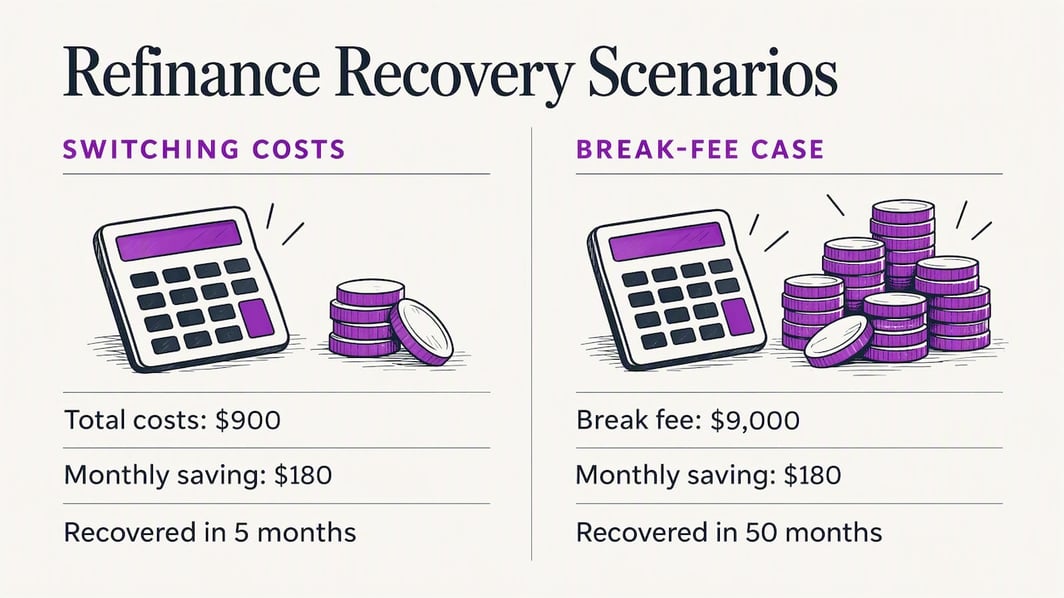
Here is an illustration with made-up round numbers, not a quote. Suppose switching saves you $180 a month in repayments. If your total switching costs came to $900, you would recover them in five months. If a $9,000 break fee were involved, it would take fifty months, and the maths looks very different.
ASIC warns that discharge and loan arrangement fees, along with LMI, can outweigh the benefits of switching in some cases. It also cautions that switching may leave you with a longer loan term. Cashback offers can look generous, but they need to be set against these costs over the long run. If you do refinance, consider asking for the same remaining term so you don’t quietly extend the debt.
Is a high fee legitimate?
You shouldn’t assume it is. Back in 2012, ASIC raised concerns about discharge and early termination fees on certain home loans, and more than 6,400 consumers were refunded over $3.3 million by the lender involved. The lesson is not that today’s fees are wrong, but that fees should reflect genuine administrative costs. If a charge looks out of line with what you were told, ask your lender to explain it in writing. If you aren’t satisfied with the answer, you can lodge a complaint with AFCA, which is free for consumers.
Our perspective
We built Bheja because most borrowers learn about the cost of leaving only after they’ve decided to leave. The discharge fee is rarely what stops someone from switching. What stops them is uncertainty: Is the fee reasonable? Is there a break cost? Will the numbers still work after everything is added up?
Our view is that the discharge fee should be one input in a full picture, not a reason to stay or go by itself. The loyalty gap, where long-standing customers end up on higher rates than new customers, usually dwarfs a one-off administrative charge. But that only holds if you have checked, and checking means looking at your actual loan, not a generic table.
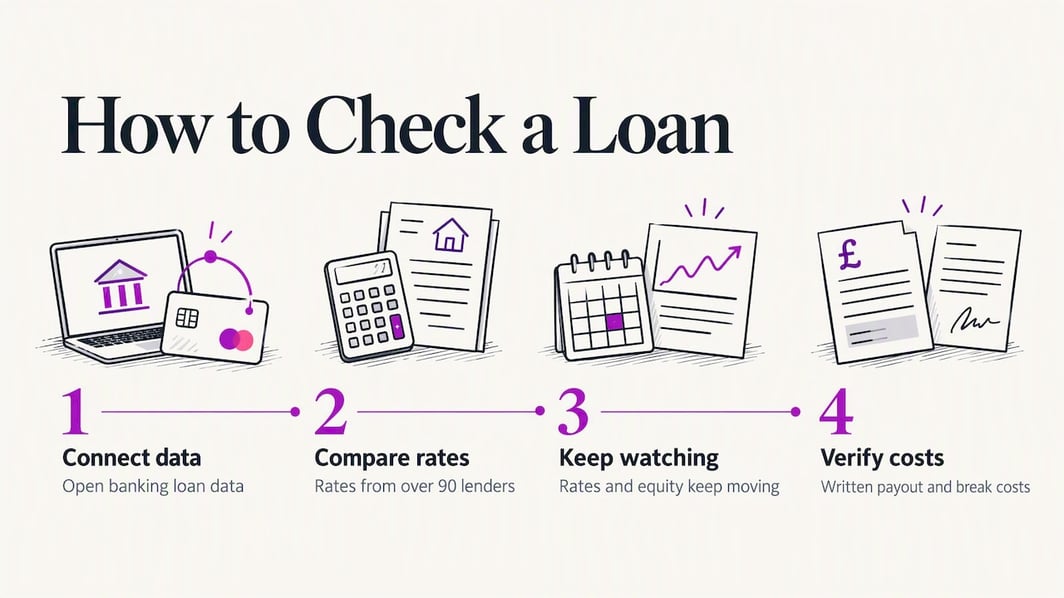
That is why we connect to your loan data through open banking, compare it against live rates from over 90 lenders, and keep watching after the first comparison. We think a one-off comparison is only half the job, because rates and your equity both move. Before you sign anything, get the payout figure, get the break cost in writing if you’re fixed, and make sure the new loan still wins once every cost is on the table.
— Pravin
Check your numbers before you commit
If you are weighing up a switch, our Home Loan Health Check shows whether you may be overpaying against more than 6,500 live rates, and our refinance calculator helps you set the savings against switching costs such as the discharge fee. When you’re ready to move, we can connect you to a licensed mortgage broker through our refinance page.
Practical ways to keep the fee down
- Ask first. Call your current lender, say you are comparing options and ask what they can do on rate and fees. Our guide on negotiating versus switching covers what to say.
- Read your contract. Find the discharge fee and any break fee before you apply for the new loan.
- Compare total cost. Use a step-by-step comparison approach that includes fees, not only the advertised rate.
- Time it well. If you’re on a fixed rate, ask whether waiting until the term ends changes the cost. Our article on the best time to refinance goes through the triggers.
- Ask your broker about it. A licensed broker can include the discharge costs when they compare options, and some new lenders offer cashback that offsets part of them. Check the conditions and the clawback terms.
- Watch fee changes. Lenders change fees from time to time. Our news piece on a major bank dropping a home loan fee shows how quickly things can shift, so check your lender’s current schedule rather than relying on an old figure.
FAQ
In most cases, yes, if your lender’s contract includes one and your loan is closed. It is an administrative charge for releasing the mortgage, not a penalty. Some lenders waive or reduce it, particularly for existing customers or retention offers, so it's worth asking.