

You can refinance a home loan when you’re self-employed in Australia, provided you meet the new lender’s requirements. The main difference is how you prove your income. Depending on the lender and your business structure, this could mean tax returns, business financial statements or other evidence.
Two years of tax returns is a common requirement, but it is not a rule across all lenders. Some mainstream lenders accept a shorter financial history or offer simplified verification for eligible business owners.
This guide covers what lenders look at, which documents to gather, what to do if your income has dipped, where low doc and alternative documentation loans fit, and how to check that a switch actually saves you money
Key points
- Self-employed borrowers can qualify for standard home loans. Income documents and minimum trading-history requirements vary by lender.
- Banks and other authorised deposit-taking institutions generally assess repayments at least three percentage points above the loan rate.
- Alternative-doc loans use different income evidence, but lenders still check whether you can afford the repayments.
- Compare switching costs, ongoing fees and the remaining loan term. A lower monthly repayment does not necessarily mean a cheaper loan overall.
How lenders assess a self-employed refinance
When you refinance, the new lender treats your application much like a fresh loan. It checks that you can afford the repayments, that the property is worth enough to secure the debt, and that the loan is suitable for you.
For an employee, payslips and salary credits may provide much of the income evidence. For a self-employed borrower, the lender may need to look at both personal income and business performance.
Business turnover, profit and personal income are different figures. A business can have substantial sales but also substantial expenses. The lender needs to establish how much income is available to meet your repayments after allowing for relevant costs and commitments.
Your business structure also matters. A sole trader’s income is documented differently from a company director’s salary or income received through a trust. Your documents need to support the income you declare; bank deposits and taxable profit do not need to be identical. APRA’s guidance recognises that assessing self-employed income can involve cash-flow evidence, supporting documents and third-party verification.
Responsible lending
For home loans covered by responsible lending laws, lenders must make reasonable inquiries about your requirements, objectives and financial situation, take reasonable steps to verify your finances, and assess whether the loan would be unsuitable. Mortgage brokers have related obligations when providing credit assistance. ASIC explains these requirements.
The serviceability buffer
APRA requires authorised deposit-taking institutions, including banks and credit unions, to apply a serviceability buffer of at least three percentage points above the loan rate. A 6.00% loan would generally be assessed at 9.00% or higher.
This is an assessment rate, not the interest rate you pay. Non-bank lenders have their own assessment policies and are not directly subject to this APRA requirement.
If you want the plain-English version, we explain it in what a buffer rate is and why it matters.
The documents you will usually need
Requirements vary by lender and business structure. Some lenders ask for two years of personal and business records, while others accept one year or simplified evidence for eligible applicants.
Depending on your circumstances, the lender may ask for:
- Personal tax returns and ATO notices of assessment for the required period
- Business tax returns, and where relevant a profit and loss statement and balance sheet
- Your ABN details and, if you operate through a company or trust, the structure documents
- Statements for the home loan you want to refinance
- Statements for other debts, such as credit cards, car loans and business loans
- Recent bank statements showing income arriving
- Proof of ATO debt arrangements, if you have any
- Business Activity Statements (BAS), GST registration details or evidence of salary paid by your business, where required
Before applying, confirm which financial years the lender needs and how recent the documents must be. If your latest return has not been lodged, ask what evidence it will accept rather than assuming you must wait or use an alternative-doc loan.
Why your accountant matters
Many self-employed people legitimately reduce taxable income through deductions. However, taxable income is not always the same as the income a lender will use in its assessment.
Some lenders allow certain expenses, such as depreciation, to be added back when calculating income. Which adjustments they accept depends on their policy and the supporting evidence.
Your accountant can explain the business figures and prepare accurate records. A mortgage broker can check how different lenders may assess them. Neither can guarantee the lender will accept a particular income figure.
An accountant’s letter also does not replace every other document automatically. Its role depends on the lender and the application.
What if your income has dipped?
A weaker year doesn't automatically rule out refinancing, but it may reduce the income a lender accepts and the amount you can borrow. Some lenders average income over a period; others may use a lower recent figure when income has fallen.
The reason for the decline can help explain the figures, but you still need to demonstrate that you can afford the loan. Useful supporting information may include:
- An explanation of what changed. A lost contract, illness or business restructure may help explain a decline when supported by records.
- Recent trading evidence. Current financial statements, BAS or business bank statements may help show whether income has recovered.
- Details of one-off costs. Your accountant can identify unusual expenses, while the lender decides whether to adjust for them.
- Your current commitments. Business debts, credit card limits and other repayments can affect the assessment.
A smaller loan or fewer financial commitments may improve borrowing capacity. However, using savings to reduce debt also leaves less cash available for household or business expenses. That trade-off needs to be considered.
If you have been told you can't refinance, ask what exactly the issue was: income, equity, credit history or the property. Another lender may assess the application differently, but approval is not assured.
Can a lender make an exception to its assessment policy?
APRA allows banks to make prudent, limited exceptions to lending policy. For refinancing, additional evidence such as a borrower’s repayment history may be relevant.
An exception is not an entitlement, and having substantial equity doesn't remove the need to demonstrate repayment capacity. The lender must still meet its responsible lending obligations.
Full doc, low doc and alternative documentation
You don’t necessarily need an alternative-doc loan just because you’re self-employed. Some mainstream lenders accept fewer documents from eligible borrowers through a simplified income verification process.
If you can’t meet a lender’s standard documentation requirements, a low-doc or alternative-doc loan may be an option. These loans use different evidence to verify your income. You still need to show you can afford the repayments.
Having fewer tax records does not mean you can apply without a business history. For example, Pepper Money’s published guidance says it considers eligible alternative-doc applicants with at least six months of ABN and GST registration, plus supporting income evidence. Other lenders have different requirements.
Alternative documentation may give you another way to qualify, but check what that flexibility costs. Compare the rate, fees and features with your current loan. If you plan to refinance again once you have more financial records, remember that a cheaper loan is not guaranteed and another switch may involve additional fees.
Work out the net benefit before you switch
A cheaper rate does not guarantee you come out ahead. Moneysmart's advice is to make sure the benefits outweigh the costs before you switch. The costs can include:
The formula is simple:
Net benefit = interest saved over the time you will hold the loan − total switching costs − value of lost features
A worked example
Suppose you owe $600,000 and your repayment is currently based on a rate of 6.40%. A new lender offers 6.00%. Using a 30-year term for illustration, the monthly repayment falls from about $3,753 to about $3,597, a difference of about $156 a month, or roughly $1,870 a year. If switching costs total $1,200, you recover them in under a year. If they total $4,000, it takes closer to two years and three months, and it only works if you keep the loan that long.
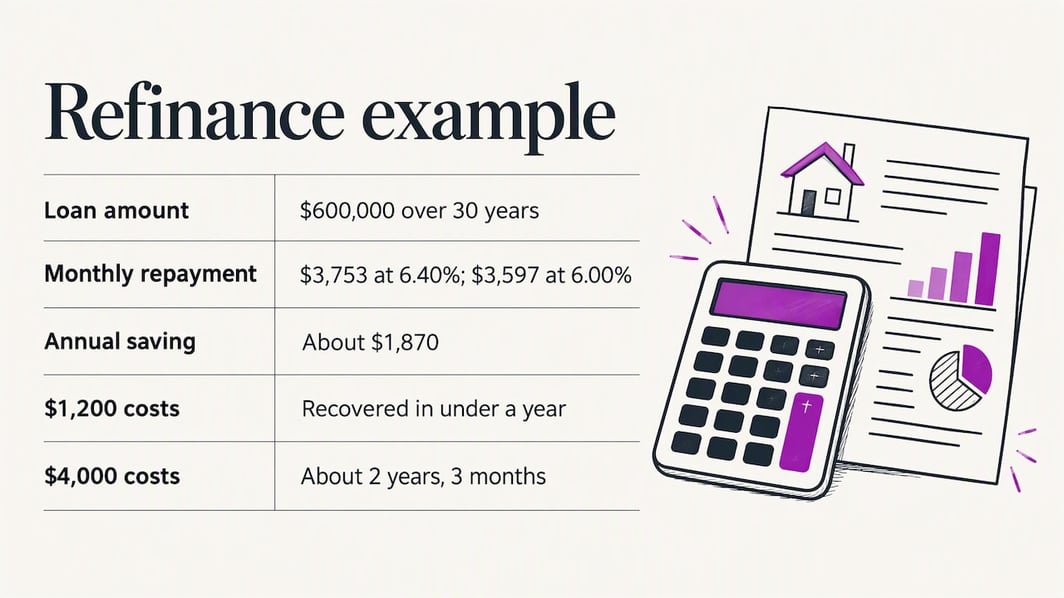
This is an illustration, not a quote. You can run your own figures through a refinance calculator, then use the home loan repayment calculator to see how your repayment moves at different rates.
Watch the loan term
If cash flow is uneven, stretching a loan back out to 30 years to lower the monthly payment is tempting. Moneysmart warns that extending the term can increase the total interest you pay.
Negotiate or switch?
Before you do the paperwork, it is worth asking your current lender for a better rate. Sometimes that works and avoids the documentation entirely, and sometimes it only narrows the gap. We lay out the trade-offs in should you negotiate or switch lenders, and timing questions are covered in when is the best time to refinance. If the lender will not move, you have a concrete comparison to take elsewhere.
Our view: check the income requirements before applying
For self-employed borrowers, finding a lower rate is only part of refinancing. You also need to know whether the lender will accept your income evidence.
Checking this early can help you avoid spending time on an application that does not fit the lender’s requirements. Your accountant can explain your business figures, while a mortgage broker can help identify lenders whose policies may suit your circumstances. The lender makes the final assessment.
At Bheja, we see the initial rate comparison as a starting point. Understanding the potential savings, switching costs and documentation requirements gives you a clearer basis for deciding whether to proceed.
Check where you stand with Bheja
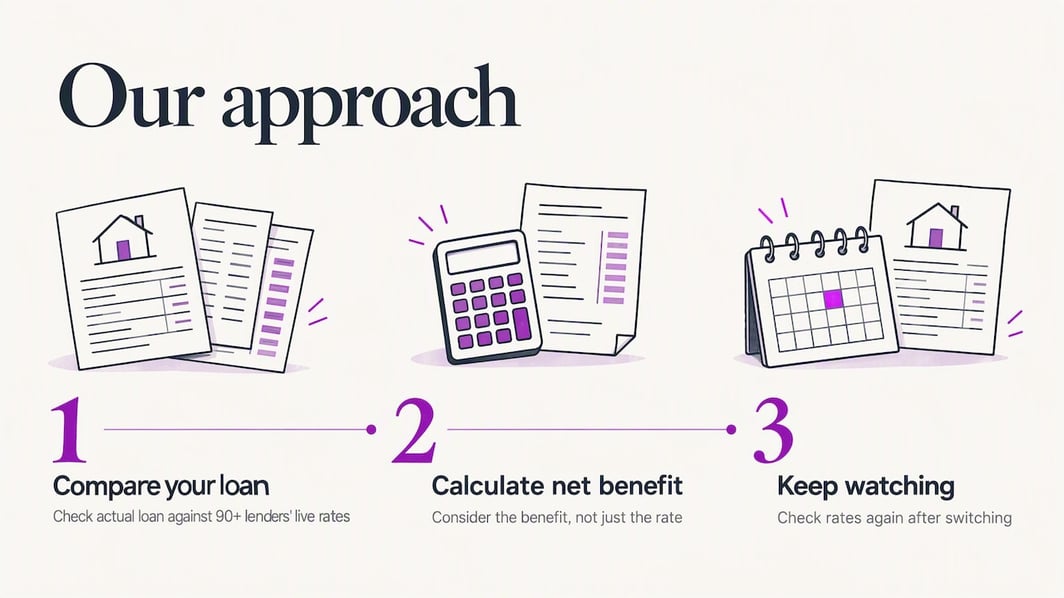
Our Home Loan Health Check compares your current loan against more than 6,500 live rates from over 90 lenders to help identify potential savings.
The result is a rate comparison, not loan approval. Your eligibility depends on the lender’s assessment, including your income, business history and supporting documents.
If you want help exploring your options, refinancing with Bheja connects you with licensed mortgage brokers who can review your circumstances and support your application.
A step-by-step plan for your refinance
- Find out what you are paying. Pull your current rate, remaining balance, remaining term and any fixed-rate expiry date.
- Estimate the saving. Compare against current rates and put the switching costs on the other side of the ledger.
- Check your equity. Your LVR affects both rate and approval. The LVR calculator shows where you sit.
- Stress test your budget. Look at repayments with the buffer in mind, not just today's rate.
- Gather the documents. Use the list above and check that your most recent return is lodged.
- Prepare your explanation. If any year looks weak, write down why and what has changed.
- Apply through a licensed professional or directly. Ask them how the lender treats your business structure before lodging.
- Settle and then review. Make sure the old loan is discharged properly, then set a reminder to review again.
FAQ
Sometimes. Many lenders prefer two years of returns, but policies differ, and some lenders accept shorter histories or alternative evidence. Ask a licensed broker which lenders suit a shorter trading history, and weigh any higher rate or fees against the saving.