


- A non-bank lender holds no banking licence and takes no deposits. It still needs an Australian Credit Licence, must follow responsible lending rules and must belong to AFCA.
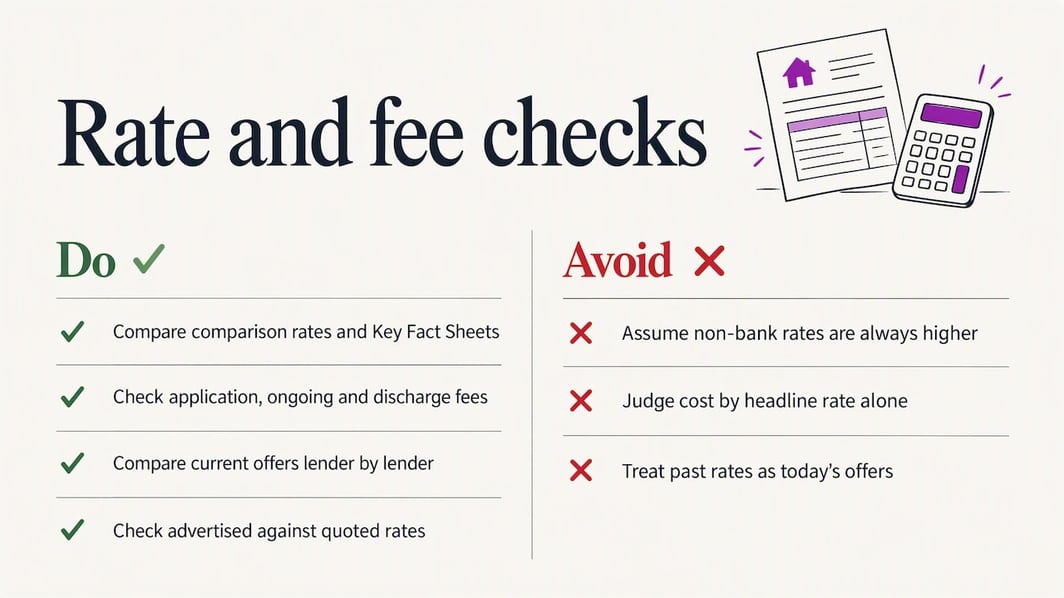
- Non-bank rates have often sat above major-bank rates, but the gap changes over time and many non-banks price sharply for standard borrowers. Compare on the comparison rate and Key Fact Sheet, not the headline rate.
- Non-banks tend to suit borrowers banks handle poorly, such as the self-employed or those with low documentation. Standard salaried borrowers often find a bank or a non-bank can both work.
- "Second-tier lender" is an informal label with no legal definition. Check each lender's actual licence and funding rather than relying on the label.
- The right answer depends on your own loan, so compare live rates against what you pay now before you decide.
The difference between a bank and a non-bank lender is a licence. Banks are authorised deposit-taking institutions (ADIs), so they take deposits and are supervised by APRA. Non-bank lenders do not take deposits, fund their loans from wholesale markets and investors, and are regulated mainly as credit providers. For most borrowers the practical differences are rate, flexibility, speed and the features attached to the loan. Neither type is better in every case.
This guide explains how the two types of lender work, where they differ on cost and eligibility, what protections apply, and how to decide which is worth a closer look for your own loan.
What is a non-bank lender?
A non-bank lender writes home loans without holding an ADI licence. That means it cannot take customer deposits, so it cannot fund loans the way a bank does. The sector is large and varied: the financial crimes regulator AUSTRAC counted over 600 non-bank lenders and financiers in the Australian market in its earlier risk assessments, though that figure covers everything from home loan lenders to car and personal finance providers.
By the numbers, non-banks are still the smaller player. The Reserve Bank of Australia put them at roughly 5 per cent of total financial system assets as of March 2023. Their share of new lending is growing, though. Analysis of ABS Lending Indicators reported that non-banks made up 10.7% of new home lending in the June 2026 quarter, up from 4.8% in 2019.
What does second-tier lender mean?
You will see "second-tier lender" used in broker conversations and search results, and it is a loose term. In everyday use it usually means any lender outside the big four banks. Some people use it only for non-banks, and others stretch it to include smaller banks, regional banks, mutuals and credit unions.
These groups are different in ways that matter. A smaller bank or credit union is still an ADI, so it takes deposits and sits under APRA supervision. A non-bank is not an ADI. When a lender is described as second tier, ask two questions: does it hold an ADI licence, and where does its loan funding come from? Those answers tell you more than the label does.
The label also hides something else. Some lenders that look independent are owned by, or funded through, larger institutions. ASIC has noted that banks and non-bank lenders are increasingly linked, for example when banks provide financing for non-bank warehouse facilities. So the line between "bank money" and "non-bank money" is blurrier than it looks.
How the two types fund and regulate their loans
Funding
Banks lend largely against customer deposits, supported by wholesale funding. Non-bank lenders, according to the RBA, typically fund loans through warehouse facilities, securitisation or investor capital. In plain terms, they borrow from financiers to fund a pool of loans, and may then bundle those loans and sell them to investors.
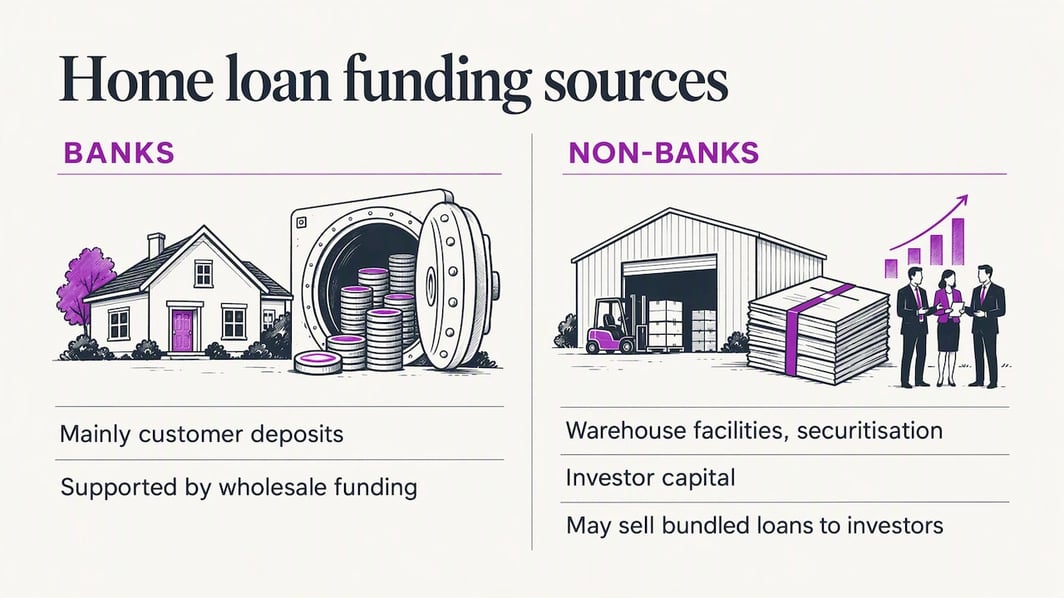
Non-bank lenders fund their loans through wholesale markets rather than household deposits. Changes in these funding costs can affect the rates they offer.
Conditions have improved since 2022. The RBA reported in February 2026 that some wholesale funding costs had eased relative to benchmark rates. However, this doesn’t automatically mean cheaper home loans. Your rate also depends on the loan, your circumstances and the lender’s pricing.
Regulation
Non-bank lenders are regulated, but differently from banks. They are not generally subject to the same APRA rules on capital and liquidity. However, lenders providing regulated home loans must generally hold an Australian Credit Licence, meet responsible lending obligations and belong to AFCA. Licensing exemptions can apply.
If you have a complaint, you can raise it with the lender first, then take an unresolved complaint to AFCA, subject to its rules.
Funding is another difference. Banks can use customer deposits as well as wholesale funding, while non-banks cannot take household deposits. The RBA has identified funding and liquidity risks across the non-bank sector during market stress. These risks vary between lenders and business models.
Funding problems do not cancel your existing loan or repayment obligations. However, a lender may restrict new lending, and changes to an existing variable rate remain subject to your loan contract and applicable notice requirements.
Non-bank lenders vs banks: side-by-side
The table shows tendencies, not rules. Individual lenders vary a lot inside each group.
Rates and fees: what the evidence says
Rates and fees: what to compare
A non-bank loan isn’t automatically more expensive, or cheaper, than a bank loan. The rate offered depends on the lender, the product and your circumstances. Our current mortgage rates page can help you compare available offers.
Look beyond the advertised interest rate. As Moneysmart explains, a comparison rate combines the interest rate and most fees. It is a useful starting point, but doesn’t include every cost or loan condition. Compare rates calculated using the same loan amount and term.
You can also request a Key Facts Sheet, where available, based on the amount and term you are considering. Its standard format helps you compare repayments, fees and estimated total costs. Separately check charges for offset or redraw, early repayment and leaving a fixed-rate loan.
Compare the rate you’re actually offered.
The advertised rate may differ from your individual quote. In its 2020 home loan price inquiry, the ACCC found that discretionary discounts made comparisons harder. It also noted that some smaller banks and non-bank lenders did not offer these discounts or relied on them less.
That finding doesn’t establish how every lender prices loans today. The useful takeaway is to compare written quotes for the same borrowing amount, remaining term and repayment type, including the rate, fees and features available to you.
Eligibility, approval speed and flexibility
Non-bank lenders may offer options for borrowers who don’t meet a particular bank’s lending criteria. The RBA notes that they often serve borrowers and market segments underserved by banks, and compete on service and turnaround times.
Depending on the lender, this may help if:
- You are self-employed and need alternative documents to verify your income.
- Your income varies, such as earnings from contracts, commissions or several sources.
- You have past credit problems, but can demonstrate your current ability to repay.
- Your circumstances fall outside standard policy, such as a shorter trading history or an unusual property.
Flexibility isn’t guaranteed. Each lender sets its own requirements, and some banks also accommodate non-standard circumstances. Approval speed depends on the application, supporting documents, valuation and lender workload.
Features vary too. Both banks and non-banks may offer offset accounts, redraw and extra repayments. Compare the specific loan rather than assuming either type of lender offers more.
Which suits you: buyer, refinancer or investor?
First home buyers
Both banks and non-banks may be options, depending on your deposit, income and borrowing needs. Compare rates, fees and features you expect to use.
If you are considering a government home-buying scheme, check whether the lender participates. Not every lender offers access to every scheme. Housing Australia publishes the participating lenders for the Australian Government 5% Deposit Scheme. Housing Australia
Our first home buyer comparison can help you explore loan options.
Homeowners refinancing
Comparing banks and non-banks can give you a broader view of available rates and features. You can also ask your current lender for a better offer before deciding to switch.
Our guide to negotiating or refinancing explains the differences. If switching looks worthwhile, consider the fees, any fixed-rate break costs and your remaining term when assessing the best time to refinance.
Property investors
Lenders can assess rental income, existing debts and investment portfolios differently. An investor who doesn’t qualify with one lender may meet another’s criteria.
However, a larger borrowing limit doesn’t necessarily mean a better loan. Compare rates, fees and repayments, including how your budget would cope with vacancies, repairs or higher interest rates.
What to check before choosing a lender
Whether you choose a bank or non-bank, the key checks are similar:
- Check licensing. Confirm the lender’s Australian Credit Licence details through ASIC’s registers, or verify any applicable exemption.
- Check AFCA membership. AFCA provides free external dispute resolution for eligible complaints that remain unresolved with the lender.
- Compare written offers. Use the same loan amount, term and repayment type. Request a Key Facts Sheet where available, and check costs not included in the comparison rate.
- Understand rate changes. For a variable loan, check the lender’s terms and notice requirements. Past decisions don’t guarantee how it will respond to future cash rate changes.
- Check the cost of leaving. Discharge fees and any fixed-rate break costs can affect whether refinancing later is worthwhile.
- Consider broker support. Mortgage brokers must act in your best interests when providing credit assistance. Our broker versus bank comparison explains how their services differ.
A licensed mortgage broker can help assess loan options if your income or credit history is complex. If you are struggling with debts or repayments, a financial counsellor provides free, confidential support.
Our perspective
The question isn’t simply ‘bank or non-bank?’ It’s whether the loan offers good value for your circumstances.
A lender’s category tells you how it is funded and regulated. It doesn’t tell you whether its loan will cost you less. That comes down to the rate you’re offered, the fees, the features you need and the repayments you can manage.
That’s why we built Bheja—to help borrowers compare their existing loan with other options and keep it under review as rates and circumstances change.
— Pravin
See how your current loan compares
Bheja’s Home Loan Health Check compares your current rate with live rates from bank and non-bank lenders. You can also securely connect your loan through Open Banking, with your consent, to use your actual loan information and track it for better-rate alerts.
A lower rate is a starting point. Eligibility, fees, features and switching costs determine whether an alternative could leave you better off.
If you want to explore switching, you can connect with a licensed mortgage broker through Bheja for an obligation-free discussion. Connecting through Open Banking can also prefill much of your application, with a broker reviewing the details before it proceeds.
You can also run your own numbers with our mortgage calculators, and keep an eye on your loan afterwards so a better rate does not pass unnoticed.
FAQ
Non-bank lenders offering regulated home loans generally need an Australian Credit Licence, must meet responsible lending obligations and must belong to AFCA. They are not subject to the same APRA supervision as banks, but that doesn’t mean they are unregulated.
Check the lender’s licence, AFCA membership and loan terms. Regulation provides consumer protections, but doesn’t guarantee that a loan is suitable or affordable for you.