


Yes, you can refinance with your current bank, and for many borrowers it is the quickest way to a lower rate. An internal refinance (also called an internal switch or rate review) moves you onto a cheaper rate or a different loan product within the same lender, usually with less paperwork and lower fees than a full switch. The catch is that the bank has little reason to offer its best rate unless you ask, and a better deal elsewhere may sometimes still be worth the extra effort. This guide explains how to do it, what it costs, how it touches your credit file, and how to decide between staying and leaving.
Key points
- Ask your current lender for a better rate firstnew customers are often offered better deals than existing borrowers.
- Internal switching fees can run from nil to $1,000, according to Moneysmart, so ask for the figure in writing before you agree.
- Any refinance application can be recorded on your credit report, so compare first and apply once.
- Use an outside benchmark. Without live market rates, you can't tell whether your bank's "new offer" is actually competitive.
Can you refinance with the same bank?
Yes. You may be able to refinance your home loan with your existing lender, although not every change to your loan counts as refinancing.
Refinancing generally involves replacing your current home loan with a new one. As Moneysmart explains, the decision should come down to whether the benefits outweigh the costs.
If you want to stay with your current lender, there are several options worth exploring:
- Negotiate a lower interest rate. Your lender may agree to reduce the rate on your existing loan without replacing it. This is a rate negotiation, not refinancing.
- Switch to another home loan product. You may be able to move to a different loan offered by the same lender, potentially with a more competitive rate or features such as an offset account. Depending on how the lender structures the change, this may be an internal product switch or a refinance.
- Restructure or increase your borrowing. You might apply for a loan top-up, change your loan term or split your mortgage between fixed and variable rates. These changes don't necessarily involve refinancing, and the lender may require additional checks or a credit assessment.
The process, costs and eligibility requirements depend on the changes you request. A straightforward rate reduction may be relatively simple, while increasing your borrowing generally involves a more detailed assessment.
Why your bank may be willing to cut your rate
Your bank doesn't necessarily want to lose you to another lender. Keeping an existing borrower can be more attractive than losing the loan to a competitor, particularly when that borrower has a strong repayment history.
That gives you a reason to negotiate.
Banks have historically offered more competitive rates to new borrowers, but the gap has narrowed. According to the Reserve Bank of Australia (RBA), the difference between average new and existing variable mortgage rates fell from around 0.35 percentage points in 2019 to just 0.03 percentage points in December 2025.
The RBA attributes part of this change to borrowers refinancing or negotiating better rates with their existing lenders. Some banks have even made it easier for customers to request a lower rate.
However, these are market averages. Your individual rate could still be considerably higher than comparable loans available today, including those offered by your current lender.
This is sometimes called the loyalty tax: the extra interest a borrower may pay by remaining on an uncompetitive home loan.
Moneysmart recommends asking your existing lender for a better deal before switching. It also suggests comparing any offer from your bank with loans available elsewhere.
How much could a lower rate save?
Even a relatively small rate reduction can make a difference.
For example, on a $600,000 outstanding mortgage balance, reducing the interest rate by 0.50 percentage points would lower the interest charged by approximately $3,000 over the first year, assuming the balance remained unchanged.
In practice, the saving would differ as repayments reduce the balance, and the effect on monthly repayments would depend on the remaining loan term.
Moneysmart notes that a rate just 0.50 percentage points lower could save thousands of dollars over time.
How much will you pay at a lower rate?
Ask Bheja, your AI mortgage copilot, how your repayments changes at various interest rates. Enter your loan details to instantly see the impact on your repayments.
Example questions to ask Bheja, your AI mortgage assistant:
- Show the impact of a 0.25% interest rate cut on a $870,000 home loan with a term of 30 years, and an interest rate of 5.74%.
- Show the impact of a 0.50% interest rate cut on a $870,000 home loan with a term of 30 years, and an interest rate of 5.74%.
- Show the impact of a 0.75% interest rate cut on a $870,000 home loan with a term of 30 years, and an interest rate of 5.74%.
How to refinance with your current lender, step by step
1. Find out what you pay now
Get your current rate, remaining balance, remaining term, and any fees from your latest statement or app. Note whether the loan is fixed or variable, and when a fixed period ends. If you have an offset account, note its balance, because an offset can change the real comparison between two loans.
2. Benchmark against the market
Before you phone the bank, find out what comparable loans are being offered elsewhere. This is where sometimes one might end up settling for less without even realising: somebody might ask the bank for "a better rate", get a small trim, and accept it without knowing what the market would give them. A benchmark gives you a number to negotiate against. Our health check can help you see how your interest rate stacks up against what's on offer in the broader market.
3. Call or message the bank's retention or home loan team
Say plainly that you are reviewing your loan and have seen cheaper rates elsewhere (it can help to keep the details handy. Ask three questions:
- What is the lowest rate you can offer me on my current loan, and on your current products?
- What fees apply to switching internally, and can they be waived?
- From when will the new rate apply?
Write down the name of the person you spoke to and the date, and ask for the offer in writing.
4. Compare the offer on total cost
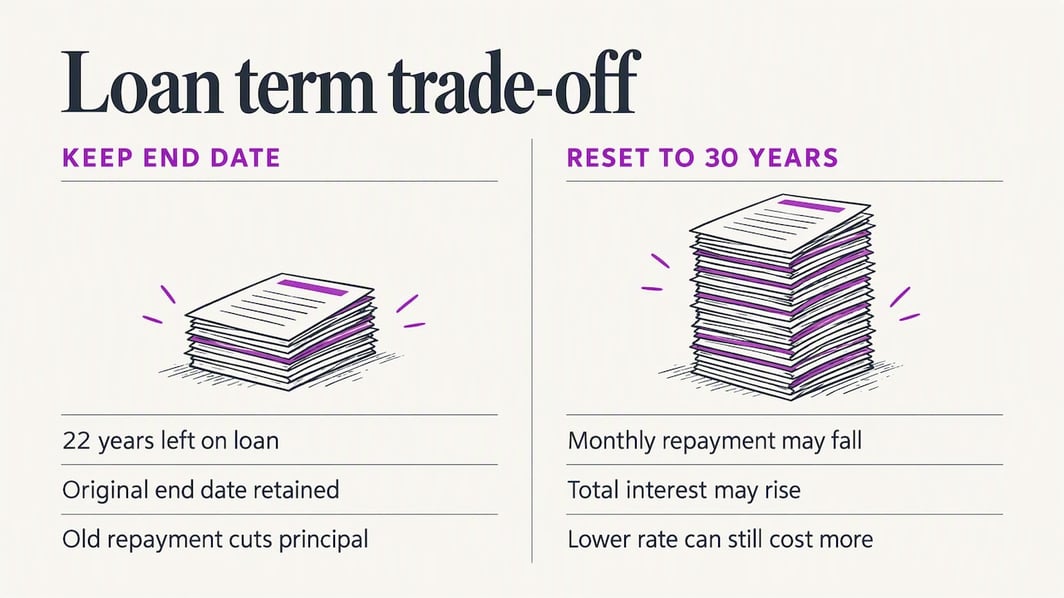
A lower interest rate could reduce your monthly repayments, but that doesn't necessarily mean you'll pay less over the life of the loan. If you refinance a mortgage with 22 years remaining into a new 30-year term, the additional eight years could increase your total interest costs, even at a lower rate.
Compare the total interest and fees over the remaining loan term, not just the monthly repayment. You could ask your lender to retain your original loan end date or consider maintaining your previous repayment amount, where permitted, to pay down the principal faster.
The aim is to understand whether the new arrangement reduces your overall borrowing costs, rather than simply making repayments smaller.
5. Accept, or take the offer to another lender
If the bank matches the market, you may accept and document it. If it doesn't, you could consider switching. Either way, you have spent an hour, not months.
What an internal refinance costs
Internal refinances are usually cheaper than moving, but not always free. Moneysmart reports that internal switching fees range from nil to $1,000, while total entry fees on a new loan (application, valuation, legal and settlement) range from nil to over $1,700, depending on the lender.
Costs to ask about:
Moneysmart also flags that any cashback offer should be weighed against long-term interest and fees, since a cashback can sit on top of a loan that costs more over time.
Does refinancing hurt your credit score?
It can, briefly and usually modestly, and the effect depends on how many applications you make rather than whether you stay or go. A refinance, whether with the same bank or a new lender, involves a credit application, and credit applications can appear on your credit report. A bunch of applications in a short period can look like financial stress to the next lender who checks.
- A simple rate reduction on an existing loan may not involve a new credit application at all. Ask the bank whether it will check your credit file before you agree to anything.
- A new product, top-up or restructure is more likely to be treated as a full application.
- Shopping around is safer when done through comparison tools that don't lodge applications. Apply formally once you have chosen.
- Missed repayments do more damage than an enquiry. Keeping your repayments on time is important.
There is no single minimum credit score for refinancing. Each lender sets its own policy. If you have defaults or arrears, expect a lender to ask more questions, and consider checking your free credit report before applying so there are no surprises. If you are behind on repayments, speak to your lender's hardship team or contact the National Debt Helpline on 1800 007 007 before applying for anything new.
Will the bank reassess whether you can afford the loan?
For a straightforward rate reduction on your existing loan, the bank may not need to reassess your borrowing capacity. However, refinancing into a new loan or increasing your borrowing generally involves a credit assessment.
APRA requires lenders to assess new housing loans with a serviceability buffer of 3 percentage points above the loan rate, and APRA confirmed it would stay at that level in May 2026. If your income has fallen or your debts have grown since you took out the loan, a new assessment may not go as smoothly as when you first borrowed. Our explainer on the buffer rate shows how this works, and the borrowing capacity calculator gives you a quick read on where you stand.
It is also why refinancing when you are under financial pressure needs care. Moneysmart's credit factsheet, Can't pay your debts, warns that consolidating debts can provide short-term relief while costing more over time. High fees added to a new loan balance can also reduce your equity. Ask for a written breakdown of every fee before you sign.
Same bank or a different lender?
Staying put could be the right call when your bank matches or comes close to the best comparable rates, fees are low, and the loan structure suits you. Leaving can makes sense when the gap is large enough to repay the switching costs within a sensible period. However, the decision also depends on your financial circumstances and whether you meet another lender's eligibility and serviceability requirements.
The two options work together. A realistic outside offer is the best argument you can bring to your own bank. We go further into this question in our piece on whether to negotiate or switch, and on the best time to refinance.
Should you use a broker to refinance?
A broker can compare loans across a panel of lenders and handle the paperwork, which suits people who want help with a complex refinance or who are short on time. Brokers are paid by lenders in most cases, so ASIC and Moneysmart both suggest asking how your broker is paid and whether the recommendation is in your best interest.
Questions worth asking any broker:
- Which lenders are on your panel, and is my current bank among them?
- How are you paid, and does it change if I choose a different lender?
- Will you show me the comparison, including the options you did not recommend?
- Who monitors my loan after settlement?
We look at the trade-offs in our comparison of a mortgage broker versus a bank and at ASIC's current focus in why ASIC wants brokers to stay proactive.
Our view: know your options before negotiating
Your bank knows what it can offer to keep your business. But do you know what comparable lenders are offering?
That's the information gap Bheja aims to close. Our Home Loan Health Check compares your existing loan against available rates from more than 90 lenders, helping you understand whether your current deal is competitive before approaching your bank.
If your lender offers a competitive deal, you may have little reason to switch. If it doesn't, you can explore refinancing through Bheja. We use Open Banking through Australia's Consumer Data Right (CDR) framework to securely pre-fill much of your application with your consent, reducing the paperwork involved in switching. A licensed mortgage broker reviews your circumstances and supports you through the process.
We also believe a competitive home loan needs regular attention. Rates and loan products change, which is why Bheja continues monitoring your loan and alerts you when potentially better rates become available.
"You shouldn't have to change banks just to find out whether you're getting a fair deal. We built Bheja to give borrowers the information to negotiate confidently and make switching easier when it makes financial sense."
— Pravin Mahajan, Founder, Bheja.ai
What to watch out for when refinancing with your current bank
Refinancing with your existing lender may be convenient, but that doesn't automatically make it the best financial decision. Consider these situations before accepting an offer:
- You are in a fixed term. Changing or ending a fixed-rate loan early can trigger break costs, even if you stay with the same lender. Check the costs before making any changes.
- You are under financial stress. Refinancing may be difficult if your financial circumstances have changed. If you're struggling with repayments, ask your lender about hardship assistance or other available options before taking on a new loan.
- The bank offers features you don't need. A package with an annual fee may not be worthwhile if you don't use its features, such as an offset account. Our Offset Tracker can help you assess whether your offset is delivering value.
- You are borrowing more. A top-up or debt consolidation may require a new credit assessment and could increase your total borrowing costs. Depending on your loan-to-value ratio and the lender's requirements, lenders mortgage insurance (LMI) may also apply.
Frequently asked questions
No. An internal refinance involves replacing or restructuring your home loan with your existing lender, while switching lenders involves closing your existing loan and taking out a new one elsewhere. Switching lenders generally requires a new credit application, discharge of the existing mortgage and settlement. Simply negotiating a lower rate with your current bank isn't necessarily refinancing.