


Separation is never easy, and a mortgage may be the last thing on a couple’s mind as they go through the process. However, knowing your options early can make it easier to decide what happens to the home and help avoid financial issues down the track.
Key points
- Work out the full amount you need to borrow. You may need to cover the existing mortgage, any agreed payout to your former partner and refinancing costs.
- Check whether you can afford the loan on your own. The lender will assess your eligible income, expenses, debts and repayment capacity—not simply whether you have enough equity.
- A property settlement does not automatically end joint mortgage liability. Both borrowers remain responsible until the loan is repaid or the lender formally releases one of you.
- Coordinate the loan and property transfer. Check borrowing capacity before committing to a settlement deadline, and get legal advice on the transfer documents and any stamp duty relief available in your state or territory.
What are your options for the home after separation?
If you own a home together, you’ll need to work out what happens to both the property and the mortgage. Your options depend on your property settlement, what each of you can afford and whether the lender approves any changes to the loan.
One of you keeps the home
One partner may take over ownership and pay the other an agreed amount as part of the property settlement. This could involve refinancing the joint mortgage into one person’s name.
The person keeping the home needs to qualify for the debt they take on, including any additional borrowing needed to fund the payout. The amount payable to the other partner depends on the settlement—it is not automatically half the home’s equity.
You sell the home
Selling allows you to repay the mortgage and divide the remaining proceeds according to your property settlement, after selling costs and other relevant adjustments.
If the sale proceeds do not cover the mortgage and costs, the shortfall will also need to be addressed.
You keep the property jointly for a while
You may agree to keep the property and joint mortgage for a period while you arrange finance or decide on longer-term plans.
Both borrowers remain responsible for the mortgage while their names are on the loan. There is no universal rule for how mortgage and household expenses are shared after separation, so it is worth getting legal advice on the arrangements.
A family lawyer can help document who will pay the mortgage, rates, insurance and maintenance, and when the property will be sold or transferred. That agreement does not, by itself, release either borrower from their obligations to the lender.
Do you need to refinance to remove your former partner from the mortgage?
Refinancing is a common way to remove a former partner from a joint mortgage. You take out a new loan in your own name to repay the existing joint loan. If you need to borrow extra to pay your former partner an agreed amount under the property settlement, the lender will assess that too.
However, refinancing is not always necessary. Some lenders allow a borrower to be removed through a loan variation, usually after a full credit assessment of the person keeping the loan. Macquarie’s published guidance outlines this option.
Either way, your lender needs to be satisfied that you can afford the debt you’re taking on. Your former partner remains liable until the lender formally releases them or the joint loan is repaid. An agreement between you about who makes the repayments does not, by itself, change your obligations to the lender.
Removing someone from the mortgage is also separate from removing them from the property title. Your lawyer or conveyancer can help coordinate the ownership transfer with the loan arrangements.
Can you refinance before the divorce is final?
Yes. You can explore refinancing after separation without waiting for a divorce order. Divorce ends the marriage; dividing property and debts is a separate process. The Federal Circuit and Family Court explains that divorce does not settle financial or property matters.
The lender may ask for documents showing how the property and mortgage will be dealt with. Depending on its requirements, these could include court orders or a separation agreement. Your lender or broker can confirm what it needs before you apply.
Your former partner may also need to sign documents to discharge the existing loan and transfer their ownership interest. If they will not cooperate, a family lawyer can explain your options.
Before you agree to a payout amount or a deadline to take over the mortgage, check how much you may be able to borrow. Your lawyer can help document what happens if the lender declines your application or approval takes longer than expected.
How lenders assess whether you can take over the loan
Being able to manage the joint mortgage does not automatically mean you will qualify to take it over. The lender will assess your financial position without relying on your former partner’s income.
That does not necessarily mean relying on a salary alone. Other eligible income may count, depending on the lender’s policy.
Income and expenses
The lender needs to establish whether you can afford the proposed loan after allowing for living expenses, other debts and financial commitments. For this assessment, you may need to provide:
- Payslips, tax returns or business financial statements.
- Statements for home loans, personal loans, credit cards and buy-now-pay-later accounts.
- Evidence of child support, spousal maintenance or other income.
- Details of your living expenses and dependants.
- Relevant property settlement documents.
If you pay child support or maintenance, the lender will consider those payments when assessing your commitments. If you receive them, whether they count as income, and how much is accepted, depends on the lender’s requirements.
Your budget should reflect your expected expenses after separation, including changes to housing costs, childcare and insurance.
The interest rate buffer
Banks and other authorised deposit-taking institutions generally assess home loan repayments at at least three percentage points above the loan’s interest rate.
For example, a loan charging 6.00% would generally be assessed at 9.00% or higher. This buffer rate tests repayment capacity; it is not the interest rate you would pay. Non-bank lenders use their own assessment policies.
The assessment buffer is different from your own mortgage buffer: savings or accessible extra repayments that could help cover repayments if your circumstances change.
Equity and LVR
If you borrow extra to pay your former partner, your loan-to-value ratio (LVR) may increase. LVR compares the loan amount with the property’s value.
For example, if the lender values your home at $900,000 and you need a $700,000 loan to cover the existing mortgage and agreed payout, your LVR would be about 77.8%, before fees.
Borrowing above 80% LVR may mean paying lenders mortgage insurance, depending on the lender and any exemptions. Having enough equity does not guarantee approval—you still need to show you can afford the repayments.
The lender’s valuation is used for its loan assessment. Your property settlement determines the payout to your former partner. You can estimate your LVR using the mortgage calculators.
Choosing features for your new loan
Compare the features you will use alongside the rate and fees.
An offset account holds savings separately from the loan and reduces the balance on which interest is calculated. Redraw gives you access to extra repayments already made into the loan, subject to the lender’s rules.
When comparing offset accounts and redraw, check access conditions, fees and whether the loan charges a higher rate for those features.
If you still have a joint offset or redraw facility, discuss access arrangements with your lender and lawyer while the settlement is being finalised.
Step by step: refinancing into your name
The process depends on your lender and property settlement. These are the main steps.
- Get legal advice on the proposed settlement. Establish what needs to happen to ownership, the mortgage and any payout. Check deadlines before committing to arrangements that depend on loan approval.
- Speak with your current lender. Ask about removing a borrower from the mortgage, the assessment required and whether you need a new loan.
- Check borrowing capacity. Include any payout you need to borrow and the costs you expect to fund. A borrowing capacity estimate can provide a starting point, but you will still need to meet the lender’s home loan eligibility requirements.
- Review your debts and available savings. Credit card limits and other commitments can affect borrowing capacity, even when balances are low. Consider any changes alongside the cash you need for settlement and ongoing expenses.
- Compare suitable loans. You do not have to remain with your existing lender. Compare eligibility, rates, fees, features and the remaining term, and allow enough time for the refinance application and settlement process.
- Submit the required documents. These may include income records, settlement documents and details of the proposed payout. The lender will arrange or accept a valuation according to its policy.
- Coordinate the refinance and ownership transfer. Your lender and legal representative can organise the loan payout, any payment to your former partner and the documents needed to transfer ownership. Landgate’s guidance highlights the need for care when preparing legally binding transfer documents. Requirements may differ between states and territories.
Note that if your property settlement orders or agreement specify a timeframe for refinancing, discuss it with your lender early. Tell your lawyer promptly if you cannot obtain approval within that timeframe.
What if you cannot qualify on your own?
If a lender will not approve the amount you need, ask what is preventing approval. You may need more income evidence, a smaller loan or a lender that assesses your circumstances differently.
The next step depends on the reason:
- If the lender will not accept some of your income: Another lender may assess child support, maintenance or variable earnings differently. A broker can check which refinancing options may be available before you submit another application.
- If you need to borrow too much: Savings or other assets allocated to you in the settlement may reduce the loan required. However, using them could leave you with less money for living expenses and emergencies.
- If you need more time: Your lawyer can discuss whether a staged payout or revised timetable is possible. Any change needs to be agreed or legally authorised; you cannot simply postpone an existing obligation.
- If keeping the home remains unaffordable: Selling may need to be considered as part of the property settlement. Qualifying for a loan is one question; managing the repayments alongside your other expenses is another.
A guarantor may help where additional security is needed, but does not automatically solve an income shortfall. Availability depends on the lender, and anyone providing a guarantee should understand the financial risks and obtain independent advice.
If repayments are becoming difficult
You can notify your lender of financial hardship verbally or in writing. It must consider your request and respond within the applicable timeframes, although assistance is not guaranteed.
You do not need to wait for a refinance application to be decided before contacting the hardship team. A financial counsellor can also help you understand your options.
Broker or bank: who should you ask?
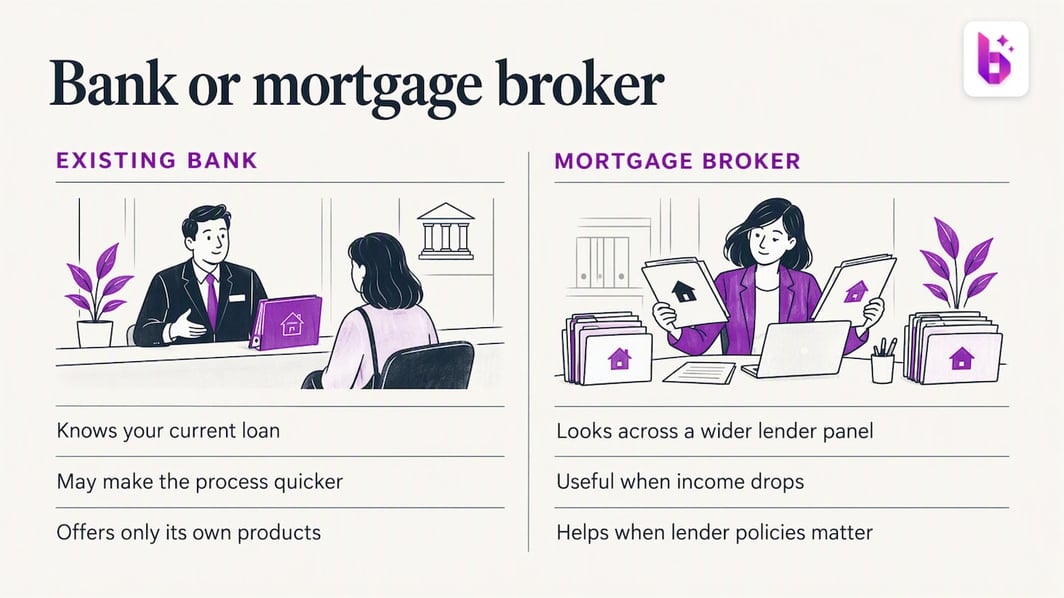
Your current lender can explain its process for removing a borrower and whether you need a new loan. It can also discuss changes to your existing loan, but will only offer its own products.
A mortgage broker can compare lenders on its panel and check how they assess your income and commitments after separation. Ask which lenders they compare, how they are paid and whether they have experience with separation-related refinancing.
Whether you negotiate with your current lender or switch, compare the total costs and requirements. A lender or broker can assess your borrowing options; your lawyer advises on your property settlement.
Wanting to keep the family home is understandable. But taking over the mortgage can mean borrowing more, just as you have less household income to cover it. The question is whether the repayments leave enough for the rest of your life, such as bills, children, unexpected costs and rebuilding your savings. Getting approved matters, but so does being able to manage the loan afterwards.
— Pravin
FAQ
Usually not. In most cases the existing mortgage has to be refinanced into one person's name, and a lender that agrees to a simple name removal is unusual. Speak to you lender to understand their exact requirement.