


Bheja's quick take
- Your lender can reduce your rate to keep your business, and having at least 20% equity and a good credit score gives you more to bargain with, according to Moneysmart.
- Before you call, know your current rate, your lender’s best advertised rate, and a few specific, comparable rates from other lenders.
- Ask for a match to a named rate. If the answer is no, ask for the discharge authority form, which is usually passed to the lender’s retention team.
- Refinancing has costs (fees, possibly lender’s mortgage insurance), so compare the saving with those costs, and keep the loan term similar to what you have left.
Yes, you can negotiate your home loan rate, and in Australia it is one of the few financial conversations that can pay off within a single phone call. The approach is the same each time: find out what your loan costs now, find out what comparable lenders charge, then ask your current lender to match a specific rate. If it will not, you ask for the paperwork to leave, which tends to reach the people who are able to say yes.
This guide sets out how that conversation works, what evidence to bring, what to say, what to check before you switch, and how to estimate what a lower rate is worth to you.
Why a rate negotiation can work
A home loan rate is not fixed for the life of the loan in the way a price on a shelf is. Lenders set advertised rates, then adjust what they charge individual customers depending on competition, risk and how likely a customer is to leave. A borrower who never asks is, by definition, a borrower who is unlikely to leave, and that is often reflected in the rate they pay.
The Australian Competition and Consumer Commission examined this in its home loan price inquiry. It found that the gap between rates on new and existing loans would not have persisted without material impediments to switching. In a well-functioning market, it reasoned, borrowers would move to rates closer to those on newer loans, and lenders would offer existing borrowers lower rates to keep them.
The size of that gap was measurable. As at September 2020, borrowers with loans between three and five years old were paying about 58 basis points more than the average rate for new loans, and those with loans over ten years old were paying about 104 basis points more, according to the ACCC. That is 2020 data, so treat it as evidence of the pattern rather than today’s exact gap. The pattern is what matters: loyalty has often been priced in, sometimes called the loyalty tax.
Step 1: Find out what you are paying and what is available
The strongest negotiating position comes from facts, not frustration. Gather three numbers before you pick up the phone.
- Your current rate and repayment. Check your latest statement, including whether the loan is variable, fixed or split, and how many years remain.
- Your lender’s best rate for a borrower like you. Lenders often advertise lower rates for new customers or for particular loan sizes and loan-to-value ratios. Ask which of those you qualify for.
- Competitive rates across the market. You want specific, comparable figures: the same type of loan (owner-occupier or investment, variable or fixed) and a similar loan-to-value ratio.
The Conversation makes the same point: once you know the best rates around, roughly what your property is worth, and whether you would pass the serviceability buffer, you are in a much better position to call your bank. It also suggests having a list of specific, comparable rates and asking whether your bank can match them.
Our current mortgage rates page is one place to see where the market sits, and the home loans comparison lets you narrow by loan type. If you want to compare against your own loan rather than a generic table, our Home Loan Health Check is built to highlight whether you may be overpaying and to suggest alternatives from the live rates we track.
What the rate environment looks like
Rates move, so always check the day you call. As a guide to the recent range: The Guardian reported in October 2026 that after the latest rate increase was passed on, the average owner-occupier variable rate would be 6.49%, with some lenders offering rates close to 6%. On a $600,000 loan with 25 years remaining, moving from the average to that lower rate would cut monthly repayments by about $180, according to the same report.
The Conversation’s Shaun Bond wrote in November 2026 that a basic variable loan from a major bank should soon sit around 6.6% to 7.0% after the rise, and that if your rate is higher than that, it is worth asking for a better deal or exploring refinancing. That gives you a rough yardstick: a rate noticeably above the range for basic variable loans is a reason to call.
Step 2: Check your own position
Lenders do not just look at the rate you want. They look at who is asking. Two things carry the most weight in a retention conversation.
Equity. Moneysmart notes that having at least 20% equity in your home gives you more to bargain with. Equity is the gap between your property’s value and your loan balance. A rough, current estimate of your home’s value is useful here, and our LVR calculator shows where you stand in a few seconds.
Credit score. Moneysmart also says a good credit score helps with negotiations. If you have not looked at your credit file in a while, do so before you call so there are no surprises.
The serviceability buffer
If you are considering refinancing as your fallback, the buffer matters. Under Australian lending rules, banks must assess your capacity to repay including a 3% minimum serviceability buffer. The Conversation points out that with typical variable rates moving to around 6.6% to 7%, lenders will check your ability to pay rates of even 9.6% to 10%. A loan you comfortably hold today may be assessed differently by a new lender, so it is better to know this before you threaten to leave. Our guide to what a buffer rate is and why it matters explains how it is applied.
Step 3: Make the call
The research behind this guide points to a simple structure for the conversation. A mortgage broker, Tom Uhlich, shared a script with news.com.au built on the same ideas.
- Name a real competitor and a real rate. A vague claim that you have seen cheaper loans gives the lender nothing to respond to. A named lender and a specific rate does.
- Ask them to match it. Be direct about what you want: the rate, not a general review.
- Push past the first offer. The first number you hear is often not the best one. Point out that at the competitor’s rate you would be saving thousands a year, and ask what more they can do.
- Be ready to leave. If the lender will not move, ask for the discharge authority form and say you will be refinancing.
The Guardian quoted a data analyst saying borrowers have a better chance when they talk tough about leaving and call once they know their own rate, their lender’s best rate and better rates across the sector. Better still, she said, is to have an actual offer from another bank.
Why the discharge form matters
According to Uhlich, the discharge authority form is passed to the bank’s retention team, which he described as a different beast from the home loan pricing team because its whole job depends on saving loans. He noted that some lenders, including ANZ and BOQ, offer around $2,000 in retention cash to keep customers. Treat that as a possibility rather than a promise: offers vary by lender and by time.
Discharge is also a process the ACCC has pushed to make easier. It recommended that lenders provide a standardised Discharge Authority form and complete the discharge process within 10 business days, as set out in its 2020 findings. Asking for the form is a normal request, not an aggressive one.
A short worked example
Suppose you have a $600,000 variable loan with 25 years left at 6.49%, and the lowest variable rate you can find from a comparable lender is 6.24%. By our own arithmetic, the monthly repayment would fall by roughly $90 at the lower rate, or a little over $1,000 across a year. That is an illustration to show the method, not a quote. Your figures will differ with your balance, remaining term and the lender’s actual offer.
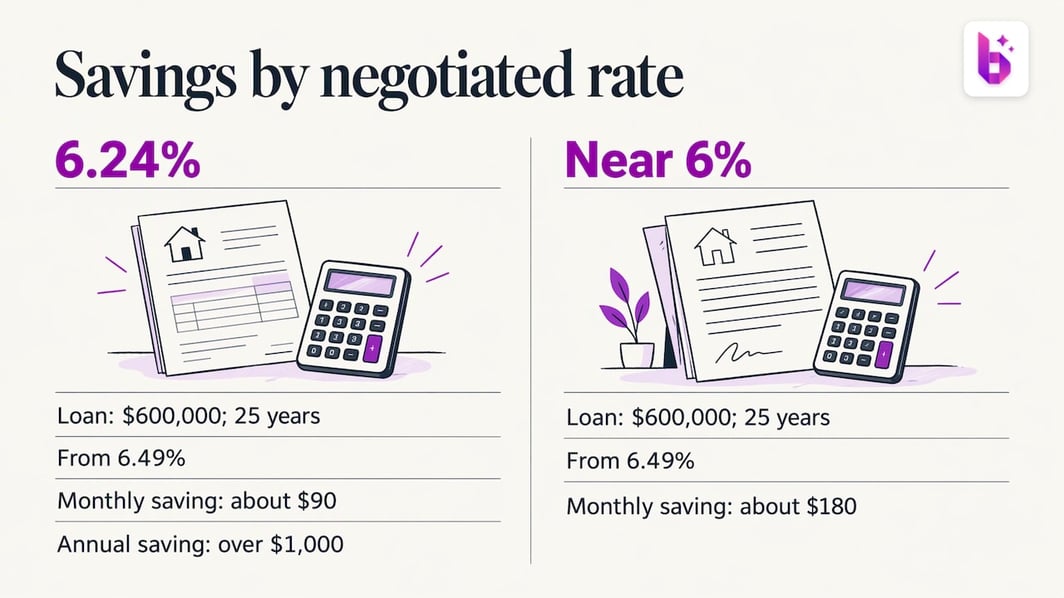
Now compare it with the larger gap in The Guardian’s example: from 6.49% to near 6%, the same loan would save about $180 a month.
Step 4: Decide between negotiating and refinancing
Negotiating is quick and costs nothing. Refinancing may save more but involves paperwork and fees. The decision turns on the size of the saving relative to the cost of moving.
Moneysmart lists the costs to check when switching:
The Guardian reports that switching can take over a month and typically costs more than $1,000, although the one-time fees may be offset by the longer-term benefit of a lower rate. A simple test: divide the total switching costs by your monthly saving. The result is the number of months before you are ahead. If that number is small compared with how long you plan to keep the loan, switching is worth a serious look.
Our refinance calculator helps with that comparison, and our guide on whether to negotiate or switch lenders goes deeper on the trade-offs. If you decide to move, the refinance process, step by step shows what happens after you apply.
Keep the loan term in check
If you do switch, Moneysmart advises being firm on the length of loan you want. Otherwise you could end up with a longer term than the years you have left on your current mortgage, and the longer you hold a loan, the more interest you pay. Negotiate a loan with a similar length to your current one, even if a longer term would lower the repayment.
Features, not just rates
A lower headline rate is one part of the picture. Check whether you would lose features you use, such as an offset account, redraw or the ability to make extra repayments. Our offset account calculator and extra repayments calculator show how those features affect interest. If you are deciding between loan structures, our guides to fixed versus variable rates and the types of home loans in Australia cover the main options.
When to negotiate
There is no wrong time to ask, but some moments give you more leverage.
- After a rate rise or cut. Lenders adjust at different speeds and by different amounts, so the gap between your rate and the market can open quickly.
- When your loan is a few years old. The ACCC’s research found the gap widened with the age of the loan. It recommended that lenders prompt borrowers with loans older than three years to review their rate.
- When a fixed term is about to end. Rolling onto a standard variable rate without comparing is a common point at which people begin paying more. Our guide on the best time to refinance covers this.
- When your equity has grown. If your loan-to-value ratio has fallen, you may qualify for a better rate band than when you started.
Many borrowers don't realise they can renegotiate during the loan term at all. You do not need to wait for a trigger, and it is reasonable to repeat the exercise every year or so.
What if the lender says no?
Then you have two clear paths. You can ask for the discharge form and request that your case go to the retention team, as described above. Or you can apply with another lender, ideally with a broker who is licensed in Australia and who has an obligation to act in your best interests. If your lender will not match a rate you have evidence for, refinancing is the logical next step.
One caution applies at this point. A new lender will run its own assessment, including the buffer, and may value your property differently from your current lender. Having your numbers ready speeds the process up.
How Bheja fits in
In our experience of how people approach this, the hard part is rarely the phone call. It is finding out whether you are overpaying and knowing which rate to quote. That is where we help.
We connect to your loan data through open banking, compare it with more than 6,500 live rates from more than 90 lenders, and highlight where you may be paying more than you need to. Our monitoring is designed to alert you when a saving opportunity appears, so you are not relying on memory or a once-a-year check. If you want help with an application, we connect you with licensed Australian mortgage brokers.
Start with the Home Loan Health Check to see how your rate compares, then use our refinance service if you decide to move. Prefer to check the numbers yourself? Our mortgage calculators cover repayments, borrowing capacity, offset accounts and the costs of buying or selling.
Our perspective
Most borrowers do not overpay because they are careless. They overpay because comparing their own loan with the whole market is slow, and nobody tells them when the gap has opened.We built Bheja around that problem. Looking at a table of advertised rates is useful, but it says little about your loan, your equity and your remaining term.
When we analyse your actual loan data through open banking, the comparison becomes personal, and so does the argument you can make to your lender. Our view is that a negotiation is strongest when it rests on a specific rate from a named lender, and that continuous monitoring beats an annual review. Rates change, and so does your equity.
A prompt when a saving appears means you can call at the right moment, with evidence in hand, whether the outcome is a lower rate from your current lender or a switch with the help of a licensed broker.
FAQ
Yes. Moneysmart explains that you can tell your current lender you plan to switch to a cheaper loan elsewhere, and the lender may reduce your rate to keep your business. Equity of at least 20% and a good credit score strengthen your position.