


- Usable equity is generally up to 80% of your property’s value, less what you owe. A $400,000 home with a $220,000 loan has about $100,000 of usable equity.
- Borrowing beyond 80% may attract lenders mortgage insurance (LMI), and the lender’s own valuation and serviceability checks decide the approved amount.
- Refinancing can involve break fees, discharge fees, application fees and, in some cases, stamp duty, so the overall saving needs to survive these costs.
- On an investment property, interest deductibility depends on what you do with the cash, not on the refinance itself.
- Keeping released funds in a separate loan split makes both repayments and tax records easier to follow.
A cash-out refinance means taking out a new home loan, or increasing an existing one, for more than you currently owe, and receiving the difference as cash. The amount you can access depends on your property’s value, your lender’s loan-to-value ratio (LVR) limit, and whether your income supports the larger debt. Most lenders work to about 80% of the property’s value, so the usable amount is that figure less your current balance. The cash is new borrowing, which means it carries interest, fees and repayments of its own.
What a cash-out refinance is and how it works
Equity is the difference between what your property is worth and what you owe against it. If your home is valued at $800,000 and your mortgage balance is $500,000, your total equity is $300,000. Not all of that can be borrowed against, because lenders generally cap lending at a percentage of the property’s value.
In a cash-out refinance, you apply for a new loan that is larger than your existing balance. The new loan first pays out the old one, including any fees, and the remainder is paid to you or to a nominated account. Two variations are common:
Refinance with another lender. You apply for a larger loan that pays out your existing mortgage and provides the additional funds. The new lender assesses your finances and the property’s value before deciding whether to approve it.
Increase your existing loan. You apply to your current lender for a top-up or higher limit. It assesses whether you can afford the extra borrowing and have enough equity. Approval is not automatic.
The extra borrowing can also be set up as a separate loan split, either with your current lender or when refinancing. This is a way to structure the borrowing, rather than a third way to access equity.
The additional funds sit in a separate loan account, which may have its own rate, term and repayment arrangements. This can make it easier to track how the money is used—particularly for investors, as we explain in the tax section below.
Our guide to types of home loans in Australia explains the main loan structures and features.
How much equity can you release?
The standard guide is 80% of the property value, less your current loan. Westpac states that lenders will generally consider lending up to 80% and that usable equity is typically calculated as the property value multiplied by 80%, less the amount owed. That is a general rule of thumb. Individual lenders, properties, loan purposes and loan structures can all produce different limits.
A worked example
Suppose your home is valued at $400,000 and your loan balance is $220,000. Eighty per cent of the value is $320,000. Subtract the $220,000 you owe and your usable equity is $100,000. NAB uses the same example to illustrate the calculation.
Now a second case, with a larger property. Your home is valued at $1,000,000 and you owe $550,000.
This is a scenario, not an approval. The lender will commission its own valuation, which may be higher or lower than your estimate, and it may approve a smaller amount after checking your income, expenses and other debts.
What happens above 80%
Borrowing more than 80% of the property value may mean paying LMI. NAB notes that, when buying a new property, avoiding LMI usually requires a 20% deposit. Some lenders will lend above 80% for particular purposes, but the cost of LMI is added to the overall borrowing. Your LVR can be tested with a loan-to-value ratio calculator before you apply, so you know where a given amount would land.
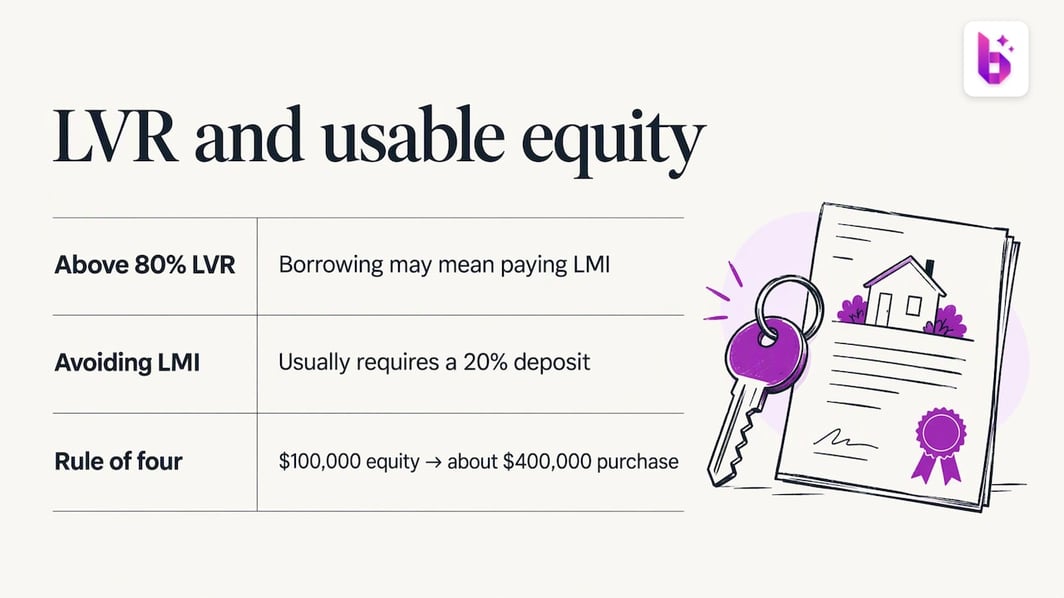
You may also come across the “rule of four”. NAB describes multiplying usable equity by four to estimate a possible property purchase price. For example, $100,000 in usable equity suggests a price of around $400,000.
At that price, a 20% deposit would be $80,000, leaving $20,000 towards purchase costs. Actual costs may differ, and the rule does not assess whether you can afford the repayments. The equity you access is also borrowed money that must be repaid.
What lenders assess before approving the extra borrowing
A cash-out application is a request for new credit, and Australian lenders are obliged to treat it that way. ASIC’s Regulatory Guide 209 says licensed lenders and brokers must make reasonable inquiries about your financial situation, verify the information, and must not provide or recommend credit that is unsuitable for you. This applies to new credit and to credit limit increases.
In practice, you can expect the lender to look at:
- The property: an independent or automated valuation, the property type and location.
- Your income: payslips, tax returns or business financials, and rental income if the property is an investment.
- Your expenses and debts: living costs, credit cards, personal loans and any other mortgages.
- The purpose of the funds: renovations, an investment deposit, debt consolidation or something else. Purpose can affect both approval and pricing.
- Your credit history: repayment behaviour on existing loans and cards.
The approved amount is often lower than the theoretical usable equity. Strong equity doesn't guarantee you can borrow against it, and NAB makes the same point: plenty of equity doesn't mean a lender will say yes.
Common uses, and when releasing equity may suit you
Borrowers typically release equity to:
- renovate or extend the home, which may lift its value;
- fund the deposit and costs on an investment property;
- consolidate higher-interest debts such as credit cards or personal loans;
- cover large, planned expenses such as education or a vehicle.
It tends to suit people who have a clear purpose, a stable income that comfortably covers the larger repayments, and a plan for the loan beyond the first year. Moneysmart, ASIC’s consumer site, takes the view that refinancing is worthwhile only when the overall benefit holds up after interest, fees and term are counted, and that a lower advertised rate alone does not prove a better outcome. That principle applies strongly to a cash-out, where the loan is also getting bigger.
For investors, NAB cautions against using every cent of usable equity if you have no other funds. Keeping a buffer in case rents fall, rates rise or a property sits vacant is a sensible way to structure the borrowing. Our guide to the best time to refinance covers the timing question in more detail.
A note on the partner example
If you are modelling how an Australian lender may view your own equity position, this walkthrough of lender and ATO checks shows how a cash-out is assessed for an investment property, including a worked lender example.
What it costs to refinance and release equity
The cash itself is borrowed money, but there are also costs of switching. Moneysmart lists the costs that can apply when you switch home loans: fixed-rate break fees, discharge fees, application fees, switching fees and, in some circumstances, stamp duty. It advises comparing the new loan’s rate, fees, term and repayments with your existing loan before you proceed.
Westpac also lists refinancing costs, valuation fees and potentially LMI among the costs of releasing equity. A practical way to check the economics:
A refinance calculator can do the first three steps in a few minutes, and the home loan repayment calculator shows how a larger balance changes repayments. If you're weighing a switch against a conversation with your current lender, see whether to negotiate or switch.
The risks to manage
The main risks follow from the loan being larger and secured against your home.
- Higher repayments and a longer term. Westpac lists higher repayments, extended loan length and potential financial stress among the risks of equity release. Stretching a loan back out to 30 years lowers each repayment but increases the total interest paid.
- Converting unsecured debt to secured debt. Moneysmart explains that moving credit card or personal loan debt into your mortgage puts your home at risk if you cannot repay, and that a longer term can raise the total cost even as repayments fall. If you consolidate, consider making extra repayments on that portion so it does not linger for decades.
- Negative equity. Westpac warns that if your property’s value later falls below your loan balance, you may be in negative equity. The more of your equity you release, the thinner your margin for a price fall.
- Rate movements. A larger loan magnifies the dollar effect of each rate change on a variable loan.
These are reasons to size the borrowing to a clear purpose and to keep a buffer, not reasons to avoid assessing the option. Extra repayments and offset accounts can both reduce the interest on the released funds, and the extra repayments and offset account calculators show the effect for your numbers.
Releasing equity from an investment property: tax treatment
With an investment property, the tax treatment of the interest depends on what you use the cash for. The ATO says that interest on borrowed money can be claimed to the extent the funds are used to earn assessable income, such as buying, repairing or renovating a rental property. Interest on funds used for private purposes is not deductible, and where the purpose is mixed, the interest has to be apportioned.
Three examples show how this works in practice:
A refinance doesn't create a deduction by itself. The test is the purpose of the borrowed funds, not the property that secures the loan. That's why it helps to draw the cash-out as a separate split, rather than topping up a single loan that also holds earlier, deductible borrowings. A loan used partly for private and partly for investment purposes means apportionment calculations that may continue for the life of the loan.
This is general information, not tax advice. Before you structure a cash-out against an investment property, speak with a registered tax agent or accountant about your own situation.
Step by step: applying for an equity-release refinance
- Estimate your equity. Use a recent valuation or comparable sales, and apply the 80% guide to see indicative usable equity.
- Define the purpose and the amount. Borrow what you need rather than the maximum available.
- Review your current loan. Check for fixed-rate break costs, discharge fees and any features, such as an offset account, you would lose.
- Compare loans. Look at the rate, fees, features and repayment type, not only the headline rate. Our step-by-step comparison guide explains what to weigh.
- Prepare documents. Income evidence, identification, statements for all debts and details of your property.
- Apply and arrange the valuation. The lender values the property and assesses your application.
- Settle. The new lender pays out the old loan and releases the cash. The refinance process is outlined in full on our site.
Our perspective
Equity release is often discussed as a single decision, but it is really three decisions made together: whether to switch or stay, how large the new loan should be, and how the borrowing should be structured. The first is where many Australian borrowers lose money without noticing. A loan that was competitive at settlement may have drifted well above current market pricing, and that gap is a cost whether or not any cash is released.
For that reason, we think the sensible order is to check the existing loan first. If the rate is higher than comparable loans, a refinance that also releases equity can address both problems at once. If it's already competitive, the case for borrowing more has to rest on the purpose of the funds, not on the equity merely being there.
Bheja is designed to help with the first step. By connecting to your loan data through open banking, it highlights whether you appear to be overpaying and compares your loan against more than 6,500 live rates from over 90 lenders. Where a refinance makes sense, licensed Australian mortgage brokers can support the application. Ongoing monitoring and alerts are intended to keep the comparison current after you have decided.— Pravin
Check your loan before you borrow more
Before deciding how much equity to release, it helps to know whether your current loan is competitive. The Home Loan Health Check uses your open banking data to show whether you may be paying more than you need to, and our refinance page explains how to move to a better loan, with licensed brokers available to support the application.
Once you have switched, home loan monitoring can alert you to future savings opportunities so a good rate stays a good rate.
FAQ
In Australian usage the terms are generally used for the same idea: borrowing more against your property than you owe and taking the difference as cash. The mechanism may be a refinance to a new lender, an increase with your current lender or a separate loan split. It is different from retirement equity-release products for older homeowners, which work under separate rules.