


- A guarantor is released when the lender is satisfied that the loan is adequately secured by your property and you can service it alone. The usual benchmark is a loan-to-value ratio (LVR) at or below 80%.
- There are two paths: ask your current lender for a release, or refinance into a new loan in your name only. The right one depends on your equity, your income and the lender’s policy.
- Expect a valuation, a credit assessment and paperwork signed by everyone on the loan. Release can take weeks, and fees may apply.
- The guarantor stays legally liable until the release is formally completed, so do not treat a verbal agreement as the end of the guarantee.
Removing a guarantor from a home loan requires lender approval and does not happen automatically. Typically, a guarantor is released in one of two ways: either your current lender agrees to release them once your loan-to-value ratio (LVR) falls to around 80% or less, or you refinance the loan solely in your name. In both cases, the lender will assess whether you can manage the loan repayments independently.
What a guarantor actually does on your loan
A family guarantee lets a close relative, usually a parent, use equity in their own home as extra security for your loan. NAB explains that the guarantor offers equity in their property instead of cash, and that the guarantee commonly covers the gap between your deposit and 20% of the purchase price. It does not reduce your repayments. It simply lets the lender treat the loan as lower risk.
Loan structures vary between lenders. For instance, Bankwest explains its Family Guarantee as comprising two separate loans: typically, 80% of the loan is secured by the property you are purchasing, while the remaining 20% is secured by both that property and a portion of the guarantor’s home equity. According to Credit Union SA, their guarantee only covers the amount necessary to reduce the loan-to-value ratio (LVR) to 80%.
This matters for removal. If the guaranteed portion is a clearly defined slice of the debt, the release question becomes: has that slice been repaid, or has the property value risen enough, that the lender no longer needs the guarantor’s property as security?
How to release a guarantor, and why lenders are cautious
Acting as a guarantor can affect a parent’s finances long after their child buys a home. If the borrower cannot repay, the guarantor may have to cover the amount guaranteed. Any property provided as security could be at risk, and the guarantee may limit the guarantor’s ability to borrow. NAB also warns that an unpaid loan followed by bank action can affect the guarantor’s credit score.
Removing the guarantee ends that responsibility and releases the property securing it. However, the lender must agree to the release. It will need to establish that the loan meets its requirements without the additional security.
The process varies between lenders. Some lenders may allow a borrower to request release when its loan-to-value requirements are met, while others may require an internal refinance. Depending on the lender, a new valuation and an assessment of the borrower’s finances may be required
How much equity do you need to release a guarantor?
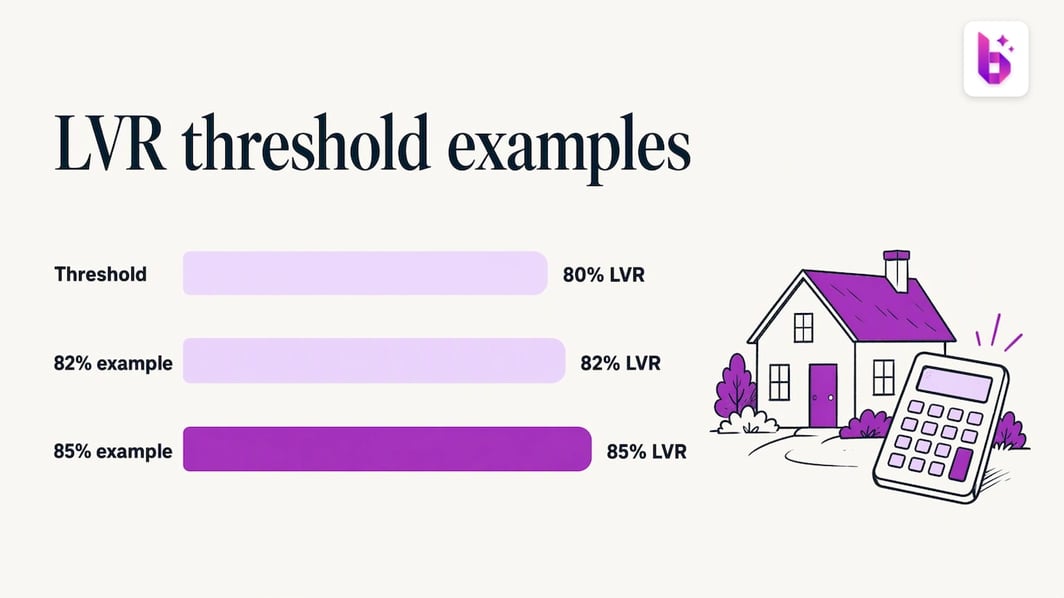
Lenders commonly consider releasing a guarantor when the loan is around 80% or less of the borrower’s property value. However, reaching that level does not automatically release the guarantee.
This percentage is your loan-to-value ratio, or LVR. For example, a $480,000 loan on a property valued at $600,000 has an LVR of 80%. If the lender values the property at $650,000, the same loan has an LVR of about 74%.
The exact requirements depend on your lender:
- IMB allows a release request when the loan falls below 80% of the purchased property’s value, based on an independent valuation by an IMB panel valuer. Approval remains at IMB’s discretion.
- Westpac says borrowers can request release once the required LVR of less than 80% is reached. Its criteria also include the borrower not being in default and the remaining loan not requiring LMI.
The lender may also review your finances and repayment history before agreeing to the release.
How can your LVR fall?
Your LVR can fall as you repay the principal, if the property’s value increases, or through a combination of both. Property values can also fall, so growth cannot be assumed.
Extra repayments can reduce the balance sooner, subject to your loan’s conditions. The extra repayments calculator can show the potential effect on your balance, interest and repayment period. Extra payments don't necessarily reduce your minimum monthly repayments.
Some guarantor arrangements have a separate loan split for the guaranteed portion. The conditions for releasing that security depend on the lender and guarantee documents. When comparing changes to the structure, consider loan splits and potential break costs.
The lender will use an accepted valuation to assess the property’s value. An online estimate alone does not establish that you meet its release requirements.
For more on reducing the balance, see these ways to pay off a home loan faster.
Option 1: Request a release from your current lender
You may be able to remove the guarantee without switching lenders. Your current lender will assess whether the loan can continue without the guarantor’s support.
It may require a property valuation, updated income and expense information, and a review of your repayment history. For example, Macquarie’s published process says removing a guarantor usually requires a full credit assessment of the remaining borrowers.
The lender can explain whether it will process the request as a variation or require a new application, along with the fees and expected timeframe.
The guarantor remains liable under the guarantee until the lender formally releases them. A lower LVR or an informal agreement doesn't end that liability.
Option 2: Refinance without a guarantor
Another option is to replace the existing loan with one that does not require a guarantee. This could be with your current lender or a different lender.
The lender will assess your income, expenses, debts, credit history and property value. An LVR of 80% or less may help avoid LMI, but it does not guarantee approval.
Refinancing may also provide an opportunity to change your rate or loan features. However, a lower rate doesn't automatically outweigh the costs of moving.
At settlement, the new loan pays out the existing debt. The release of the guarantee and any security over the guarantor’s property should be confirmed as part of that process.
What could refinancing cost?
Costs may include:
- Discharge fees on the existing loan.
- Break costs if a fixed-rate loan ends early.
- Application, valuation or settlement fees on the new loan.
- Government mortgage registration and discharge charges.
- LMI, if required.
Your payout figure includes the outstanding balance and interest owed up to settlement, as well as applicable charges. The loan balance itself is not a refinancing fee.
Comparing loans over the same remaining term helps show whether the savings outweigh the switching costs. Extending the term may lower repayments while increasing total interest.
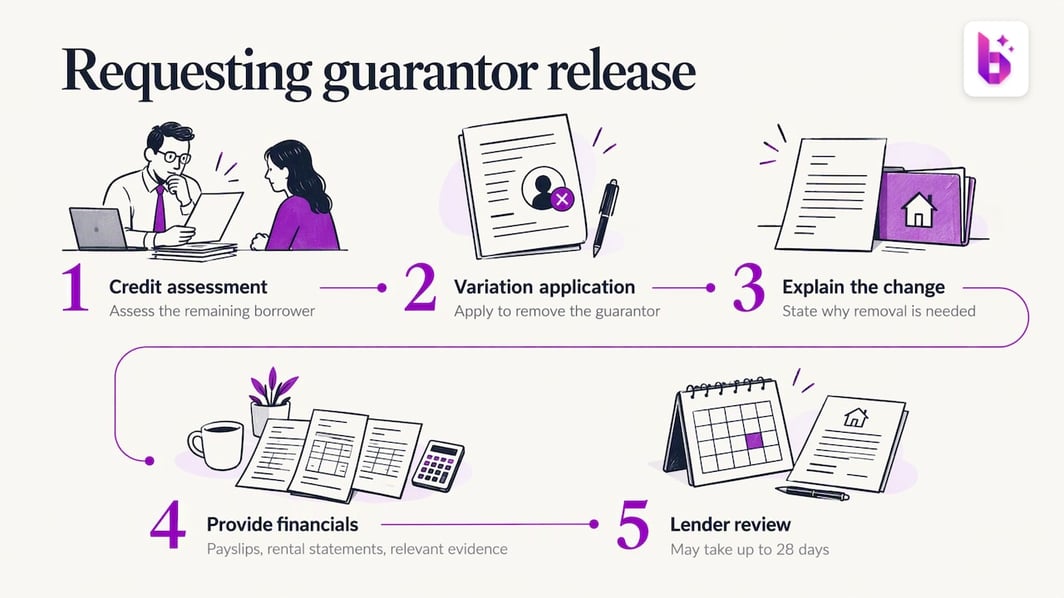
Step by step: removing a guarantor
The order below works for either path. Where we can take work off your hands, we say so.
Step 1: Find your actual loan balance and the guarantee terms
Find your current loan balance and review the guarantee documents. Check how much the guarantee covers, whether it supports a separate loan split and what conditions apply to its release. A capped guarantee and a separate loan split are different features—your arrangement may have both.
If the release conditions are unclear, ask your lender to explain them.
Step 2: Estimate your LVR
Divide your outstanding loan balance by the estimated current value of your property, then multiply by 100. For this estimate, use the property you purchased, excluding the guarantor’s property.
For example, a $480,000 loan on a property worth $600,000 has an LVR of 80%.
An LVR around or below 80% may meet one of the lender’s release requirements, but it does not guarantee approval. The lender’s accepted valuation and other assessment criteria will determine whether the guarantee can be released. Our LVR calculator and other mortgage calculators let you run these numbers quickly.
Step 3: Check you can service the loan alone
The lender will assess your income, debts and living expenses without the guarantor’s support. Bankwest lists servicing the total repayments as an eligibility condition for its guarantee, and the same logic runs in reverse at release. Our borrowing capacity calculator can help you run your numbers.
Step 4: Decide between release and refinance
Your current lender may be able to release the guarantor without replacing your loan, subject to its assessment. Refinancing is another option, but any rate saving needs to be weighed against switching costs and the new loan’s term.
Bheja’s Home Loan Health Check uses the loan details you provide to compare your current rate against more than 6,500 live rates from over 90 lenders and estimate potential savings. You can also securely connect your loan through Open Banking for ongoing monitoring and alerts when a lower rate becomes available.
If you want to explore refinancing to remove a guarantor, a licensed mortgage broker can assess your eligibility, the lender’s requirements and switching costs.
Step 5: Gather your documents
The lender may ask for identification, income evidence, bank statements and current loan statements. If you receive rental income, it may also request rental statements. Other documents will depend on your circumstances.
If you refinance through Bheja, securely connecting your accounts through Open Banking can prefill much of your application. A licensed mortgage broker can review the information and help you provide any additional documents the lender requires.
Step 6: Apply and arrange the valuation
Your lender may require a valuation to assess whether the guarantor’s property can be released as security. If you refinance, the new lender will also assess the value of your property.
A lower valuation means a higher LVR and could affect approval. The lender may require the loan balance to be reduced before agreeing to the release. Valuation and release or discharge fees may also apply, so ask for the costs when submitting your request.
Step 7: Sign the discharge or release paperwork
On a refinance, the old lender needs a discharge authority. CommBank’s process is to complete the form online, print it, have all borrowers and guarantors sign it, then email it or drop it at a branch. The guarantor must sign too, so line up their availability early. Solicitors or conveyancers handle settlement coordination, so plan around that timing rather than asking by phone.
Step 8: Confirm the release in writing
After settlement or variation, ask for written confirmation that the guarantee is discharged and the guarantor’s property is no longer security. It's advisable for the guarantor to keep this letter. It's also advisable for guarantors to seek independent legal advice before signing any release or guarantee document, as the lender cannot advise them.
How long it takes
Timing depends on the lender and whether you request a release or refinance. The lender may need updated documents, a valuation and a credit assessment before approving the change. Refinancing also involves approval and settlement of the new loan, so the process can take several weeks. Ask your lender or broker for an estimated timeframe.
Common mistakes
- Assuming the guarantee ends when the balance looks low. It ends only when the lender formally releases it.
- Relying on your own valuation. The lender’s valuer decides the figure used.
- Missing a signature. Incomplete discharge forms hold up processing.
- Forgetting fees on the old loan. Early repayment or break costs can reduce the benefit of leaving.
- Refinancing to remove the guarantor while ignoring the rate. If you are already applying for refinance, it can also be an opportunity to review your rate.
Our perspective
A family member’s guarantee does not end automatically as you repay your loan. It is worth knowing what your lender requires for release, rather than assuming the guarantee is still needed—or that enough time has passed.
There are two options to explore: asking your existing lender to release the guarantee, or refinancing into a loan that does not require one. Refinancing may also offer a different rate, but the costs and approval requirements still matter.
Bheja’s Health Check helps with the rate comparison. A broker can then assess potential refinancing options, while the lender decides whether it can approve the loan without a guarantor. Whichever route you take, the release needs formal confirmation.
- Pravin
FAQ
Often yes, if your lender has a release process and your loan meets its criteria, typically an LVR at or below 80% and proof you can service the loan alone. Lenders such as IMB and Credit Union SA require an application and a valuation, and release is at the lender’s discretion.