


- There is no legal cap on refinancing frequency in Australia, and you can refinance at any point after settlement.
- Many lenders suggest holding a loan for around two years so you can build equity and recover upfront costs, but a good reason can justify moving sooner.
- Fees, break costs on fixed rates, lenders mortgage insurance (LMI) and credit enquiries are some factors to consider before refinancing.
- Divide your total switching costs by your monthly saving to get a break-even period, then compare it with how long you expect to keep the loan.
- Review your loan regularly, and refinance when the numbers justify it, not on a fixed schedule.
You can refinance as often as you like. Australian lenders do not set a legal limit, and Westpac says you can refinance at any time after settlement, with no rule against doing it more than once a year. The practical limit is financial: every switch can carry fees, a credit enquiry and a period before the savings repay those costs. The better question is not “how often am I allowed to?” but “does this particular switch save more than it costs?”
This guide explains what governs timing, how soon you can refinance after buying, how to calculate a break-even point, and the situations where a second or third refinance is reasonable.
Is there a limit on how many times you can refinance?
There is generally no set limit on how often you can refinance your home loan. Each application is subject to the lender’s approval criteria, and waiting periods or other conditions may apply.
Refinancing frequently can reduce the benefit of switching. Discharge, application and possible fixed-rate break costs can add up, particularly if you switch again before recovering the previous costs. NAB highlights fees, credit enquiries and the time needed to recover switching costs as considerations.
Applications involving a credit check can leave an enquiry on your credit report. Several applications in a short period may affect your credit score and how lenders assess a later application.
What can limit your ability to refinance?
There may be no set limit on refinancing, but four factors can affect whether another switch is possible or worthwhile:
- Switching costs. Discharge fees, application fees and any fixed-rate break costs can outweigh the savings. Switching again before recovering the previous costs can reduce the benefit further.
- Your equity. With less than 20% equity, you may need to pay LMI, unless an exemption applies. This can add substantially to switching costs and outweigh potential savings.
- Your current finances. The new lender will assess your income, expenses, debts and repayment history. Approval for your existing loan does not guarantee approval for another.
- Your application history. Several credit applications in a short period may affect your credit score and how lenders assess you. Frequent refinancing and multiple applications can raise concerns, but there is no universal annual application limit.
How soon can you refinance after buying a home?
Technically, straight after settlement. Nothing stops you legally from applying a week or a day after your purchase settles. Whether you should is a separate matter.
There are a few reasons a new loan is a weaker candidate for an immediate switch:
- Low equity. Right after purchase, many borrowers have a high loan-to-value ratio (LVR). If it is above 80%, a new lender may charge LMI, and that cost can outweigh a lower rate.
- Recent credit activity. You have just completed a full loan assessment. Another application soon after adds a further credit enquiry.
- Upfront costs not yet recovered. If you paid fees to set up the first loan, a quick move means paying a second set before the first has paid off.
Holding on for a couple of years can help you build equity and recover upfront costs, although refinancing earlier can be right when there is a good reason. A realistic reason might be that your lender’s rate has become uncompetitive, your fixed term has ended, or your circumstances have changed.
Can you refinance again after three months?
It may be possible, subject to the new lender’s approval criteria and any minimum loan-history requirements. There is no universal three-month waiting rule.
The main question is whether another switch is worthwhile. Include any discharge fees, fixed-rate break costs, new loan fees and possible LMI, then compare these with the expected savings over the time you plan to keep the loan. Having less than 20% equity or facing a fee does not automatically rule out refinancing, but either can make it more expensive.
What does each refinance cost?
Each refinance can involve another set of fees, which may reduce or outweigh the savings from a lower rate. Costs vary depending on your existing loan, the new lender and government charges in your state or territory.
As a broad guide, Unloan puts typical refinancing fees at $500–$2,000. Its breakdown includes application fees of $0–$750, discharge fees of $150–$500, valuation fees of $50–$600 and settlement fees of $100–$400, plus title search and registration charges. Not every fee applies to every refinance, and some lenders waive certain charges.
Your total could be substantially higher if fixed-rate break costs or lenders mortgage insurance apply. NAB outlines the main refinancing costs, including fees for closing the existing loan and establishing the new one.
When requesting a payout figure, distinguish switching fees from money you already owe. CommBank explains that its payout figure includes the outstanding balance and accrued interest alongside applicable fees. The balance itself is not a refinancing cost.
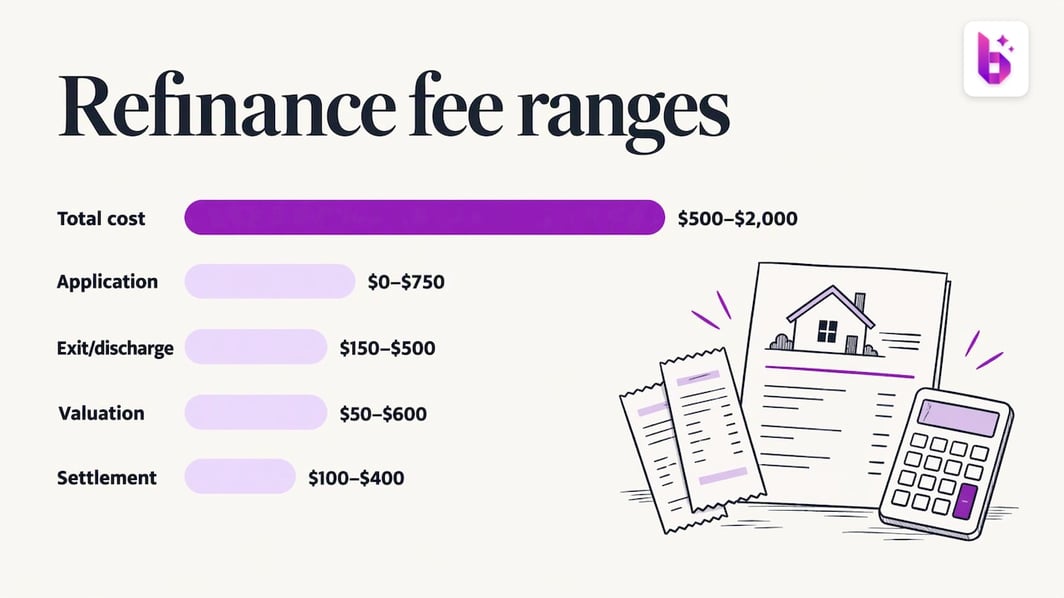
Treat any range as a starting point. Your own quote from the old and new lender is the figure that matters, and fixed-rate break costs can be well above the typical range.
Costs on a $300,000 loan
A smaller loan does not mean smaller fees, because most charges are flat. On a $300,000 balance, a $1,500 switching cost is 0.5% of the loan. That is why the rate gap has to be wide enough, and the loan long enough, to repay it. Our refinance calculator helps you test this with your own balance and rate.
How to work out your break-even point
A break-even calculation tells you how many months it takes for the saving to repay the cost. The formula is simple:
Total switching costs ÷ monthly repayment saving = months to break even
Before refinancing, it helps to consider whether the expected savings outweigh the costs, including the time to recover them. Here is a worked example with hypothetical figures.
The figures are illustrative only, and the monthly saving depends on your remaining term and repayment type.
How often should you refinance?
An exact schedule does not exist, but a pattern is common. Teachers Mutual Bank suggests it is usually worth reviewing your loan every couple of years rather than reacting to every small rate movement. Repeated refinancing usually means paying fees each time.
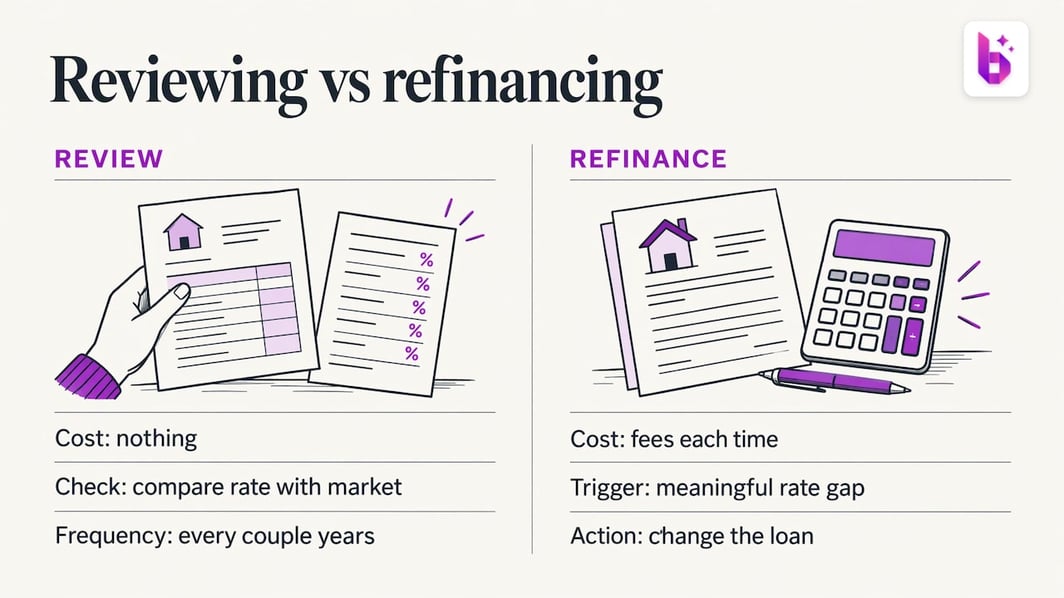
The key distinction is between reviewing and refinancing. A review costs nothing: you check your rate against the market, and you may only act if the gap is meaningful. A refinance is the action that carries costs.
Moments when a review is worth doing
- An introductory or fixed rate is ending. The rate that follows is often higher than what new customers are offered.
- The RBA moves the cash rate. Lenders do not pass changes on equally, so your gap to the market can change.
- Your equity has increased. Paying down the loan or a rising property value can move you under 80% LVR and open up sharper pricing.
- Your circumstances have changed. A new income, a move from owner-occupier to investor, or a plan to renovate can change what loan suits you.
- Your lender has not improved your rate. Before switching, it is worth asking whether your current lender will match a better offer. We compare both paths in negotiating a better rate or switching lenders.
When refinancing again is probably too soon
Another refinance may offer little benefit if the switching costs exceed the expected savings over the time you plan to keep the new loan. Large fixed-rate break costs can also make switching less worthwhile.
Recent credit applications are another consideration. Several applications in a short period may affect your credit score and how lenders assess you, but there is no set number that automatically makes another application too soon.
The question is whether the next switch offers enough benefit to justify its costs, not simply how long it has been since the last one.
What to check before you refinance a recent or fixed loan
Run through these questions before you lodge an application:
- Does my current loan have a fixed term? If so, ask for a break cost estimate in writing. Moneysmart’s guide to switching home loans is a sound checklist for fees, loan terms and LMI.
- What is my current LVR? Use a valuation estimate and your current balance. Below 80%, you are better placed.
- What are my exit and discharge costs? Ask your lender for the exact figures.
- What will the new lender charge? Include application, valuation and settlement fees.
- How long will I keep this loan? A saving that takes 24 months to recover is poor value if you plan to sell in 18.
- Have I made other credit applications recently? Frequent applications can concern lenders.
It also helps to know how long the process takes. Teachers Mutual Bank says most refinances take from a couple of weeks to over a month depending on the lender, paperwork and valuation. AMP says settlement usually takes around 2 to 3 weeks after approval, while Ubank says approval to settlement generally takes about 2 to 4 weeks. Our step-by-step refinance process shows what happens at each stage.
Our perspective
Most guidance on refinancing frequency gives a rule of thumb, such as every two or three years. We think the better rule is to measure. A loan that was competitive at settlement can drift away from the market without any single event that tells you so, and many borrowers only notice when they search for a rate by chance.
That is why we built Bheja around ongoing monitoring rather than a one-off comparison. By connecting to your actual loan through open banking data, we can compare what you pay with more than 6,500 live rates from over 90 lenders, and highlight whether you may be paying a loyalty premium. If a better option appears, you can be alerted, then decide whether the saving outweighs the cost of moving.
Our aim is not to encourage more refinancing. It is to make each decision an informed one: you know your gap, you know your break-even, and you switch only when the numbers support it. Where you want to proceed, licensed brokers can help with the application.— Pravin
Check your loan before you decide
If you are unsure whether it is worth moving again, start with the Home Loan Health Check. It reviews your loan against the live market so you can see whether you may be overpaying, and our refinance service connects you with licensed brokers if you decide to go ahead. You can also ask a question through Ask Bheja.
FAQ
There is no set number, but it might be too often when the costs of a new switch exceed the saving over the time you will keep the loan. Multiple applications within a year may also raise concerns for lenders. Check your break-even before each move.