


- Ask for the broker’s credit licence or credit representative details and verify them on ASIC’s Professional Registers before the first meeting.
- Brokers are usually paid by the lender, so you generally pay no direct fee. If a fee does apply, it should be set out in a written quote you sign before any services are provided.
- Ask for a written list of the lenders the broker can arrange loans with, and ask which lenders they cannot access.
- Ask for more than one option, including the lowest-cost loan, and ask why each one is in your best interests.
- It can help to do your own independent research, even when you're working with a broker, so you can make an informed decision.
Choosing a mortgage broker involves checking their licence or credit representative status, understanding how they are paid and finding out which lenders they can access. The loan options they present, and their reasons for recommending one, can also help you assess their approach.
Australian mortgage brokers must act in your best interests when providing credit assistance. However, their lender access, experience and services can differ. This guide explains what to check, questions to ask and how brokers differ from comparison websites.
What a mortgage broker does, and what they owe you
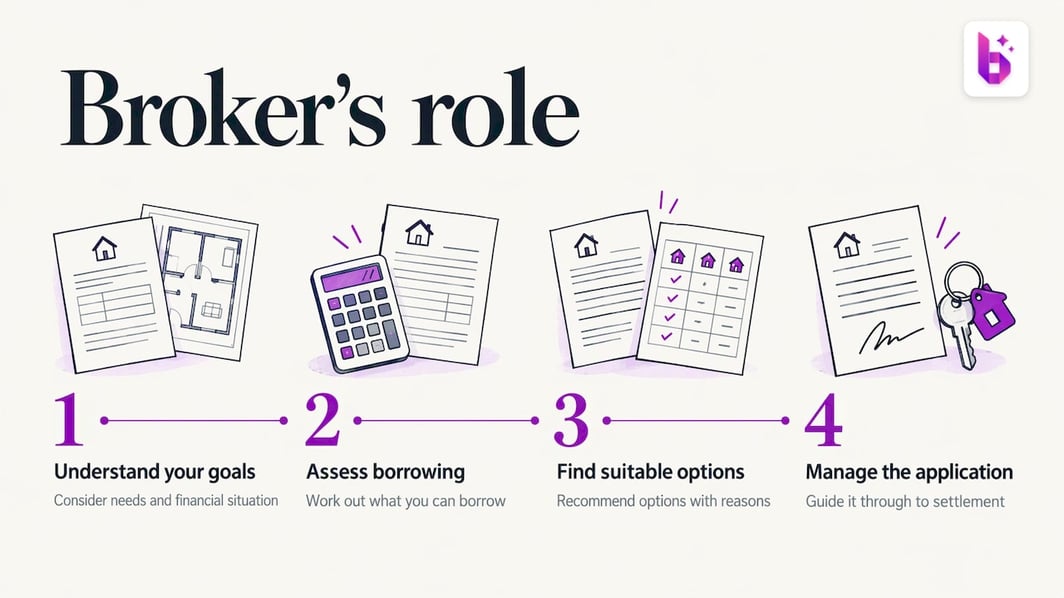
A mortgage broker works with banks and other lenders to help arrange a home loan. Brokers can assess your borrowing capacity, explain loan options and manage the application through to settlement. They can assist with buying a home, purchasing a residential investment property or refinancing.
Brokers must act in your best interests when providing regulated credit assistance. ASIC’s Regulatory Guide 273 explains these obligations, which took effect on 1 January 2021.
This involves considering your needs, goals and financial situation. ASIC’s guidance says brokers should record and explain why their recommendations are in your best interests. If your interests conflict with those of the broker, their licensee, a lender or another relevant third party, yours must come first.
A recommendation should therefore explain why the loan fits your circumstances, including the costs, features and trade-offs considered.
Step one: verify the licence
Every broker should hold an Australian credit licence or act as a credit representative of a licensee. Moneysmart’s advice is to ask for the licence or representative details and check them in ASIC’s Professional Registers Search before you meet. It also suggests finding brokers through personal recommendations or a mortgage broker professional association, then checking the status of each one.
A few practical points:
- Ask for the number in the first call or email, not at the end of the process.
- Search the register yourself rather than relying on a logo or a badge on a website.
- Confirm that the name on the register matches the person you are dealing with, and note which licensee they operate under.
- Only deal with Australian-licensed brokers. UK or other overseas credentials carry no weight for an Australian home loan.
The habit of checking before engaging applies well beyond finance. A guide to vetting a provider before signing makes the same point for home services: confirm the credentials first, then discuss the job.
Step two: understand the lender panel
Most brokers work with a panel of lenders rather than the whole market. ASIC’s RG 273 explains that brokers review credit contracts from their available lender panel and recommend based on your information and the product’s characteristics. A long panel therefore does not, by itself, prove that the broker covers every loan available.
Most brokers work with a panel of lenders rather than the whole market. ASIC’s RG 273 explains that brokers review credit contracts from their available lender panel and recommend based on your information and the product’s characteristics. A long panel therefore does not, by itself, prove that the broker covers every loan available.
Useful panel questions include:
- Which lenders can you arrange a loan with, and which can you not?
- Do you have preferred lenders, and why?
- Would any lender that suits my situation fall outside your panel?
A straightforward answer to the last question is a good sign. It shows the broker understands that a panel is a starting point for a recommendation, not a guarantee of coverage.
Useful panel questions include:
- Which lenders can you arrange a loan with, and which can you not?
- Do you have preferred lenders, and why?
- Would any lender that suits my situation fall outside your panel?
A straightforward answer to the last question is a good sign. It shows the broker understands that a panel is a starting point for a recommendation, not a guarantee of coverage.
Step three: understand how the broker is paid
In most cases, the lender pays the broker, so you generally pay no direct fee. For more detailed information on how mortgage broker commissions work in Australia, see our article How Mortgage Broker Commissions Work in Australia. Any direct fee must be set out in a written quote that you sign before services and payment are requested.
Questions to ask a mortgage broker
The questions below follow the themes in ASIC’s guidance. Our own checklist of questions to ask your broker goes further, but these cover the essentials.
About their recommendation
- Why is this loan in my best interests, given my needs, goals and finances?
- Can you show me at least two other options, including the lowest-cost one?
- How would my current bank’s loan compare?
Moneysmart says a broker should present more than one option and explain how each loan works, what it costs and why it suits you. You can also ask them to include your existing lender for comparison. You can also ask the broker to explain in writing how recommendations are made, and instruct them in writing to find the loan that best suits your circumstances.
About fees and features
- What fees apply, to whom, and when?
- How do the loan’s features, such as an offset account or redraw, affect the total cost?
- Is there a fee I would pay you directly, and is it in a written quote?
About conflicts and ongoing support
- Do you earn more from some lenders than others?
- Will you review my loan later, or is your involvement finished at settlement?
- Who do I contact if my rate or circumstances change?
The last two matter more than most borrowers expect. A loan that was competitive at settlement can drift away from the market over time, so it helps to know who is watching it.
Broker or comparison website: how they differ
A broker and a comparison website do different jobs. A broker gives personal credit assistance and carries the legal best-interests duty. A comparison website displays products, usually with limited knowledge of your finances. Both have a place, but each needs different checks.
For comparison sites, Moneysmart’s guidance on comparison websites says they may earn money from sponsored links, commissions from product providers, or by collecting and selling personal information. It adds that rankings and criteria are not always clear and sponsored results may be shown prominently. Check how the site is funded, and whether you can see all the compared products or only the sponsored ones.
For brokers, the equivalent checks are the ones above: the panel, the commission structure and the reasons behind the recommendation.
Our view is that the two are complementary. Use an independent tool to understand where your rate sits in the market, then use a licensed broker to turn that into an application. We cover the related question of banks versus brokers in our broker versus bank analysis.
Check the recommendation against the market
A broker’s recommendation is the start of your decision, not the end. Moneysmart says to ask for more than one option, including one with the lowest cost, and to compare costs and features. Its home loans guide points out that small differences in interest rates, costs and repayments can matter over the life of a loan, and it offers a comparison process and a switching calculator.
A worked example shows why. Suppose you borrow $600,000 over 30 years. A 0.25 percentage-point difference in the interest rate changes your monthly repayment by a few tens of dollars. That looks minor in any one month, but across thousands of repayments it adds up to a meaningful sum. Fees and features can shift the picture again, which is why a lower advertised rate is not automatically the cheaper loan. Our explainer on advertised rates versus comparison rates covers the difference, and the repayment calculator lets you test the figures yourself.
Speaking with more than one broker and researching loans independently can help you compare their approach and recommendations. A borrowing capacity calculator provides an estimate of what you might borrow, but this may differ from both a lender’s assessment and the repayments you feel comfortable managing. Having your own budget in mind gives you a clearer basis for the first conversation.
Arrive prepared with Bheja
If you already have a home loan, it can help to know how it measures up. Our Home Loan Health Check uses open banking data to show whether you may be overpaying and what alternatives exist among live rates from more than 90 lenders.
If the check points to a saving, you can continue with your application or connect with a licensed mortgage broker on Bheja to support the application. You can also ask Bheja a question about your loan, or review our questions to put to your broker before your first meeting.
Making the final decision
After meeting two or three brokers, compare them on the same footing:
- Credentials: all licences verified on the ASIC register.
- Panel: a written list of lenders, and a clear answer on which are not available.
- Payment: commission and any direct fee explained, with any fee in a signed written quote. Note that broker services are usually free for you, the borrower.
- Advice: more than one loan option, with reasons tied to your goals and a low-cost alternative included.
- Support: a clear plan for reviewing the loan after settlement.
Clear answers, in writing where possible, can help you understand a broker’s services, lender access and reasons for recommending a loan. They do not guarantee the outcome, but provide a useful basis for comparison.
If a problem arises, the credit guide should explain the complaints process, including access to the Australian Financial Complaints Authority (AFCA). Moneysmart also explains how to raise a complaint about a mortgage broker.
FAQ
Usually you pay no direct fee, because the lender pays the broker a commission. Moneysmart notes that a direct fee may apply in some cases, and it must be set out in a written quote you sign first. Cost still depends on the loan chosen, so compare rates, fees and features across the options you are shown.