


- A second mortgage keeps your first loan in place and adds a separate loan against the same property. The new lender ranks behind your first lender if things go wrong.
- Refinancing replaces your existing loan, so you end up with one loan, one lender and one rate. You can usually borrow extra equity through it as well.
- Second mortgages usually carry higher rates than a standard home loan, because the lender’s claim on the property ranks behind your first lender’s. Refinancing is typically the lower-cost way to borrow against equity.
- Refinancing has its own costs (discharge, application and possibly break fees), so check the break-even point before you switch.
- Both options put your home on the line. If cash flow is the problem, talk to a licensed mortgage broker before you sign anything.
A second mortgage adds a new loan, secured against your home, on top of the one you already have. Refinancing replaces your current home loan with a new one, often from a different lender. For most Australian homeowners who just want a lower rate or some extra cash, refinancing is the cheaper and simpler route. A second mortgage tends to make sense only in narrower cases, such as a short-term need, or an existing loan with terms too good to give up.
What is the difference between a second mortgage and a refinance?
The core difference is what happens to the loan you already have.
Second mortgage. Your current loan stays exactly as it is, with the same lender, rate and repayments. A second lender (sometimes your existing one, usually a different one) lends you extra money and registers its own mortgage over the same property. Your first lender is the “first mortgagee” and gets paid first if the property is sold to recover debts. The second lender ranks behind, which is why it charges more.
Refinance. A new lender pays out your old loan and replaces it with a new one. The new loan can be the same size, smaller, or larger if you have equity and want to borrow against it. You end up with a single loan, and the old mortgage is discharged. Moneysmart notes that refinancing to a lower interest rate might save you money.
A simple way to hold the two apart: a second mortgage is an addition, a refinance is a replacement.
How a second mortgage works in Australia
A second mortgage lets you borrow against a property that already has a mortgage, while keeping the existing loan in place. You have an additional loan to repay, secured against the same property.
“Second” refers to the lender’s position. If the property is sold to recover unpaid debt, the first mortgage lender generally has priority over the second, subject to any priority arrangements. This leaves the second lender with a greater risk of not recovering its money.
Second mortgages can support different borrowing needs, but availability, permitted uses and loan terms depend on the lender. They are different from refinancing, which replaces your existing loan, or a top-up, which increases borrowing with your current lender.
Do you need your existing lender’s consent?
You may need your existing lender’s consent, even if it is not required to register the second mortgage. The land registry’s rules and your mortgage contract are separate requirements.
For example, NSW’s Registrar General explains that consent is not required to register a subsequent mortgage. However, your existing mortgage contract may still require it.
Registration requirements vary across Australia. As JHK Legal explains, registering a second mortgage in Victoria involves obtaining a title nomination from the party controlling the title, typically the first lender. The lender may also request a deed of priority to set out the lenders’ respective rights.
A solicitor or conveyancer can confirm the registration steps and any consent or priority arrangements needed for your property.
What does a second mortgage cost?
The second lender’s lower priority can make the borrowing more expensive. Costs depend on the lender, the property, your financial position and the loan’s terms.
The full cost may include:
- Interest charges.
- Establishment, valuation and legal fees.
- Registration and discharge fees.
- Ongoing charges.
- Extension or default charges, if applicable.
The repayment structure matters too. A short-term loan may require the remaining balance to be repaid in a lump sum at the end. Lower monthly payments do not necessarily mean a lower total cost.
Pros of a second mortgage
- You keep a good first loan. If your current loan has a low rate, a fee-free offset account or other features you value, a second mortgage lets you leave it alone and only pay the higher rate on the extra money.
- No break costs on the first loan. This matters most if you are on a fixed rate with a break fee, or if you are partway through a fixed term.
- It can be faster. Some second mortgage lenders assess and settle quickly, which is useful for time-sensitive needs.
- You only borrow what you need. The extra rate applies to the smaller second loan, not your whole balance.
Cons of a second mortgage
- Higher borrowing costs. Rates may be higher than on a first mortgage because the second lender ranks behind the first and takes on greater risk.
- Your property is at risk. It secures both loans. If you cannot meet your obligations, enforcement action could lead to its sale.
- Two loans to manage. You remain responsible for your existing loan as well as the second one, adding to your repayment commitments.
- Limited availability. Not all lenders offer second mortgages, and eligibility and loan terms vary.
- Fees can add substantially to the cost. Establishment, valuation, legal and discharge fees can be significant relative to the amount borrowed, particularly on a small, short-term loan.
- A large final repayment may be required. Some loans require the outstanding balance to be repaid at the end of a short term. Refinancing or selling the property to repay it may take longer than expected.
How refinancing works
When you refinance, you apply to a new lender for a loan large enough to pay out your existing one. The new lender assesses your income, expenses, debts and the value of your property. If approved, it settles with your old lender, the old mortgage is discharged, and your repayments move to the new loan.
You can refinance for several reasons: to get a lower rate, to change from fixed to variable (or the reverse), to access a feature like an offset account, to consolidate debts, or to borrow extra against your equity. If you are weighing these choices, our guide to refinancing your home loan covers the steps in more detail.
Pros of refinancing
- A lower rate on the whole balance. If you qualify for a cheaper rate, it applies to the refinanced balance rather than just the additional borrowing. The interest savings may outweigh the switching costs.
- One loan to manage. Refinancing can combine your existing mortgage and additional borrowing into one loan, although you may choose separate loan splits.
- Features that suit your needs. An offset account or redraw facility may help reduce interest or provide access to funds. Availability, fees and access conditions vary.
- Access to equity. You may be able to borrow more through the new loan, subject to your property valuation, repayment capacity and the lender’s requirements.
Cons of refinancing
- Switching costs. Discharge, application and fixed-rate break fees, along with valuation and government charges, can reduce or outweigh the savings. Lenders mortgage insurance may also apply.
- A new credit assessment. For loans covered by consumer credit laws, lenders must make reasonable inquiries about your financial situation, requirements and objectives, and take reasonable steps to verify your finances. Changes to your income, debts or expenses may affect approval.
- A longer term can mean more interest. Restarting a 30-year term after paying your loan for ten years may lower repayments but increase total interest. Keeping a similar remaining term makes the comparison clearer.
- Additional borrowing increases your debt. Accessing equity means borrowing against it. You will pay interest on the extra amount, and your property remains the security.
What does each option cost? A worked example
The numbers below are illustrative only, not quotes or current market rates. They show how the structure drives the cost.
The situation. You own a home worth $900,000 and owe $500,000 at 6.50% variable. You want $60,000 for a renovation. For simplicity, we look at annual interest only, ignoring principal repayments.
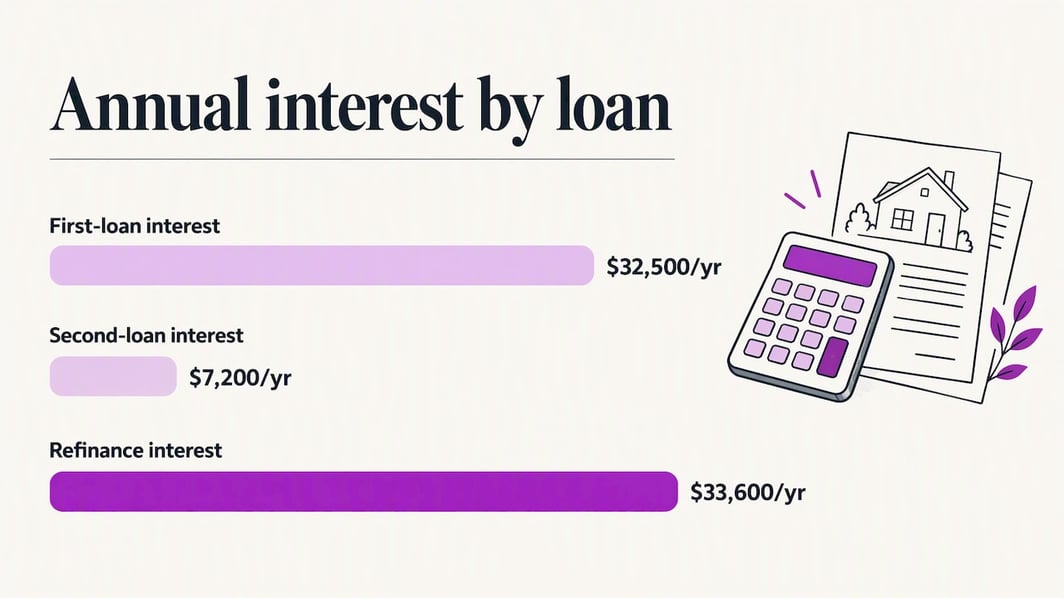
Option A: second mortgage. You keep the $500,000 loan at 6.50% and take a $60,000 second loan at an assumed 12.00%.
- First loan interest: $500,000 × 6.50% = $32,500 a year
- Second loan interest: $60,000 × 12.00% = $7,200 a year
- Total: $39,700 a year
Option B: refinance and borrow the extra. You refinance to a single $560,000 loan at an assumed 6.00%, with assumed switching costs of $1,500.
- Interest: $560,000 × 6.00% = $33,600 a year
The gap. Option A costs about $6,100 more in interest each year in this illustration. The $1,500 switching cost in Option B is recovered in about three months. Your combined borrowing is the same in both cases, $560,000 on a $900,000 home, which is a loan-to-value ratio (LVR) of about 62%.
Now change the story. Suppose your existing loan is on a fixed rate of 3.00% with 18 months left and a large break fee. Refinancing would mean giving up a very cheap rate on $500,000 and paying to exit it. In that case a second mortgage for a short period may cost less overall, which is the scenario where the Option A structure earns its place.
The lesson is not that one option always wins. It is that the rate on your existing loan, any break costs, and how long you need the money decide the answer. A mortgage switching calculator, which Moneysmart recommends for estimating how long it takes to recover upfront costs, makes this concrete. You can also run your own numbers with our refinance calculator or the home loan repayment calculator.
When a second mortgage may make sense
A second mortgage is worth considering when:
- Your current loan is hard to leave. It has a very low fixed rate, or exit costs are high enough to outweigh the saving from switching.
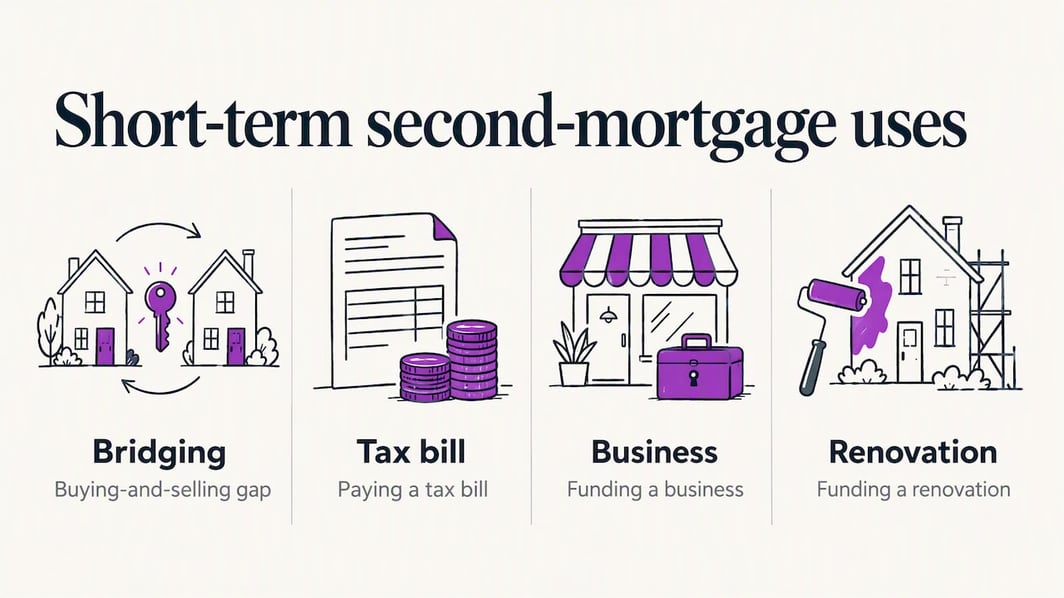
- You need the money for a short time. Examples include bridging finance between a purchase and a sale. A shorter term limits how long you pay the higher rate.
- A bank refinance would not work for you right now. Timing, documentation or circumstances can make a standard bank approval slow or uncertain. Be careful here, since a second mortgage lender that approves you when banks will not may be pricing in more risk.
- You have a clear exit plan. You know exactly how and when the second loan will be repaid, such as from a property sale or a confirmed payment.
If you are borrowing to cover everyday spending or to repay other debts without a plan to change the underlying problem, be wary. Moneysmart warns that turning unsecured debt into secured debt increases the risk, because the lender can sell your home if repayments are not met. It also notes that debt consolidation can leave you deeper in debt if the extra available credit tempts you to spend more.
When refinancing is usually the better choice
Refinancing tends to win when:
- Your current rate is higher than what new customers are being offered. Our page on current mortgage rates in Australia shows where the market sits.
- Your fixed term is ending, or you are on a revert rate after an introductory period. If you suspect your rate has crept up, see our explainer on the honeymoon rate.
- You want a long-term way to access equity at standard home loan rates.
- You want a simpler setup with one loan, and perhaps a feature such as an offset account.
- Your loan is large relative to what you could save. The bigger the balance, the more a small rate difference is worth.
Before switching, it is also worth asking your current lender for a better rate. Our article on whether to negotiate or switch lenders walks through that decision, and the guide on the best time to refinance covers timing.
Five checks before you choose
- Find your exact rate and exit costs. Read your loan contract or ask your lender for a payout figure. This tells you whether a break fee applies.
- Define how much you need and for how long. A short, specific need points one way, a permanent need another.
- Compare the total cost, not just the rate. Look at the comparison rate, fees and features. Our guide to advertised versus comparison rates explains why.
- Check your borrowing capacity. Lenders must assess whether a loan is unsuitable, so know what you can realistically borrow with the borrowing capacity calculator.
- Stress-test your repayments. Ask what happens if rates rise or your income falls. With a second mortgage you may be juggling two repayments at once.
Our perspective
A second mortgage can look attractive because it leaves your existing home loan in place. But keeping that loan is only one part of the calculation. What would you pay across both loans, including interest, fees and any final lump-sum repayment?
Refinancing may mean giving up an existing rate or paying break costs. A second mortgage may preserve that rate but make the additional borrowing more expensive. Neither option wins on that detail alone.
At Bheja, we help borrowers understand how their current rate compares with advertised alternatives. That gives you a starting point. A broker can then assess the borrowing options, eligibility and total costs—including how a short-term loan would be repaid.— Pravin
FAQ
A second mortgage adds another debt secured against your property. Whether it is appropriate depends on the borrowing purpose, total costs and ability to repay both loans. It may carry higher rates and fees than a standard home loan, and some products require a large final repayment. Your property could be sold if you default.