


- The RBA lifted the cash rate target to 4.85%on 3 November 2026. It is the fifth hike this year, so the gap between what existing borrowers pay and what new customers are offered matters more than it has in years.
- There are several places to compare, such as lender websites, comparison websites, mortgage brokers, government guidance and personalised data-driven tools. Each answers a different question.
- Compare on the Key Fact Sheet, the personalised comparison rate and the cost of switching, not on the headline rate alone.
- A lower rate can be worth less than it looks once you take features, fees and break costs into picture. Cheapest may not be the best and the right loan for you depends on your unique circumstances.
For a home loan, your existing loan details can provide a more useful starting point than a generic rate table. With your consent, Bheja uses Open Banking to read those details, compare your rate against more than 6,500 live rates from over 90 lenders, and monitor for lower rates over time. A licensed mortgage broker is available if you want to explore your options.
Other comparison services have a role too. This guide explains what each offers, its limitations and how to assess the results before making a decision.
General advice warning: this article is general information only. It does not take into account your objectives, financial situation or needs. Consider whether it is appropriate for you, and read the product disclosure and the lender’s Key Fact Sheet before applying for any loan. The examples below are hypothetical.
Why the answer matters more in 2026
The RBA’s November decision lifted the cash rate to 4.85%, effective 4 November 2026. This was the fifth increase of the year, putting further pressure on variable-rate borrowers.
Higher rates make it more important to understand how your loan compares with available offers. But an advertised rate alone does not show whether a loan offers better value. Fees, features and eligibility conditions also affect the comparison.
The comparison site you use matters too. Sites may cover different lenders and products, and sponsored offers may appear prominently. Knowing what is included and how results are ranked helps you assess the options beyond the headline rate.
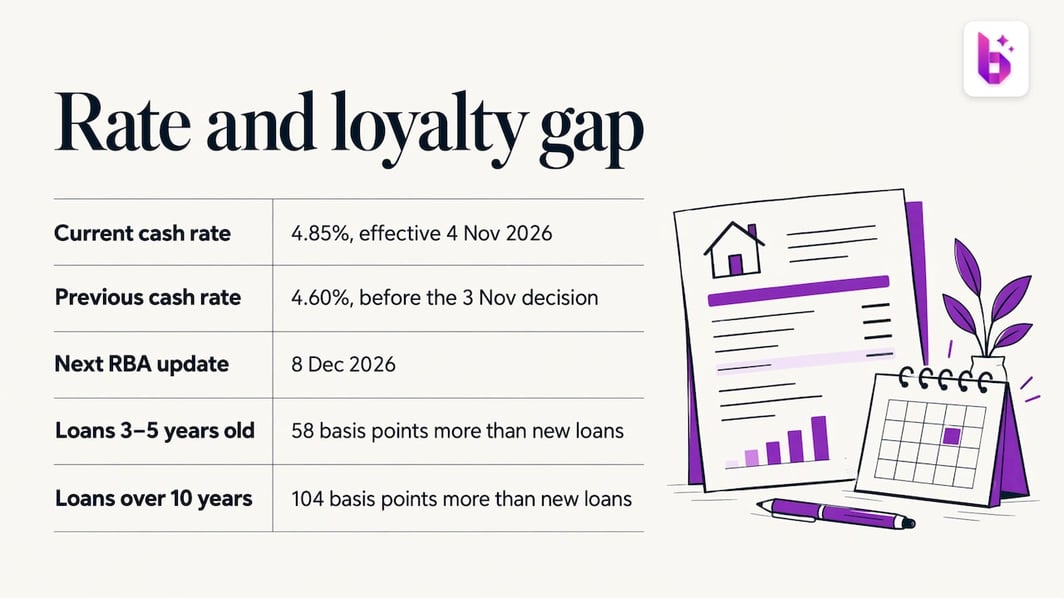
The ACCC’s 2020 home loan inquiry found that borrowers with older loans paid higher rates on average than those with newer loans. However, more recent data shows why that finding should not be treated as a fixed “loyalty tax”. In September 2026, RBA figures showed average owner-occupier variable rates of 6.23% on outstanding loans and 6.22% on new loans—a gap of just 0.01 percentage points.
These averages do not show whether an individual loan is competitive. The useful comparison is between your current rate and offers available for a similar loan, taking account of eligibility, fees and features.
The five places Australians compare home loans
Your current lender
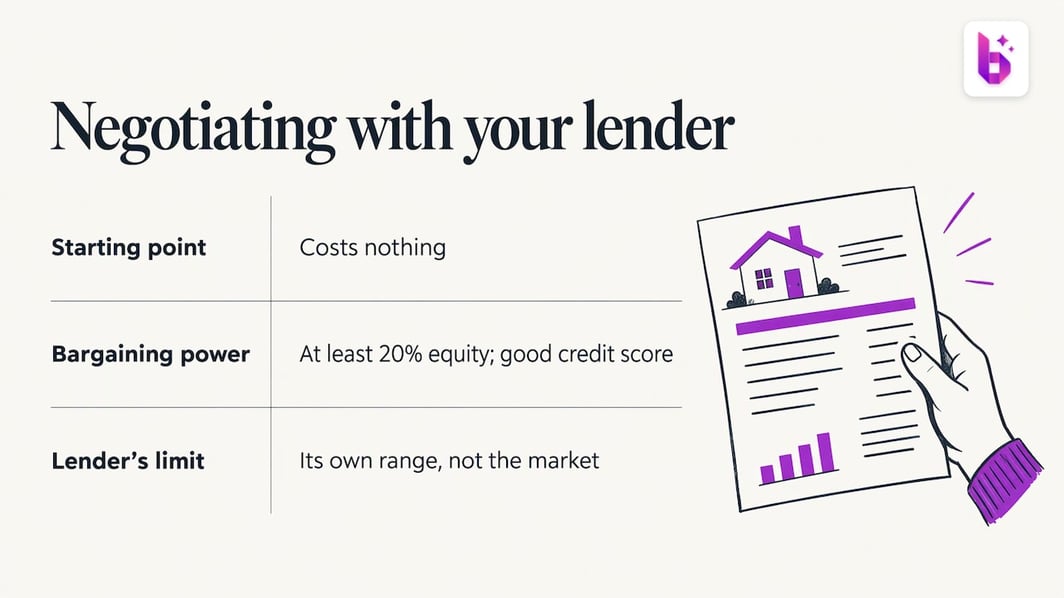
Start here, because it costs nothing. Moneysmart, the Australian Securities and Investments Commission’s (ASIC) consumer site, suggests telling your lender you plan to switch. It notes that with at least 20% equity and a good credit score you have more bargaining power to get a better deal.
The limit of this route is that a lender can only offer its own range. You learn what it will concede, not what the market offers. Our guide on whether to negotiate or switch covers how to weigh the two.
Comparison websites
Comparison sites are the best known answer to this keyword, and they are useful for seeing a spread of advertised rates. Moneysmart’s own caution is that comparison websites are businesses that may earn money through promoted links and may not cover all options. A table of advertised rates is also not about you. It does not know your balance, your remaining term, your offset balance or what you currently pay.
Mortgage brokers
A licensed broker can compare lenders on your behalf and handle the application. The trade-off is how brokers are paid: lenders pay them. That is true of the brokers we connect you with, and we state it whenever we compare Bheja with other options. ASIC has said brokers should recommend refinancing only when it has appropriate long-term benefits and should disclose likely repayments, fees and the total cost of refinancing in advance. That's a fair standard to hold any recommendation to, ours included. Our article on how ASIC’s scrutiny of recommendations applies to you shows how to apply it.
Government guidance
Moneysmart doesn't rank lenders or read your loan, but it explains what to compare and where costs hide. We use it as the checklist for the rest of this article.
Personalised, data-driven tools
This is the category Bheja belongs to. Instead of asking you to type in a rate and a balance, it takes your approval to connect to your loan through open banking, the system that lets you share your bank data securely with an accredited service. It then compares your actual loan against more than 6,500 live rates from over 90 lenders and flags whether you appear to be overpaying. That is what the ACCC’s loyalty gap looks like when it is applied to one person’s loan.
How to compare fairly: the method
- Work out what you can afford to borrow. Moneysmart advises doing this first, then comparing loans from at least two lenders. Our borrowing capacity calculator is one way to get a starting figure.
- Get the Key Fact Sheet for each loan. Moneysmart explains that this compulsory document has the same layout for every lender and shows the initial interest rate, a personalised comparison rate, total repayments, monthly repayment and fees. It is the like-for-like tool, because a headline rate in an advertisement is not.
- Use the comparison rate, with care. It folds many fees into a single percentage, but it is calculated on a set loan amount and term, so treat it as a guide and check it against the Key Fact Sheet for your own loan size.
- List the switching costs. Moneysmart names break fees on fixed-rate loans, discharge fees, new-loan application fees, internal switching fees and possible stamp duty.
- Check your equity. With less than 20% equity you may have to pay lender’s mortgage insurance (LMI), which can outweigh the saving from a lower rate.
- Ask about features. Extra-repayment fees, offset and redraw facilities, and the rate that applies when a fixed or introductory rate ends all change the real cost.
- Run the break-even. Divide the total cost of switching by the monthly saving. The answer is the number of months before you are ahead.
If you want the whole process end to end, our step-by-step comparison guide and the refinance process guide go through it in order. Couples buying together who are weighing up how to hold the property can also use a property purchase BFA checklist to prepare the legal side.
Worked examples: $600,000 and $850,000
These examples are hypothetical. They assume a 25-year remaining term, principal-and-interest repayments and the rates stated. They are not current market rates, and they are not offers.
Example 1: a $600,000 loan
You pay 6.40% and find a lender at 5.90%.
- Repayment at 6.40%: about $4,014 a month.
- Repayment at 5.90%: about $3,829 a month.
- Monthly saving: about $185, or roughly $2,215 a year.
Suppose discharge, application and other switching costs total $1,200 (an assumption; your Key Fact Sheet and lender will give the real figures). The break-even is $1,200 ÷ $185, or about 6.5 months.
Example 2: an $850,000 loan
Same rates, larger balance.
- Repayment at 6.40%: about $5,686 a month.
- Repayment at 5.90%: about $5,425 a month.
- Monthly saving: about $262, or roughly $3,138 a year.
With assumed switching costs of $1,500, the break-even is about 5.7 months. A larger loan makes the same rate gap worth more in dollars, which is why the saving per month rises while the costs rise less.
Look beyond the rate: features affect the savings
A lower rate is only part of a home loan comparison. If switching means losing a feature you use, such as an offset account, the interest savings may differ from what the rate gap suggests.
A 100% offset account reduces the loan balance on which interest is calculated. For example, a $600,000 loan with $50,000 in a linked offset incurs interest on $550,000.
The example below compares an existing loan at 6.40% with a $50,000 offset balance against a new loan at 5.90% without an offset.
This is not an apples-to-apples comparison: the loans have different features. It illustrates why those features need to be included when estimating savings.
These simplified calculations assume unchanged rates and balances for one year. They exclude fees and assume the $50,000 is kept separately after switching, earns no interest and does not reduce the new loan balance.
Under these assumptions, the lower-rate loan incurs slightly more interest on the $600,000 balance and less on the $850,000 balance. The result would change if the money reduced the new loan or earned interest elsewhere.
The point is to compare the whole loan. Offset benefits, redraw access, repayment flexibility and fees can all affect its value. A lower-rate loan may still offer better value, but the savings calculation needs to account for the features you gain or lose.
What to ask your lender before you leave
Before you start a refinance, it is worth asking your current lender what it will do on your rate. Retention teams, the staff who deal with customers who say they are leaving, can often offer more than the standard rate on the website. Ask for:
- a lower variable rate in writing, with its effective date;
- the rate it would give a new customer with your loan size and equity;
- any fee waivers, and whether any offer is conditional on a cashback or package;
- what the rate becomes when any fixed or introductory period ends.
A lower rate and a cashback are separate questions. A cashback loan does not automatically carry a higher rate than an equivalent loan without one, so compare the rate and the total cost of each, not the label. If you need a second view of your position, the Home Loan Health Check shows how your current loan sits against the market, and when to refinance explains timing.
Our perspective
We built Bheja around one observation: most comparison happens once, at the moment of buying, and then stops. Rates move, the loyalty gap opens, and nobody tells the borrower.
A table of advertised rates cannot show you that. Your own loan can. Reading it through open banking, comparing it against live rates from over 90 lenders and alerting you when a saving appears is, in our view, a more honest form of comparison, because it begins with your numbers rather than a lender’s marketing.
We also say plainly how we earn. Our brokers are paid by lenders when a loan settles, and you should weigh any recommendation, ours included, against the Key Fact Sheet and your own break-even. The tool is there to make that check quick, not to replace it.— Pravin
Where Bheja fits
If you want one place to see whether you are overpaying and what the alternatives are, start with the Home Loan Health Check. If the numbers point to a switch, we can help make the process seamless through open banking or connect you with an accredited broker for the application. You can browse owner-occupier, investment, fixed, variable and split loans on our home loans page, and our credit guide is available through our site. Whichever place you use, compare against the Key Fact Sheet before signing.
FAQ
It is a good starting point for seeing advertised rates, but Moneysmart notes that these sites may earn money through promoted links and may not cover all options. A tool that reads your own loan gives you a comparison tied to what you pay now.