


- Lenders cannot charge early termination (“exit”) fees on secured home loans entered into after 1 July 2011, but they can charge a discharge fee and, on fixed-rate loans, a break fee.
- A break cost only arises on a fixed-rate loan, and it depends on your balance, the time left in the fixed term and the movement in wholesale interest rates.
- Most fixed-rate loans allow some extra repayments each year or across the fixed term; going over that limit can trigger a break cost.
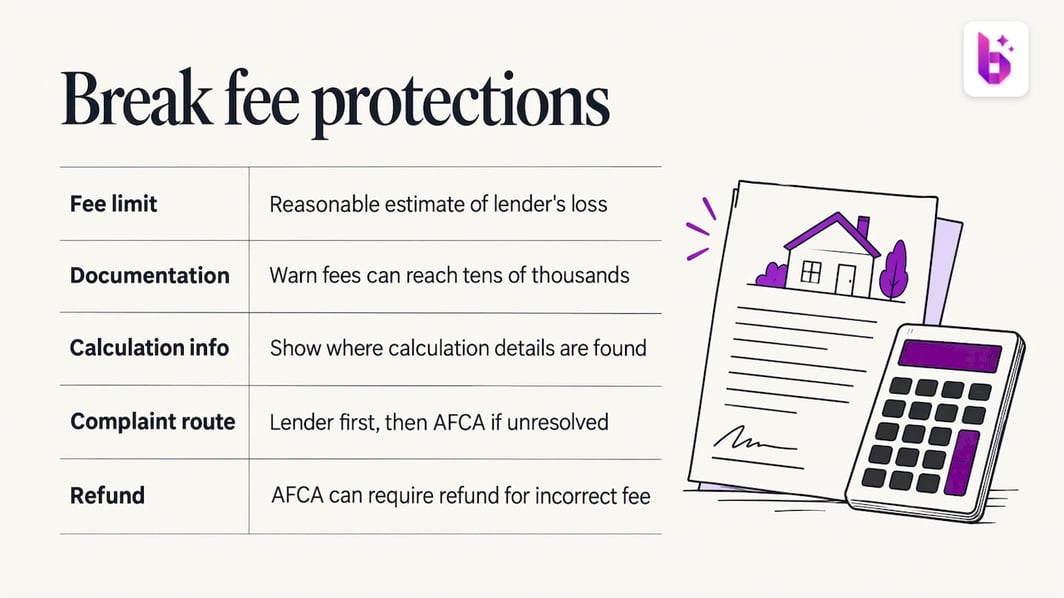
- A break cost cannot lawfully exceed a reasonable estimate of the lender’s loss, and the Australian Financial Complaints Authority (AFCA) can order a refund if it was charged incorrectly.
- Ask your lender for a written payout and break cost estimate before you commit to refinancing, because the figure changes with wholesale rates.
If your home loan was signed after 1 July 2011 and has a variable rate, your lender generally cannot charge you an early repayment fee for paying it off or refinancing. The fees that can still apply are a discharge fee, which covers the lender’s administrative cost of closing the loan, and, on fixed-rate loans, a break cost. The break cost can be large, so it pays to know how it works before you refinance, make a lump sum payment or change your loan.
What an early repayment fee actually is
“Early repayment fee” is an everyday phrase rather than a single legal category. ASIC’s Regulatory Guide 220 (November 2023) defines an early termination fee as any fee payable because of the early repayment of a residential loan that is additional to standard discharge fees. In practice, that umbrella covers two different charges:
Separate from both is the discharge fee (sometimes called a termination fee), which is charged when the mortgage is released. Readers searching for “home loan exit fees” are usually asking about one of these three, and the rules differ for each.
What the 2011 ban changed
According to The Law Handbook, regulation 79A of the NCCP Regulations stops credit providers from charging early termination fees (also known as exit fees) on secured home loans entered into after 1 July 2011. The same source notes that lenders can still charge a break fee on a fixed-rate loan, along with a discharge fee that reimburses the reasonable administrative cost of ending the credit contract.
This gives a practical rule of thumb:
If your loan is older than July 2011, read the original contract or ask your lender in writing which fees still apply to you.
How break costs work on a fixed-rate loan
The logic behind a break cost is about how lenders fund a fixed rate. AFCA’s factsheet on break fees explains that the lender borrows funds from someone else and pays interest on them. If you end the fixed period early and move to a lower rate, the lender has extra costs to settle with that other party, and the break fee passes those costs on to you.
That is why the fee behaves so differently from a flat exit charge. It’s not a penalty set by the lender at will. It reflects what has happened to wholesale interest rates since you fixed.
The calculation in plain terms
AFCA’s publication Breaking a fixed rate loan explains that the calculation compares the fixed-term wholesale rate for your loan’s original term with the wholesale rate for the remaining fixed term at the time you repay in full or in part. It uses the movement between those two points. ASIC’s guidance adds that a break fee is usually based on the gap between your fixed rate and the prevailing rate over the remaining fixed period.
The key consequence, set out in RG 220, is that a borrower whose fixed rate is lower than the prevailing rate will pay a lower fee, or none at all.
Three inputs drive the result:
- Balance being repaid. A larger amount broken means a larger cost.
- Time left in the fixed term. More remaining months means more exposure for the lender.
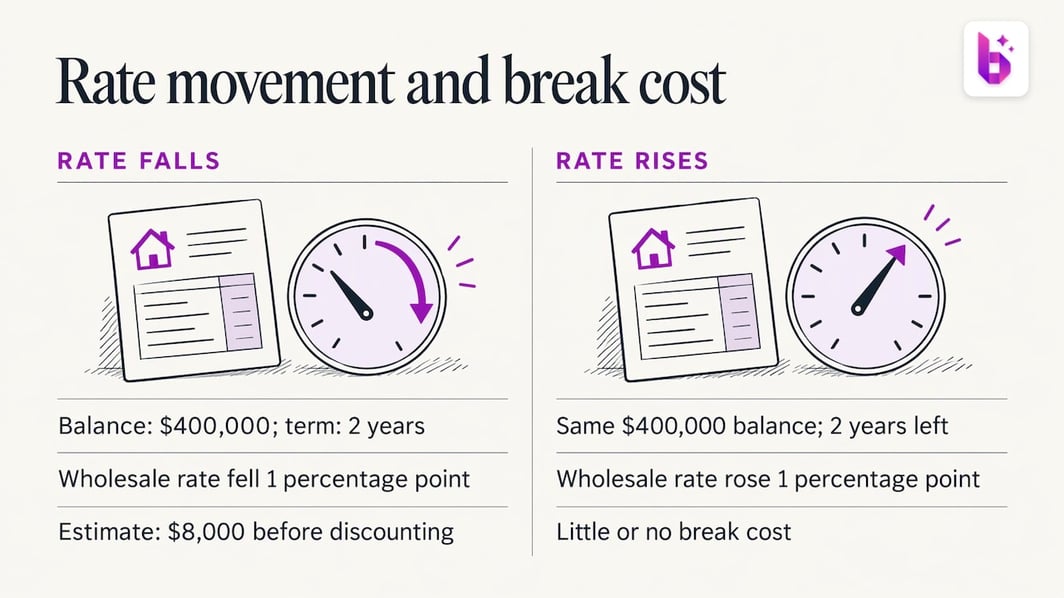
- Rate movement. If wholesale rates have fallen since you fixed, the cost rises. If they have risen, the cost may be small or nil.
A hypothetical example
The figures below are simply an illustration, not a quote from any lender. Suppose you owe $400,000 on a fixed loan with two years remaining, and the relevant wholesale rate has fallen by one percentage point since you fixed. Multiplying balance, remaining term and rate difference gives $400,000 × 2 × 0.01 = $8,000. Lenders then convert this to today’s dollars, so the final number is somewhat lower. If the wholesale rate had instead risen by a point, the same loan would carry little or no break cost.
The same loan with six months left would produce a much smaller figure, which is why the timing of a refinance near the end of a fixed term often matters more than the rate itself.
What triggers a break cost
Break costs are not limited to paying off the whole loan. Depending on your lender and contract, they can be triggered by:
Most fixed-rate loans allow a limited amount of extra repayments without penalty. The threshold varies by lender and by when the loan was taken out, and some lenders measure it per year while others measure it across the whole fixed period. Your loan contract and the key facts sheet will state yours. If you are planning a bonus payment or an inheritance paid into the loan, check this figure first.
On variable loans signed after July 2011, there is no early repayment fee on extra repayments, so putting extra money in is generally a matter of your own cash flow and whether an offset account would suit you better. Our offset account calculator and extra repayments tools let you compare those choices with your own numbers.
Discharge and other fees to expect when you leave
Break costs get the attention, but a refinance comes with several smaller charges. Moneysmart’s guide to switching home loans lists the fees to compare before you move:
The discharge fee is the one you should expect on almost every refinance. It is limited to the lender’s reasonable administrative cost, so a fee that looks like a penalty rather than a processing charge is worth questioning.
What can you do if the fees seem too high?
Under section 78(4) of the National Credit Code, as explained in RG 220, a fee payable on early termination is unconscionable if it exceeds a reasonable estimate of the lender’s loss from the early termination, including average reasonable administrative costs. ASIC also expects lenders to include a prominent warning in fixed-rate documentation that break fees can be substantial, in some circumstances tens of thousands of dollars, and to say where you can find out how they are calculated.
If you believe a break cost was calculated incorrectly, you can raise it with your lender and, if unresolved, with the Australian Financial Complaints Authority. For loans regulated by the National Credit Code, AFCA considers whether the break cost exceeds a reasonable estimate of the lender’s loss, and where it finds a fee was charged incorrectly it will require the amount to be refunded.
How to check your cost before you refinance or pay extra
A short process avoids surprises:
- Find your loan type and fixed expiry. Your loan contract or latest statement shows whether your loan is fixed or variable, and when the fixed term ends.
- Check your prepayment allowance. Note how much you can repay without a break cost and how much you have already used.
- Ask your lender for a written payout figure and break cost estimate. Because break costs rest on wholesale rates that move daily, an estimate is only valid for a short period, so request it close to the date you plan to act. One major lender states its estimates stay valid for just two business days.
- Add up every exit and entry cost. Include the discharge fee, new application fees and any stamp duty or valuation costs.
- Compare the total with the interest you would save. A refinance can make sense if the saving over the period you intend to hold the loan outweighs all the costs.
When your fixed term is close to ending, waiting a few months can remove the break cost altogether. When it is far from ending, the break cost may be the largest line in the comparison. Our guide on the best time to refinance and the step-by-step refinance process walk through the timing.
A worked comparison
The numbers here are hypothetical. Suppose you have $500,000 remaining, are paying 0.60 percentage points more than you could on a new loan, and have no break cost because you are on a variable rate. Your interest difference is roughly $3,000 a year before tax and fees. If costs to switch total $800, the switch pays for itself in a little over three months.
Now change one fact: you are on a fixed rate with 18 months left, and the break cost estimate comes back at $6,000. The saving of about $4,500 over those 18 months does not cover it, so waiting for the fixed term to end, or negotiating, is the better path. The decision turns on the exit costs, not only the headline rate. For the repayment side, see our repayment calculator and the explainer on fixed versus variable loans.
See where your loan stands
If you are weighing a switch, the Home Loan Health Check shows whether your current rate is out of line with what lenders are offering now, using your own loan details. You can then look at refinance options with the exit costs in mind, and Bheja’s monitoring will alert you if a better deal appears later, for example as your fixed term nears its end.
To test specific scenarios first, the refinance calculator lets you enter your own balance, rate and costs.
FAQ
On a secured home loan entered into after 1 July 2011, lenders cannot charge an early termination fee, but they may charge a discharge fee for administrative costs. If the loan is fixed rate, a break cost can apply when you repay in full or above the allowed threshold before the fixed term ends.