


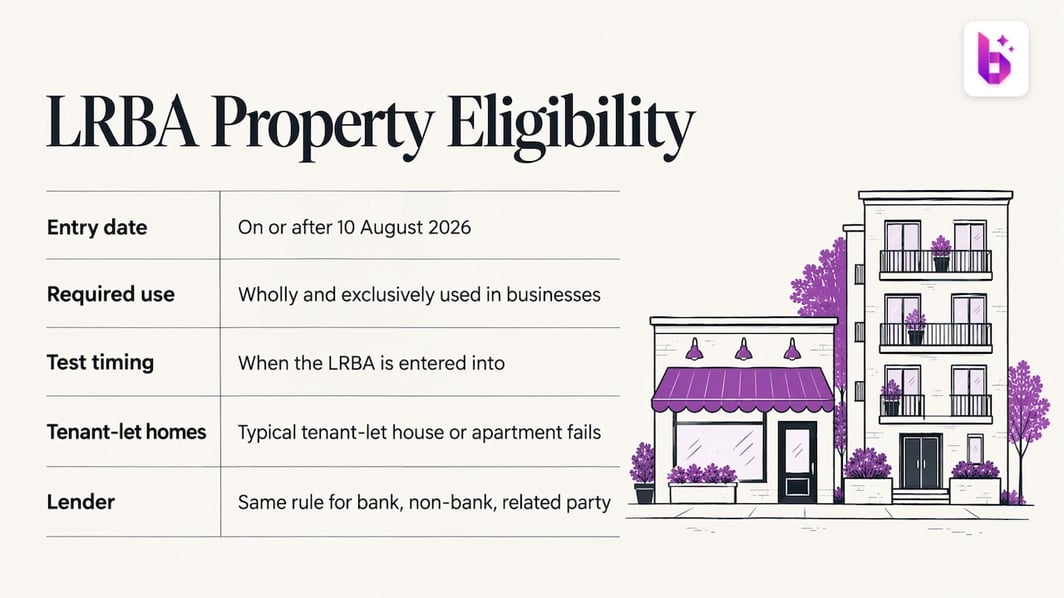
- LRBAs entered into on or after 10 August 2026 to buy real property can only be used to acquire business real property, whichever lender is involved.
- An SMSF that entered an LRBA for real property before that date can keep it and refinance it without the new restriction applying.
- An LRBA funds a single asset (or a collection of identical assets treated as one), held in a separate holding trust.
- The “5% rule” is the in-house asset limit. It is a separate rule from borrowing, but it matters for related-party loans.
- Because SMSF decisions carry legal and tax consequences, confirm your position with a licensed SMSF specialist adviser, accountant or SMSF auditor before committing.
An SMSF property loan allows a self-managed super fund to borrow to buy property through a limited recourse borrowing arrangement (LRBA). If the fund cannot repay, the lender’s claim against the fund is limited to the property bought with the loan.
According to the ATO, from 10 August 2026, new property purchases financed through an LRBA must meet the definition of business real property. This generally means property used wholly and exclusively in a business. An ordinary residential rental property generally does not qualify.
The changes do not apply to existing LRBAs entered into before that date, refinances of those arrangements, or property purchases under binding contracts exchanged before 10 August 2026. This guide explains the rules, how an LRBA works and what trustees need to consider.
What an SMSF property loan is
SMSFs are generally prohibited from borrowing. The LRBA is the exception. According to the ATO’s guidance on LRBAs, the trustee obtains a loan to buy an acquirable asset, and the asset is held in a holding trust. The SMSF holds the beneficial interest and can acquire legal ownership once the loan is repaid. If the loan defaults, the lender’s claim is limited to that asset, so the rest of the fund’s assets are protected.
Three features follow from that definition:
- One asset. For arrangements entered into from 7 July 2010, the borrowed money must acquire a single asset or a collection of identical assets that can be treated as a single asset.
- A separate holding trust. Superannuation law does not prescribe the type of trust, but the SMSF trustee must have a beneficial interest in the asset and the right to acquire legal ownership. Complex structures are unlikely to meet that requirement. A discretionary trust, for example, could not be used.
- Limited recourse. The lender can only look to the asset held in the holding trust, not to the wider fund.
In practice, this is why SMSF lending needs more paperwork than a standard home loan: there is a lender, a corporate or individual trustee, a holding trust, a contract of sale and often a separate legal advice step.
The 10 August 2026 change
Under the ATO’s guidance, new LRBAs used to buy property from 10 August 2026 are restricted to business real property, subject to the exceptions below. The rules apply whether the lender is a bank, non-bank or related party.
Business real property generally means land and buildings used wholly and exclusively in one or more businesses. Where the new rules apply, the property must meet that definition when the LRBA begins and throughout the borrowing arrangement. An ordinary house or apartment rented to residential tenants generally does not qualify.
What is not affected
The business real property restriction does not apply to:
- LRBAs entered into before 10 August 2026, including arrangements maintained or refinanced after that date.
- Purchases under binding contracts exchanged before 10 August 2026, even if settlement or the LRBA begins later.
The ATO describes refinancing as a new loan contract for the same asset, with the same lender or a different one. A qualifying earlier LRBA can therefore be refinanced without the property having to meet the new business real property test. Other LRBA requirements still apply.
For trustees with an earlier residential property LRBA, the change does not automatically prevent refinancing. The arrangement’s dates and terms determine whether the exemption applies.
What this means for different trustees
The ATO’s examples are the authority here. If your timeline sits near the cut-off, have your adviser confirm the facts against its guidance.
What the loan can and cannot be used for
Under the ATO’s rules for entering an LRBA, borrowed money can be used to:
- Buy a single eligible asset, or a collection of identical assets with the same market value that can be treated as one asset.
- Cover borrowing or purchase costs, such as loan establishment fees and stamp duty.
- Pay for maintenance or repairs to the asset.
Borrowed money cannot fund improvements. Repairs generally restore something that is damaged or worn, while improvements make the asset substantially better than before. A project may involve both, so the nature of the work and how it is funded need careful assessment. An SMSF adviser can help clarify the distinction before work begins
The 5% SMSF rule
People often ask about the “5% rule” in connection with SMSF borrowing. It is the in-house asset limit. According to the ATO’s page on SMSF investment restrictions, a fund is restricted from holding in-house assets that make up more than 5% of the market value of its total assets. A loan to a related party of the fund is one example of an in-house asset.
The rule does not cap how much a fund can borrow. It becomes relevant in two situations:
- the fund lends money to a member or related party rather than borrowing; and
- the holding trust structure needs care. The ATO guidance notes that special in-house asset rules apply if the asset is the only asset owned by the holding trust.
Because the limit is measured against the fund’s total assets, accurate valuations at the end of each income year are part of staying compliant.
Rules that apply to any SMSF property
MoneySmart outlines the property rules every SMSF has to follow, borrowing or not:
- The sole purpose test. The property must solely provide retirement benefits to fund members.
- No related-party purchases. The property must not be acquired from a related party of a member. Related parties are defined broadly and include relatives and business partners.
- No major alterations. Until the loan is repaid, major alterations to the property are not permitted.
MoneySmart also lists the leveraged property risks: higher costs, cash flow pressure, loan repayment risk if the property is vacant or contributions stop, documents that are hard to cancel if wrong, and tax losses that cannot be offset against income outside the fund.
Costs trustees should plan for
An SMSF loan carries more than the interest rate. MoneySmart lists upfront and ongoing costs including:
- advice fees, legal costs and SMSF setup costs, including stamp duty;
- administration costs, such as accounting, audit, and ASIC and ATO fees;
- property costs, such as rates, management, maintenance and insurance;
- loan costs, meaning interest and bank fees; and
- additional life insurance costs if the fund is borrowing to purchase property.
The ATO adds questions to ask about the lender itself: whether the loan can be called in early, whether the borrowing rate can change, whether the lender can sell the loan, whether the terms can be altered, and what the fees and insurance and maintenance costs are.
When comparing quotes for an existing LRBA, put the total cost over the period you expect to hold the loan side by side, not just the headline rate. An interest-only period lowers repayments but leaves the principal unchanged, which is worth understanding before you choose; our guide to interest-only home loans explains the trade-off.
Related-party LRBAs and the safe harbour rate
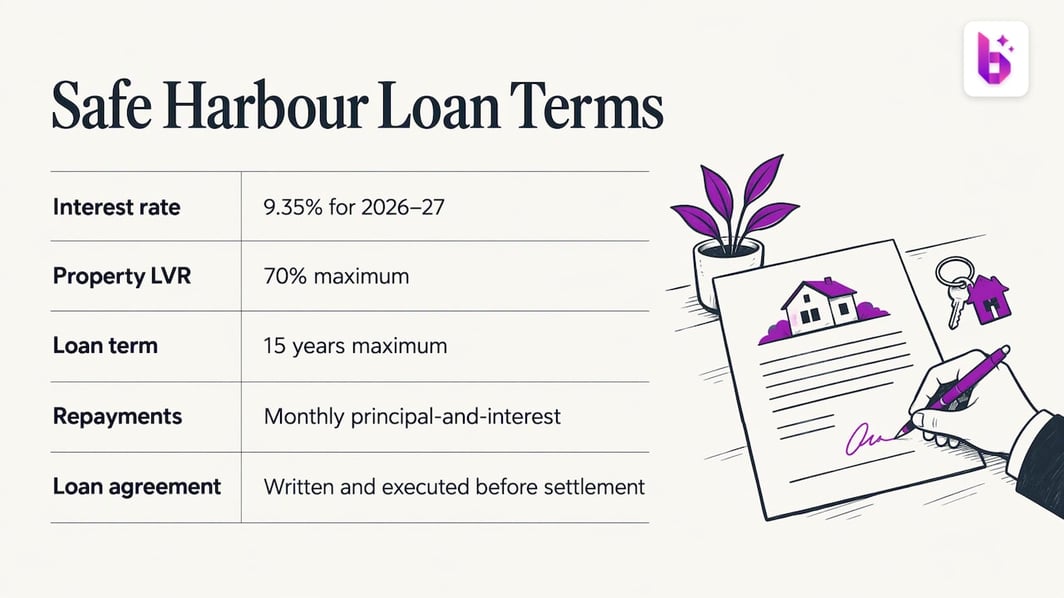
Some SMSFs borrow from a related party, such as a fund member. The ATO’s safe harbour guidance sets out loan terms it accepts as consistent with an arm’s-length arrangement for income tax purposes. Meeting the interest rate alone is not enough—the arrangement must meet all the relevant conditions.
For real property, the ATO lists a 9.35% safe harbour interest rate for 2026–27. Variable-rate arrangements use the applicable rate each financial year; separate rules allow a rate to be fixed for up to five years.
Other conditions include:
- A maximum LVR of 70%.
- A maximum loan term of 15 years, reduced by the duration of previous loans for the asset when refinancing.
- Monthly principal-and-interest repayments.
- A registered mortgage over the property.
- A written and signed loan agreement.
A loan outside the safe harbour is not automatically non-compliant. However, trustees need other evidence that its terms and operation are consistent with an arm’s-length arrangement. The safe harbour also does not replace the separate superannuation rules governing LRBAs.
Questions to settle before you borrow or refinance
- Is the asset eligible? For a new loan, is it business real property used wholly and exclusively in a business? For an existing loan, was the LRBA or contract in place before 10 August 2026?
- Is the structure right? Confirm the holding trust meets the beneficial interest and legal ownership requirements.
- Can the fund service the loan? Model repayments against likely contributions and rental or business income, including a period where the property is vacant.
- What are the lender’s terms? Compare maximum loan-to-value ratios, rate type, fees and the ability to refinance later.
- Does the strategy fit the member’s retirement plan? That is a question for a licensed financial adviser, not a calculator.
For modelling how offsets and loan structure affect an investment property, this explainer on offset accounts for investment property is a helpful companion. It covers personal-name investment loans, which follow different rules from an LRBA.
Perspective
Changes to SMSF borrowing rules make the dates behind a property transaction particularly important. A new purchase, an existing LRBA and a purchase under an earlier binding contract may be treated differently. Trustees need to establish which rules apply before committing to a loan or changing an arrangement.
At Bheja, we believe borrowers should be able to see how their existing loan compares with offers beyond their own lender. Our platform compares more than 6,500 live rates from over 90 lenders and monitors for lower-rate options.
Our service focuses on home and investment loans held in personal names. An SMSF loan requires specialist support for the fund’s borrowing and compliance requirements. If you also have a property loan outside your SMSF, Bheja can help you check how that loan compares.
- Pravin
Check the loans you hold outside your super fund
Many SMSF trustees also carry a home loan or an investment loan in their own names. Those loans sit outside the LRBA rules and can be compared against the market at any time. The Home Loan Health Check reads your loan data through open banking and shows whether you may be overpaying, and our refinance service connects you with licensed mortgage brokers if you decide to switch. If you are weighing your personal borrowing alongside a fund strategy, the borrowing capacity calculator gives a first estimate. Keep in mind that borrowing in your own name can affect how a lender views you, so see our overview of the factors that determine borrowing capacity.
FAQ
Yes, but only within limits. LRBAs entered into on or after 10 August 2026 to purchase real property can only be used for business real property. Existing LRBAs, and contracts exchanged before that date, are not affected by the change.