


- Rentvesting separates where you live from where you invest: you rent for lifestyle and borrow to buy for returns.
- Lenders do not count all of your expected rent. APRA guidance describes a minimum
20%haircut on expected rental income, so borrowing capacity is usually lower than many buyers expect. - You carry two housing costs at once: your rent and the investment loan, plus management fees, insurance, rates, maintenance and vacancy periods.
- Rent is assessable income and many property expenses are deductible, but selling can trigger capital gains tax and the property does not receive the main residence exemption.
- Test the plan against a higher interest rate and an empty month before you commit, then compare loans across the whole market.
What is rentvesting?
Rentvesting means renting where you want to live while buying an investment property elsewhere. Rental income can help cover the investment loan repayments and property expenses, while you continue paying rent on your own home.
This may appeal when buying in your preferred area is out of reach, but owning a property elsewhere is affordable. Whether it is financially workable depends on the combined costs of renting and owning, rather than the purchase price alone.
Borrowing to buy the rental property generally involves an investment loan. When assessing your application, the lender considers:
- Rental income: it may count part of the expected rent towards your ability to repay.
- Your own rent: this remains a living expense and reduces the income available for loan repayments.
The potential appeal is flexibility. You can choose where to live separately from where to invest. Defence Housing Australia identifies potential benefits including buying sooner in a more affordable location and being able to move for work or lifestyle reasons without selling the investment property.
Why buyers are considering it
Affordability pressures are prompting some first-home buyers to reconsider where and what they buy. Westpac’s 2026 research found that 41% of surveyed first-home buyers would consider rentvesting, while 74% were willing to buy in an area they had not originally considered. These figures reflect intentions, rather than completed purchases.
Our analysis of how many incomes it takes to service a mortgage explores the affordability pressures behind these choices. A lower-priced investment property may offer another route into ownership, but it still needs to fit alongside the rent and other expenses you already pay.
How lenders assess a rentvestor
Lenders assess two things: how much you can service from your income, and whether the property is adequate security. For a rentvestor, the first is where surprises arise.
Rental income is discounted
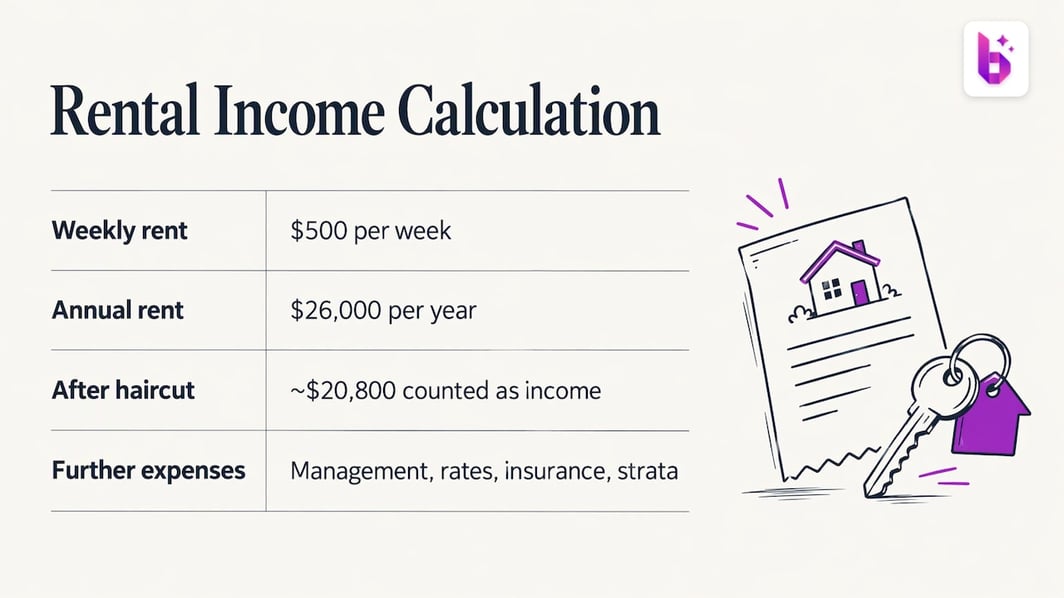
Lenders may include expected rent when assessing your income, but they generally do not count the full amount. APRA’s residential mortgage lending guidance describes a discount of at least 20% as prudent practice to allow for vacancies, with a larger reduction where vacancy risk is higher. Lender policies vary.
For example, expected rent of $500 a week adds up to $26,000 a year. After a 20% discount, $20,800 would count towards income in this simplified illustration.
Property expenses, such as management fees, rates, insurance and strata levies, also need to be included. Depending on the lender’s method, these may reduce the rental income counted or be recorded separately as expenses.
APRA also cautions against relying on future tax benefits from a loss-making rental property. This means expected rent and potential tax deductions do not translate directly into borrowing capacity.
Your own rent counts too
The rent you pay is an ongoing expense that lenders include when assessing your ability to repay. They also consider your other living costs and may compare your declared spending with a benchmark such as the Household Expenditure Measure (HEM). APRA expects lenders to use the higher of declared expenses or an appropriately adjusted benchmark.
Existing debts affect future borrowing
If you later apply for a loan to buy a home to live in, any investment loan you keep will remain part of the assessment. The lender will consider its repayments alongside rental income, property expenses and your other financial commitments.
Owning an investment property does not automatically prevent you from buying a home later, but it can affect how much you can borrow.
Our guide to borrowing capacity factors explains what lenders consider. You can also explore an estimate using our How Much Can I Borrow calculator.
The costs to include
The common mistake is to compare the investment loan repayment with the rent received and stop there. A fair comparison with buying a home to live in includes every line below.
Our stamp duty and cost of buying calculators cover the upfront items for each state.
A worked cash-flow example
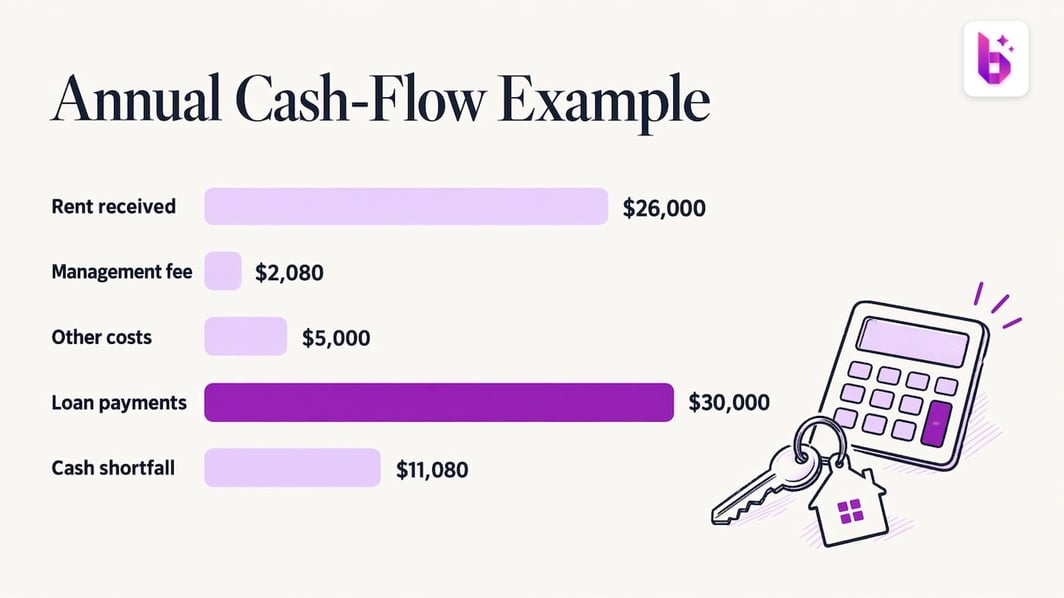
The figures below are hypothetical and exist only to show the method.
- Rent received: $26,000 a year.
- Management fee at 8%: $2,080.
- Insurance, rates, maintenance allowance: $5,000.
- Loan interest and principal: $30,000.
- Net result: $26,000 minus $2,080, $5,000 and $30,000 leaves a shortfall of $11,080, before any tax effect.
The next step is to add your own annual rent. If you pay $28,000 a year to live in a suburb you like, your total housing cost is the $11,080 shortfall plus $28,000. That is the number to compare with the cost of buying where you live. It is also the number that tells you whether the strategy is a deliberate trade-off or an accident.
Adding a vacancy month matters too. One month empty on this property removes about $2,167 of rent while the loan continues, and the property manager’s fee may not apply for that month.
Pros and cons
The advantages are real, and so are the demands on your cash flow.
What rentvesting offers
- Lifestyle choice. You can live near work, family or schools without paying that area’s purchase prices.
- Earlier entry. A lower-priced property may need a smaller deposit, which can bring forward your first purchase.
- Mobility. You can move for a job without selling a home.
- Diversification of where you invest. You choose a market on its financial merits, separate from where you live.
- Rental income. Rent from a tenant contributes toward the loan.
What it demands
- Two housing costs. You pay rent and service a loan at the same time.
- Landlord responsibilities. Repairs, tenant issues and compliance sit with you, even if an agent handles the day-to-day.
- Interest rate sensitivity. If rates rise, repayments rise, and rent usually cannot be lifted immediately to match.
- No main residence exemption. Selling an investment property can trigger capital gains tax, as Mortgage Professional Australia notes among the risks.
- No uplift where you live. You do not benefit from price growth in the suburb where you rent.
The trade-off is easiest to judge with numbers. Our piece on whether to compromise on a dream home to get into the market sooner covers the same decision from the owner-occupier side, and the guide to house, apartment or townhouse helps with choosing what to buy.
Tax basics for a rentvestor
The Australian Taxation Office’s rental properties guide states that rental income is assessable and that expenses are deductible where they are incurred in gaining or producing that rental income. It also separates costs you can claim immediately from those claimed over time, such as depreciating assets and capital works, and explains how capital gains tax applies when you sell.
Two practical points follow:
- Keep records from day one. Loan interest, agent fees, insurance and repairs all need documentation.
- Do not build the plan on a tax refund. Lenders typically avoid relying on future tax benefits from a loss-making property when they assess you, and you should be cautious about doing so too.
Tax settings for property investors can change, including the treatment of negative gearing and capital gains. Check the current rules on the ATO site and speak to a registered tax agent or accountant about your own situation before you buy.
Risks to stress-test before you buy
A rentvesting plan should survive three tests.
- Rate test. Recalculate repayments at a rate 2 to 3 percentage points higher than today’s. Our repayment calculator makes this quick. If the shortfall stops being affordable, the loan is too large.
- Vacancy test. Assume the property sits empty for at least a month or two a year in your budget.
- Rent test. Assume the rent you pay increases at your next renewal.
Buying off the plan adds its own risks, such as valuation changes between contract and settlement. The off-the-plan property risks checklist sets out the legal points to review before signing a contract.
If you also want a buffer, an offset account may help, and our offset account calculator shows the interest effect. Remember that cash held in an offset still does not reduce your rent.
Who rentvesting suits
Rentvesting tends to suit buyers who meet most of these conditions:
- Buying where you want to live is out of reach, or would stretch your budget heavily.
- Your rent is meaningfully lower than the repayments on a home in your preferred area.
- You have a stable income and a cash buffer for vacancies and rate rises.
- You are comfortable being a landlord, directly or through an agent.
- You plan to hold the property for the long term, because purchase and sale costs are large.
It suits fewer people when your rent is close to a comparable mortgage repayment, or when you expect to need your savings at short notice.
Our perspective on rentvesting loans
Rentvesting gives you flexibility over where you live, but it also means managing your own rent alongside an investment loan. The finance needs to account for both, including periods when the property is vacant.
A competitive rate at settlement is only the starting point. Rates, lender offers and your circumstances can change, so the ongoing cost deserves attention too.
That’s why Bheja uses Open Banking, with your consent, to compare your actual loan against thousands of live rates and monitor for lower-rate options. Licensed mortgage brokers can then help assess the fees, features and eligibility requirements before you decide whether to proceed.
- Pravin
Putting it into practice
- Define the comparison. Work out what you pay in rent now and what buying where you live would cost in repayments, stamp duty and upkeep.
- Check your borrowing capacity. Use a calculator that allows for rental income shading and your own rent as a living cost.
- Choose a market on financial grounds. Vacancy risk, rent levels and the property type all affect cash flow. Review the current mortgage rates for investment loans before you set a budget.
- Decide on fixed, variable or a split. Our guides on fixed versus variable and fixing part of your loan set out the trade-offs.
- Plan for the relationship side. If you are buying with a partner, agree on who covers a shortfall. Our article on mortgage stress and relationships is relevant here.
- Review the loan every year. Rates and terms drift, and a review is how you keep the cost down.
Keep the investment loan competitive
Once the property is settled, the investment loan becomes your main recurring cost, so a small rate gap compounds. The Home Loan Health Check compares your current loan with live market rates and shows whether you may be overpaying. If a better option exists, you can look at refinancing your home loan, and we can connect you with a licensed broker to support the application. For ongoing reviews, our investment home loan listings show what is available, and monitoring alerts you to savings as the market moves.
FAQ
It can be, when your rent is meaningfully lower than the cost of owning where you want to live and you can fund the shortfall on an investment loan through rate rises and vacancies. When rent and mortgage repayments are close, buying the home you live in may suit better. The answer depends on your cash flow, not on a rule of thumb.